Blog Posts and Lists
Wednesday, April 24, 2013
My Turn For The Next Big Thing
Tuesday, April 2, 2013
ELEPHANT IN ROOM: WHAT’S THE FUTURE OF BOOKS?
OLD (well, sorta)
NEW (From the Washington Post)
Monday, March 26, 2012
New Hope for Old-Fashioned Books
Exactly one month ago I received an email from my friend and colleague (and fellow East Bay resident), Marissa Moss. It began almost apologetically:“I know this probably comes out of thin air, but I've heard from so many talented writers and illustrators that they have problems getting contracts now from the major NY publishers who only want books with mass market appeal …”
Sounds like an understatement in these days of publishing uncertainty (aka “crisis”) but I was hooked. Marissa is a versatile writer and illustrator of both fiction and non-fiction, full of ambition and creativity, who has enjoyed considerable success. What was she up to?
“The golden age of picture books, when fine books were edited and published despite not being blockbusters, doesn’t have to be over,” she wrote.
Instead of lamenting the demise of publishing as we knew it, Marissa announced that she is going to turn the dearth of publishers seeking to put out beautiful books into an opportunity. She has found financial backers who share her values, and she is starting a new publishing house intended to turn back the clock by producing “quality books the old-fashioned way.” Golden Gate Books will make its mark with children’s fiction and non-fiction that book-lovers will want to hold, admire and read repeatedly.
This is actually the second recent blast of publishing news to gust my way. Our own INK is becoming a publisher of e-books, starting with the out-of-print titles of our members. I have four titles ready to go, as soon as I do the necessary scans and we work out the contract details to sell our books on the iTunes store and perhaps other e-marketplaces. This is exciting news not only because it gives authors a chance to immortalize our books and make them available at very low cost to interested readers, however many or few they may be. I am also thrilled because it is the impetus I need to enter this new world of publishing and experiment with its myriad possibilities.
While INK, for starters at least, will be e-publishing out-of-print titles (which, in the current reality of publishing, does not mean out-of-life or out-of-value titles), Golden Gate Books, despite valuing the paper-in-hand approach to reading, may also enter the e-realm by releasing all of its titles as e-books within months of their print debut.
Whether or not its titles have an e-life, Marissa is embracing web-based promotion and even fund-raising. Right now she has enough money committed to plan eight books during GGB’s first year, but if she can raise an additional $50,000 she will go for twelve with a larger marketing bang for all of them. She is using www.kickstarter.com, a fund-raising website that follows the NPR model to seek pledges from donors who receive premiums at different levels depending on how much they give. No pledges are actually collected unless the goal is achieved. In this case, it’s $50,000 in pledges by April 19, 2012. Check it out and please feel free to choose your premium:
http://www.kickstarter.com/projects/404352146/golden-gate-books-a-childrens-book-revival
Here is one piece of the pitch, where Marissa (writing from the future) summarizes the mind-set of today's typical publishers:
"Instead of taking risks on new voices or subjects, they focused on what had already sold well – one Harry Potter book led to a slew of imitators. One Twilight book created a wake of supernatural novels. Instead of looking for the great books of the future, they looked for books that were like great books of the past."
I would make one edit: change “great books of the past” to “successful books of the past.”
I recall my appearance at the Texas Library Association conference in April, 2000, after my book If You Hopped Like a Frog had just come out with Scholastic. It put forth a new, enjoyable approach to proportional thinking in which human abilities were compared, proportionally, to those of animals. Proportion is an important concept in algebraic thinking, taught in various ways (most of them confusing, boring or both) throughout the upper elementary and middle school grades. The Scholastic team was out in force at TLA giving away, waving and wearing a plethora of promotional items in various shapes, sizes and levels of extravagance. Did even one of these marketing pieces reference my book or that of any other up-and-coming author? Not on your life! Every single one was about Harry Potter, whose third (or was it fourth?) installment was hitting the American market. Harry really needed the help, didn’t he?
On May 25, 2009, I wrote a blog post here called “Paen to a Publisher,” in which I paid tribute to one of my publishers, Tricycle Press, which (along with its parent company, Ten Speed Press) had just been bought by Random House. I wondered aloud whether the many uncommon practices that had made Tricycle my favorite, if smallest, publisher would be retained once it became part of the world’s largest media conglomerate. (For example, Tricycle ignored a near-universal convention in publishing by allowing an author to have a voice in selecting the illustrator for his or her book. Tricycle even allowed authors and illustrators to influence editing decisions and sometimes gave them the final say. Can you believe?)
I have never written a postscript to that discussion and here it is: in January, 2011, Random House announced that it was scuttling Tricycle Press. My favorite publisher is history. One of the many pieces of flotsam left adrift by the maelstrom of that decision was my manuscript I Rot: The Fall and Rise of a Halloween Pumpkin, which I described in my May 24, 2010, INK blog post called “Researching With Researchers.” Since then, I have been seeking a new publisher for my rotten manuscript (and the revolting photos by Dwight Kuhn that accompany it).
Along comes Golden Gate Book, seeking authors and illustrators with worthy manuscripts in search of a publisher, authors who have established relationships with booksellers and who effectively promote their own books through school visits and other appearances. . . Along comes Golden Gate Books, promising to give the creators of books an unusual amount of control over their projects. . . Along comes Golden Gate Books, “a company that cares about the magic that happens when a parent reads a picture book to a child.”
And I am now delighted to announce that the magic of a decomposing pumpkin (and it is magical in its own transformative, regenerative way) will be featured on Golden Gate Books’ first list in the Fall of 2013.
Thursday, November 17, 2011
An Invitation to Comment: Gathering Nonfiction E-Book Data/Opinions from YOU!
At least for right now, there doesn’t seem to be a clear answer and it can be very book-specific when it comes to nonfiction. In contrast, I have plenty of fiction writer friends who are successfully getting their e-book rights back (generally from OP or almost-OP books) and publishing in this format on their own—for 100% of the profits, minus expenses. But when photo rights and book designs factor so heavily into the final product of a nonfiction book, things are much trickier. If the e-rights for photos have not already been secured for an older NF book, it is not necessarily feasible from a time or money standpoint to track them down again. I certainly make sure I have e-rights for photos now, but that wasn’t the case a few years back.
Read this recent INK post from Jim Murphy for his perspective on one aspect of this issue. And Marc Aronson has tackled this topic in his SLJ blog, Nonfiction Matters, here and here. I think it would be worthwhile as well as illuminating to have NF writers and publishers, as well as readers, teachers, and librarians share some of their thoughts and insights, to see what some of the varied experiences are. I am also quite interested in hearing from people about what they think the future will hold.
Please weigh in with your comments!
Wednesday, October 19, 2011
The life of a children's book…is it over when it's over?
- Author gets a fabulous idea and writes a manuscript or proposal
- An editor likes it and contract terms are agreed upon
- The ms is revised and edited (repeat as necessary)
- Interior artwork (if applicable) is obtained, plus jacket art
- Book is typeset, printed, bound, sent out into the world
- Marketing happens
- Reviews are written, hopefully rave
- Orders are taken and fulfilled
- Royalties are paid to authors and illustrators
- As stock runs low, the book is reprinted
- When orders decline, the book goes out of print
Right?
Or not so much. Authors have always had the option of reprinting their book themselves. Boxes of books piled in the garage may be the result. Or so I hear, not having tried it myself.
As everyone knows, things are different now because of the devices, digital book formats, and ebookstores now available. For quite awhile I’ve been wanting to put one of my out-of-print titles into ebook form and it's a thrill to announce that Tracks in the Sand is now available again on the iBookstore. Here is the trailer: Tracks originally had two printings and according to an inside source at the time was still selling several thousand copies a year when the publisher decided not to reprint. Perhaps they were more interested in selling their novelization of the Teenage Mutant Ninja Turtles movie? (Just a theory.) My recent thinking is that Tracks is a good candidate for a digital version because, among other factors, sea turtles have been around for over 100 million years. Therefore, the basic facts of their life cycle story are not likely to change in the foreseeable future, barring oil spills and many other threats to their survival. My hope is that this book can now continue to serve as a tool to help young readers learn about these wonderful reptiles.
There are many pros and cons to the various digital options…iPad or Android app? Kindle book? NOOK book? I chose the iBooks format to start with for two main reasons:
- The image quality is excellent.
- There is now an inexpensive iPad app, Book Creator, that made the process relatively easy. Note: Book Creator is also great for students to make their own EPUB books.
For a fun classroom extension, check out the Tour de Turtles, a project by the Sea Turtle Conservancy that uses satellites to follow individual sea turtles as they roam around in the ocean. Here is a post with many additional resources.
Not every OP book is a candidate for a digital version…some complex layouts don’t shrink down well to the screen size of a tablet, for example. However, I anticipate that many books that have otherwise been relegated to file cabinets will soon find a new life. So, maybe when it's over, it's a new beginning instead.
If anyone has questions about the overall iBooks publishing process, here is my post on E is for Book with many details and links. Or, feel free to leave a comment with a specific question and I’ll try to answer it.
Loreen
Wednesday, June 15, 2011
Making information interactive
For this example, let’s explore some interactive ideas about lions using the simple ability to Hide or Show an image or text string. In other words, things can appear or disappear when the Reader taps on the screen:
- Pop-up labels to identify body parts
- Show layers under the skin: muscles, skeleton (i.e. the skin and muscle layers vanish as needed)
- A timeline of lion evolution with thumbnail images that can be enlarged
- Images that can zoom way in to show details of eyes, hair, teeth
- A time-lapse sequence of photos of a growing cub
- African map with lion’s range from historic times through today into a projected future
- Switching out altered photos of a white or black lion to demonstrate how real lions blend into their habitat
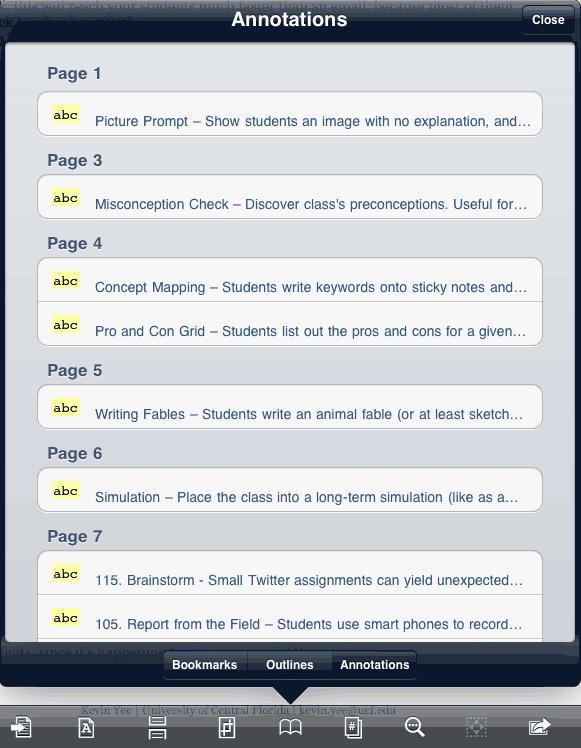
Though I’m not a classroom teacher, my books certainly seek to inform students so I’m always interested in interesting ideas in education. Recently, I came across a PDF called Interactive Techniques, compiled by Dr. Kevin Yee of the University of Central Florida. There are 182 tips listed, many which could be translatable into an interactive book app. Here are a few:
33. Misconception check: Discover class’s preconceptions...
For a nonfiction ebook, there could be an opening section that explores common myths about the topic. The reader could tap on the text and the myths could melt away like the Wicked Witch of the West, or some other fun effect.
41. Concept mapping: Students write keywords onto sticky notes and then organize them into a flowchart...
How about including a section in the digital book for Readers to move around and organize facts in various ways? They could take a screenshot of their work to save it.
131. Question and Answer Cards: Make index cards for every student in the class; half with questions about class content; half with the right answers. Shuffle the cards and have students find their appropriate partner by comparing questions and answers on their own cards.
There could be a list of question “cards” at the beginning of the ebook, then Reader searches through the material for the answers. As each question and answer are matched up, Reader scores a point.
Speaking of information, for those I.N.K. readers interested in iPad productivity apps, I downloaded, read, and highlighted favorite ideas from Yee’s list with an excellent PDF reader app, GoodReader for iPad. The image below shows the My Documents area where your PDFs are listed. (I added the green logo.) You can browse the internet and download documents at will.
As you read along, it’s easy to highlight text:
It’s going to be fun to see how information will be gathered and presented in innovative ways as the technology for creating interactive books becomes more accessible to content creators.
Loreen Leedy
my web site
Wednesday, May 18, 2011
Our Choice: a new way to showcase nonfiction
As one or two of my recent posts reveal, I’m very interested in the creative possibilities of digital books and along with a group of authors have been investigating ways to make them myself. Book apps are intriguing because they can take advantage of the touch interface available on tablets and smart phones. While most of the book apps available so far appear to have been made by a separate-from-the-author team of developers, that doesn't especially grab me. Personally, I’d rather be hands-on, figuring out the content and interactivity on the fly. Having a developer create an app from my ideas feels like having an artist ghost-illustrate my books. Or like trying drawing with a pencil on a broomstick. It can be done, but I’d rather not.
Which is not to say that I’m in a hurry to learn how to do this:
![]() |
| From the Complete Idiot’s Guide to iPad and iPhone App Development |
Fortunately, several developer groups are working on the digital book-making software that I hope to soon add to my regulars...Photoshop, InDesign, Scrivener (an awesome word processor/novel-writing/research organizing program), Illustrator, et al. Check out this quote about Push Pop Press from a Wired article:
That certainly sounds promising. I am already looking at software still in development from a couple of other sources... it’s too soon to say which system(s) will work for me. What I am sure of is that fairly soon it will be possible for non-developers to make interactive books with not just words and images but also motion, audio, video, animation, and who knows what else...
I can hardly wait!
Monday, April 11, 2011
Agents--Agents of Change?
So I called friends for suggestions and reviews of agents they know. Then began studying up online. I’d read through an agent’s client list, past triumphs, future wants. I’ve found several candidates I want to pursue, but a surprising number of times, a disturbing number of times, I came upon one of the following phrases:
--Submit middle-grade or YA fiction only
--Submissions of picture books are not welcome at this time
--Our current policy on picturebooks is that we do not solicit either texts or illustrators, but do represent picturebooks by authors whom we have already taken on for their older, longer work. Additionally, we are not looking for non-fiction.
--No nonfiction or poetry collections.
I don’t want to hyperbolic -- but I’m reminded of signs saying “Jews and Irish need not apply” and “Colored waiting room around back.”
I’m not entirely surprised. We all know that the books are a strange alliance of art and commerce and, lately, commerce rules the day. We also have a bit of a population trough in the picture book age group, schools and libraries are budget poor, picture books are expensive to produce in paper form and the technology to sell them as E-books is just enough behind their novel format cousins that it further suppresses the market. Nonfiction books, many of them picture books, can have the same problems. And don’t get me started about the backward notion some parents have about starting their kids on chapter books asap so they can get into Harvard.
I’m not really blaming these agents either. Some of them may have never had any interest in these genres. Fair enough. YA fiction is hot and everyone needs to make a living, and wants a good one at that. Also fair. But here’s my two cents to anyone listening.
*Trends change, populations ebb and flow. It pays to stay flexible.
*There will always be younger kids in greater and fewer numbers. There will always be schools and libraries. There will always be the need to learn about the world and everything in it. It pays to stay flexible. Furthermore, for agents and publishers who can attract quality voices to nonfiction to turn their backs upon it is a disservice not only to children but to our society as a whole.
*When technology changes, its costs tumble, then it will be our turn to shine. Affordable picture e-books will be widely seen in their full double-page spread glory. Nonfiction changes will be stratospheric with books about butterflies clicking onto caterpillars timelapsing quickly into monarchs and a bio of Martin Luther King building up to the “I Have a Dream” speech. Ah, the cyber-sidebars and back matter. And the possibility of a 39 Clues-type book with mysteries that teach kids who are reading/playing them everything from history to forensic science. Hence, it pays to stay flexible
*Many agents wrote on their wish list that they were looking for someone who will reinvent their genre. Well, that doesn’t just happen in dystopian fiction. Vision and innovation can be anywhere—and, when it happens, the market responds. Look at Shaun Tan or ABC3D by Marion Bataille. And so, it pays to stay flexible.
*The market also responds when anyone talented has a great take on a great idea—in any genre.
Guess what? It pays to stay flexible.
Wednesday, March 30, 2011
Playing games with information
“It’s a waste of time.”
Meanwhile, the video and computer game industry has charged ahead without me: over 65% of U.S. households have video games, 40% of all players are female, 26% are over age 50, and the industry reportedly brought in $10.5 billion in 2009 alone.
statistics source
What has inspired me to rethink this topic is Reality is Broken: Why Games Make Us Better and How They Can Change the World, by Jane McGonigal,Ph.D. The author and game designer explains the psychological reasons behind the popularity of games as well as discussing their potential to be used for the common good. The alternate reality games she specializes in “...challenge players to tackle real-world problems at a planetary-scale: hunger, poverty, climate change, or global peace...” Examples shown on her web site include World Without Oil, SuperBetter (to facilitate recovery from illness or injury), and EVOKE, a social network game designed to help empower people all over the world to invent creative solutions to our most urgent social problems. The book’s title is based on a common experience of many players...that reality is simply not as satisfying as gaming. McGonigal details a variety of techniques to jazz up real life in order to engage people the way that successful games do.
The connection to my own projects lies in finding the overlap between the qualities and objectives she describes and my own process of writing informational books for children and related activities. At minimum, a game must have these four components:
- A goal or series of goals the players work to achieve
- The rules that restrict how the goal may be reached yet foster creativity and strategic thinking to do so
- The feedback system which lets players know how close they are to achieving the goal
- Voluntary participation: the players must choose to undertake the work involved to play
Some common game elements are:
Quests motivate players to keep going. Is there a way to tie a quest to a nonfiction book? Levels are increasingly difficult sections of the game that players reach by solving problems, dodging obstacles, or otherwise improving upon their performance. Could a nonfiction book have levels? Another factor that’s increasingly important in gaming is teamwork, where people collaborate to help each other succeed in the game. How can teamwork be brought to the nonfiction experience? These concepts, a description of a public game-based school, and much more are why reading Reality is Broken has been so inspiring.
One of the reasons I’m pursuing the gaming angle is because of an episode that happened a few years ago. Two brothers were given one of my picture books about space...it was the weekend, they associated “books” with school, and therefore neither one even wanted to look at it. They’re both good students, but... Ouch! I hate to think that a kid has to steel himself to tolerate reading a book because he anticipates that it will be so unrewarding. Games are rewarding (that’s obvious!) so how to harness that quality is the question.
Can I come up with a game based on one of my books, say The Shocking Truth about Energy? After covering electricity generation and the main sources of energy in use today, the book ends with four pages of energy-saving ideas. How about a game that would not only help reduce the use of fossil fuels but would increase exercise time for students? For the 10,000* Mile Quest, players add up their bicycle, running, and walking mileage either individually or in teams made up of classrooms, grades, or schools, depending on how the game is organized. Players can use a phone app such as EveryTrail to track miles or calculate the length of routes using online tools such as MapQuest. There could be a group web site with a graph or other feedback so everyone can see their progress. Gasoline NOT burned because of the game could also be shown. A group chat area would allow players to exchange ideas about how to get more miles faster. Secret items could be hidden along various routes to allow players to score bonus points. The game could last a week, a month, or an entire school year, with various milestones along the way to celebrate. This needs more refining but that’s the general idea.
*or whatever number seems appropriate
What about adding gaming strategies to digital books or apps? For the last few months I’ve been researching ebooks and apps with an eye to the multiple ways authors can utilize them and am intrigued with the possibilities of incorporating motion and other types of interactivity. A few examples...presenting information could be made much more fun and gamelike by hiding it at first, so the reader has to search for it. Wouldn’t it be nice to include a demonstration in many cases? I’m working on a math picture book right now in which it would be terrific to have a movable shape for readers to manipulate on certain pages. Or how about having the reader assemble something? To see an amazing example of an educational app that reportedly inspires students to delve deeply into the topic, check out Frog Dissection on Teachers with Apps. It’s not a game per se, but has many of the characteristics.
The typical fantasy world kind of game still doesn’t interest me, and probably never will...but using gaming concepts to showcase real information, engage readers, and even create solutions to genuine problems sounds like a game worth playing.
Loreen
my web site