Showing posts with label Jim Murphy. Show all posts

Tuesday, March 25, 2014

VERY SAME TOPICS, VERY DIFFERENT BOOKS Rosalyn Schanzer


It's pretty impressive to see how many different ways nonfiction authors can present the very same subject matter or the very same people in their books. To get the gist, today I thought it might be fun to compare some examples of books on the same topic--mostly (but not entirely) by our own INK authors and illustrators. I'll be brief, I promise.  


So how about starting with our foremost founding father, George Washington himself. Each of these 3 authors has come up with entirely different hooks to pique your interest, so a young audience could get a pretty well-rounded view of our guy by checking out these true tales.


First up is The Crossing: How George Washington Saved the American Revolution by Jim Murphy.  His hook is to focus on Washington's growth as a leader, obviously leading up to the famous crossing of the Delaware on Christmas in 1776. He's used some very interesting artwork from the period to enhance the tale.

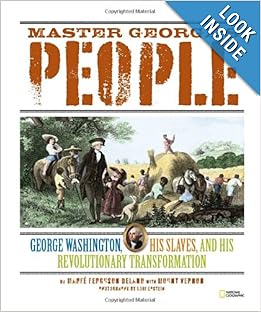
Next comes an entirely different take on George from Marfe Ferguson Delano. Her book, Master George's People, tells the story of George's slaves at Mount Vernon, and she has collaborated with a photographer who shot pictures of reenactors on the scene. 


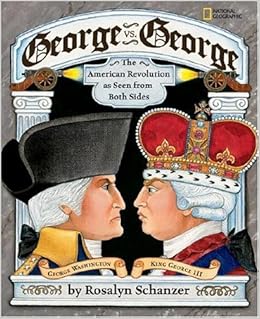
And this one is  (ahem) my version. George vs. George: The American Revolution as Seen from Both Sides shows how there are two sides to every story.  I got to meet George Washington and King George III and paint their pictures myself.
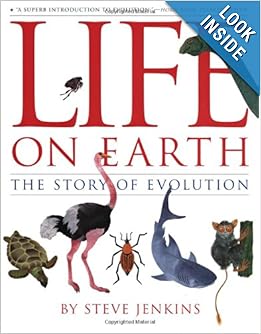
OK, on to the second set.  In one way or another, the next 3 books are all based upon Charles Darwin and his Theory of Evolution. Let's start with Steve Jenkins' handsome book Life on Earth: The Story of Evolution.  With a nod to Darwin, Steve has created a series of stunning collages along with fairly minimal text in order to focus on the history of all the plants and animals on the planet. 
And here's yet another nod to Deb Heiligman for her celebrated true tale of romance between two folks with opposite views of the world. Despite Emma's firm belief in the Bible's version of life on earth, she and Charles enjoy a warm and loving marriage.
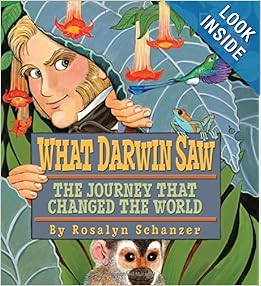
Mine again. What Darwin Saw: The Journey that Changed the World, tells about Darwin's great adventures as a young guy while traveling around the world. We're on board In this colorful graphic novel as he picks up the clues that lead to his Theory of Evolution and then does the experiments that prove it.
And here's series number 3.  Apparently these authors and illustrators were hard at work at the very same time on three very different picture books about the very same person; her name is Wangari Maathai, and she won the Nobel Peace Prize for bringing Kenya's trees back to life after most of them had disappeared. 

The artwork in all three books is outstanding, and each version is truly unique. The writing styles vary enormously too. I strongly recommend that you look at them side by side to prove that there's more than one way to skin a cat.  

Planting the Trees of Kenya was written and illustrated by Claire A. Nivola.


Wangari's Trees of Peace was written and illustrated by Jeanette Winter. 
And Mama Miti was written by Donna Jo Napoli and illustrated by Kadir Nelson.  
I'd bet anything that these folks didn't know they were creating books about the same person until all 3 versions were finally published....writing and illustrating books is a solo occupation if there ever was one. 

OK, that's it--though we could easily go on and on.  Here's hoping that if any kids examine a whole series of books on the same topic written and illustrated in such different ways, they can come up with some unique new versions of their own....and have some fun at the same time. 

Tuesday, November 12, 2013

Leaf Watching Writer-Style

   It seems as if I blinked and, poof, all the trees around our house instantly went from green to an artist's pallete of yellow, orange, and rusty brown, with dashes of muted red here and there.  And slowly, leaves are falling, making their twirling, spiraling journey to the ground.  Alison hates this time of the year (it marks the end of summer's warm weather and the beginning of winter); I find it calming (I can sit in one of our sunrooms surrounded by pots of flowering plants, coleus and whatever else we can lift and haul indoors and think about stuff.  Yes, I know, I can think about stuff any time of the year, but during this brief transition time I always go back over my writing year to evaluate it and think about future projects).
   Generally, I go over the negative aspects of my writing much more than the positive.  Did I really put in enough time at the computer?  Why did writing the backmatter and locating images for a new project seem to cause me so many problems?  Etc., etc., etc.  I think this is my 'beat yourself up' approach to making future projects better.
   Which does eventually lead to thinking about those future projects (and they are subjected to the same sort of examination -- is the research solid, don't wait so long to get images, oh, and don't write another 350 page manuscript!).  Now the good news is that Alison and I do have two future projects to work on together and she is pushing for a very tight schedule for the one we're about to start (and I agree that we took a little too long to figure out how we were going to work together on our first co-authoring adventure).  But here's the thing; I don't really know what nonfiction I'm going to be writing about on my own in the future.
   I sit there at night in the sunroom, the tiny humidifier chugging along to send out a warm mist, and wonder why no subject has really caught my attention in months that would prompt me to dig in and do some serious research.  I mean, I LOVE doing research.  I keep nosing around for a topic or an individual that I'm going to like enough to still be working on it years from now.  Usually I come across these by reading anything and everything I can get my hands on and stumble onto something that gets my attention.  Not this year.  And I did a great deal of reading this summer, so it wasn't for lack of trying. 
   The good news is that I haven't given up.  I'm still looking and reading.  And hoping -- that something amazing will come drifting into my life like a perfect red maple leaf.  Wish me luck and I'll try to keep you posted.  Meanwhile, enjoy the leaves.                   

Thursday, October 17, 2013

What Jim Murphy Said

It's 7:30 am on the day of my monthly INK contribution and I have just done something for the first time in all the years I've been blogging for INK--I deleted the post I published here several hours ago.

I have been conflicted about writing about the CCSS, which is our theme for this month, since I started to draft my blog entry. That's because I've been conflicted about CCSS since it became a thing. Sure, it's great that awareness of interesting nonfiction is increasing. But teachers and librarians have been using nonfiction in brilliant ways long before committees started presuming they knew better. Wait, let me rephrase that. You see, I started out as an editor in elementary textbook publishing and I learned nearly 30 years ago that standards committees can suck the creativity out of learning, and that education standards are continually changing.

Great teachers are great teachers.

And no, I don't think about curriculum objectives and standards when I decide to write a book about something. (This is a real question I have been asked in many a conference setting.) And I never want to. If my books fit the standards and people find that useful, that is fine by me. Heck, I've even had guides written (thank you brilliant librarians who have helped me do that) so that people can connect my books to the CCSS if they so choose. But that is not a driving force for me as a writer. Passion is. Every time. If the topic is something I can't let go of, if it makes me crazy, or joyful, or outraged, or fascinated, and I just can't wait to immerse myself in the research, to pull it apart and turn it on its head, and make the best sense of it I can as I figure out the world right along with the rest of my fellow humans--that's when I know I want to write a book.

When I visit schools and talk to kids, I always make this point. If they are interested in something, their writing will be interesting. If they are passionate about something, their readers will be engaged. It's not about curriculum objectives. I leave that to the experts.

What was the post I deleted? It was basically about hating the label "informational text." And I do. Because that label steals all the passion from what I spend my life doing. I don't mind reposting that thought. But I deleted the post because I feared it came off as too snarky on a subject respected colleagues (on and off this blog) are writing about with grace.

So I re-read some of this month's CCSS posts and was impressed with all of them. There is valuable information here, which I do not want to tarnish. My original post had called my dear friend Deborah Heiligman's George Clooney and raised her a Robert Downey, Jr., and that part I'll keep! But it was Jim Murphy's post that I nodded my head to at every single sentence and said, yes, that's what I meant. What Jim said. What Jim Murphy said.

Tuesday, June 11, 2013

Who Made That?


   It's been stressful around here for several weeks, so I was looking for some sort of mental relief.  Then along came the New York Times Magazine on Sunday with the cover story: Who Made That?  For those who haven't seen it, it's an A to Z collection of brief essays on the origin of a good number of common objects.  Things like the band aid, Bunsen burner, diet soda, white lab coat, and the breath mint are covered (though why they included Rachel Maddow in the mix escapes me.  Not that there's anything wrong with that).
   So I opened the magazine and started reading.  And almost immediately started to smile.  It's loaded with interesting, odd, startling, funny details and hard to put down if you get a kick out of this sort of (not always serious) details.
   Such as:
   Did you know that the longest single zip-line is in Sacred Valley, Peru, and is 6,990 feet long.  As the Scooter used to say, "Holy Cow!"  The longest combined zip-line is in Georgia and measures 48,000 feet! 
   Or that:
   Doris Richards founded the first dog park in 1979 in Berkeley, CA, in a space that seems to have had a good number of 'No Dogs' signs posted before she and her friends took it over. 
   Or that:
   "Nero married a man in a public ceremony and accorded him the honors of an empress."  Now that was something my textbooks seemed to have overlooked. 
   Or that:
   Before 1968, every lacrosse stick was fashioned by Native Americans and took almost a year to make: "40-year-old hickory shafts had to be cured for months before being steamed, bent and carved."
   It occurred to me while going through this list that coming across these details was one of the reasons I love to read nonfiction and do research; to come across some little known fact that grabs my attention and might grab the attention of readers.  It's these bizarre little nuggets that can humanize someone I'm writing about or provide a moment of lightness in an otherwise grim story.    And sometimes there is a connection with information that brings back a flash of a personal experience.
   While reading about Brunch, I suddenly found myself recalling a day back in the early 1950s when my friend, Paul, and I were walking from my house to his.  We were about six and the walk was about a mile distance, which we did unaccompanied.  Along the way we decided to get his mother to make us something to eat, but wondered what we should ask for.  It was 10:30AM, so it was too late for breakfast and too early for lunch.  We then started playing with all sorts of combinations of the words (BreLunch, BreakLunch, BerLun, BreakUn and other even sillier ones) and speculating on what sort of food would be appropriate.  We were nearly to his house when we hit on the word Brunch.
   We stopped in our tracks when the word was spoken and looked at each other.  It was so right we whooped and sprinted all the way to his house to let his mother know that we were geniuses and had just invented a whole new food category.  We would be famous, we told each other.  We would open a Brunch only restaurant (which we intended to call BrunchTime) and get rich.
   Of course, when we announced we wanted Brunch, Paul's mom just smiled and said sure, as if the word Brunch was old news.  Then she asked what we wanted and we asked for the only menu item we'd had a chance to think up:  A peanut butter and jelly, bacon and fried egg sandwich on toasted Wonder Bread.  With sliced dill pickle.  Now that got her attention!
   If you haven't read this Sunday's Times Magazine, you might want to take a few minutes and wonder down its aisle of invention.  Even if you don't find a personal connection to any of them, at least you'll come away kinowing what a Brannock Device is.  Have a safe and happy summer everyone.  And I.N.K. on!                  

Tuesday, March 12, 2013

It's All About Momentum

   Was chatting with a friend the other day and he asked me about this CCSS stuff he was hearing about.  I gave him a brief explanation and he thought it sounded like an interesting move and one that might benefit me and other nonfiction writers in many ways for years to come.  I said, "We certainly hope so!"  But as soon as I said that a dark cloud passed over my obvious enthusiasm.  And I added, "But there's been some push back about it."
   And we've all heard about incidents of resistance to and downright loathing for the changes to the CCSS.  Educator Diane Ravitch has come out against the CCSS and has recently called for parents to band together in an effort to get their states to withdraw their agreement to impliment the changes.  Even while saying that she finds much that is good about the changes, her anti-CCSS blogs sound like typical paranoid tea-bag rants about big gubmint and evil private business interests.  Or is that the evil gubmint and big business interests?  Anyway, it's almost as if she knows she won't convince the vast majority of level headed professional educators, so she's gone to scare tactics to get parents into her camp.
   There are other negative voices, of course.  At a recent literary conference the director of the college's library services said he liked the changes to the CCSS, except "there was too much nonfiction."  !!!!  I know a writer of children's nonfiction who feels the changes are profound and wonderful, but hates the Appendix B list of exemplar texts.  I tried to explain why I thought the appendix was useful and appropriate, but this writer would have none of that and still denounces the appendix whenever a discussion of the CCSS takes place.  Could some part of this writer's antipathy be because he/she doesn't have a book on the exemplar list?  Meanwhile, there is a blogger/reviewer who seemed downright annoyed that at last summer's ALA conference more and more publishers, especially of textbooks, are actively promoting their various products as CCSS compliant.  In the same breath, said blogger/reviewer promised to do a review column of books that are CCSS compliant.  Go figure.
   It's not that any of these individual voices will turn back the changes to CCSS on their own.  While insistent, I don't think they are ultimately very persuasive (there's too much obvious self-interest involved in their positions).  But I do think their constant, negative drone can have a wearing effect.  And I do have a parellel situation that, while it might be a bit of a stretch to some, does seem worth thinking about.  That's the anti-gun discussion that's going on right now.
   Following the terrible tragedy at Newtown, CT, there was a massive, emotional out cry for gun law changes.  This was answered by the now famous response of NRA President Wayne LaPierre (that certainly didn't do his or the NRA's image much good).  After this, a variety of news reports of shootings taking place all around the US were reported, until my wife Alison looked at the paper one day and said, "I can't stand to read about any more of these shootings!"  My response was, "if you want real gun reform, you should be ready to read about shootings every day of the week and every one should be on the front page."
   Of course, the news reporting of shootings has dropped off considerably and so has the emotional edge in the gun reform message.  But the anti-reform movement has steadily preached the usual line of "we must be careful about our Constitutional rights" "it's not the guns; it's the crazy people" "we already have enough laws; they just need to be enforced" etc., etc.  As announcers sometimes say about football games, the momentum seems to have shifted.
   What does this have to do with the CCSS?  It seems that a great many teachers, librarians, school administrators, writers and others have embraced the changes and are busily preparing to carefully impliment them.  But they aren't all explaining the changes or defending them publically.  So the negative voices seem to be holding court unopposed.  And having some effect.  Maplewood has an online community called, naturally, Maplewood Online.  Recently one poster who dislikes the school adminstration (and has for years) has begun including a condemnation of the changes to the CCSS as yet another evil plot by the school superintendent and his minions.  You would think other posters might call her on this, but they don't.  She goes on and on in various threads, each adding a negative buzz about the CCSS.  Which reminds me; I have to get a MOL account to respond to her rants!
   And that's my point.  We talk about, praise, and defend the changes to the CCSS here in this blog.  But I think we need to get our voices "out there."  Vicki did this very nicely in a response to a Dianne Ravitch blog and I'm sure others have responded in a variety of ways to similar negative comments.  But I think we need to add our voices if not daily, at least over and over again.  I'm going to respond tomorrow to the Ravitch post (though I promise not to be snarky) and then make it a practice to address the negative noise whenever I encounter it as best as I can.  I have a feeling that if enough positive voices are heard, and heard constantly, we can keep the momentum going in the right direction.                        


Tuesday, November 13, 2012

Pardon My Rant

Our toaster died a couple of weeks ago.  The event did not make it into the New York Times, but it was still newsworthy in our house.  Being toastless for two days is no laughing matter around here and besides that toaster was only 14 months old (and, of course, just out of warranty).

RANT #1:  Why can't anyone make a toaster (or other small appliance) that lasts longer than a large box of preservative loaded cereal?  I was once in an antique shop that had a shelf of old toasters, all of which worked.  One was from the 1920s called the E-Z Turn Toaster (weighing in at 5 lbs., it was nickel plated and flipped the bread to toast the other side whenever the door was opened).   There were also a bunch of Sunbeam toasters from the 30s and one by McGraw Electric from 1934 simply named the Toastmaster.  I mean, it can't be all that difficult to engineer more life into modern kitchen appliances.

Okay, so Alison went out and bought us a new toaster.  It was the Cuisinart Metal Classic 2-Slice Toaster # CPT-160.  I kid you not.  Oh, and it came with a 7 page instruction booklet!

RANT #2:  Did whoever gave this such a long, clumsy sounding name really think it would impress potential buyers?  Now, I have nothing against using the company name Cuisinart.  Or the word Toaster.  But why stick in "Metal."  I mean, do they have a plastic line of toasters I don't know about.  And "Classic."   One dictionary definition of a classic is: "Having lasting significance or recognized worth," but we all know this thing we have is built to burn out before my next birthday.  And I love adding "2-Slice."  The picture on the box and on the instruction booklet show very clearly that the toaster has...oh, let me count to be sure...yes, TWO SLOTS FOR TWO SLICES OF TOAST!  And the toaster inside confirms this.  I was worried there for a second.

RANT #3:  A 7 page instruction booklet!  Oh, come on!  Is this even remotely necessary?  Here are some of the gems of wisdom provided:  "Unwind power cord...Plug power cord into the wall outlet"  "Insert slice(s) of bread"  "To Begin Toasting.  Press the carriage bar lever until it locks into the down position"  "Always allow the toaster to cool completely before cleaning."  And guess what's on p.7.  It's an entire page for your NOTES.  Yes, 21 lines so you can jot down some of the important tips on toaster operation that you might forget overnight. 

This booklet is an example of everyday nonfiction and it is exactly the sort of lifeless, deadly, and heavy prose that turns off both adults and kids.  Hopefully, the changes in the Common Core State Standards will make kids in the future more demanding and maybe they can get companies to change the way they address customers.  Better yet, maybe some classes could rewrite booklets like this as an assignment on how to write for humans.

I'm not holding my breath on that last idea, so here's my suggestion to Cuisinart when they decide to revise the instruction booklet.  No. 1: name this the Cuisinart Toaster.  If you must, stick the CPT-160 on, too, since it sounds official.  No. 2: the cover can have that nice photo of the toaster on it, and you could even label the parts we see, such as the "cancel" button, etc.  There must be someone who sees the word cancel and doesn't understand what the button is for, right?  This would eliminate repeating all of this on p. 3, plus it would do away with such numbing text as "Extra-Lift Carriage Control Lever: Brings the toast close to the top of the toaster, making it easy to remove the smallest items."  Items?  I get "items of jewelry" and "items of interest," but "items of bread, bagels, and English Muffins" doesn't compute.  No.3: my recommendation for the interior copy.  Direct and to the point is best.  The instructions should be 1 page only.  When the happy buyer turns over the page with the handsome toaster potrait on it, he or she should be greeted with "If you really need an instruction manual to operate this or any toaster, please proceed immediately to your local police station and surrender your driver's license."  It's okay if Cuisinart wants to stick the warranty information under this, but, please, please, please, cut it back from its current 26 lines.

I feel much better now.  I have a very Lewis Black-like glow about me.

Feel free to comment with a rant of your own, be it about nonfiction for kids, about something that annoyed you recently, or even about someone taking up valuable INK blog space for a toaster rant.  I promise to do better in the future.  P.S. Humor is an important part of any book for kids.             

Tuesday, October 9, 2012

It's All Personal

1:  If you are fortunate enough to get a book published it will be reviewed.

2: It might be reviewed by a 'major' reviewer (you know, the folks who sprinkle stars around), or by a national, regional, or local newspaper or magazine, by bloggers, or by family and friends around the kitchen table.

3: Sooner or later, someone will say something about your book that doesn't sit well with you.

Number 3 happened to me a few weeks ago.

I was feeling a little anxious and aimless, so I decided to visit children's literature blogland.  I generally do this by visiting Betsy Bird's Fuse #8 blog at the SLJ site.  She has a list of favorite bloggers (including our own INK) and I roam around to see what people are chatting about.  So there I was visiting and reading this blog and that blog and another, when...pow...there was a blogger reviewing my newest baby THE GIANT and How He Humbugged America, which is about the 1869 Cardiff Giant hoax.

Now if I remember correctly the blogger had very nice things to say about the book (I would provide a link but I can't recall who the blogger was, a situation I blame on the very wonderful pain killers I was taking at the time).  But toward the end of her thoughtful review she hesitated a beat and said that she couldn't see any young reader caring about the book's subject.

What! I kind of sputtered.  But, but, but...why wouldn't kids be interested?!?  There was more, but you get the idea.  I take reviews personally.  But why wouldn't I?  I take the research and writing very personally.  It always takes a few minutes for me to calm down, but eventually I do.  Which is when I begin to blame myself for whatever a reviewer has criticized and I think back on the decisions I made about the book in question.  I this case, I began thinking about why I decided to do THE GIANT in the first place. 

Way back a few years ago, I began wondering if it would be possible to do something for young readers about Bernie Madoff and his fifty billion dollar ponzi scheme.  I quickly rejected the idea, mainly because all of the details of his fraud weren't in (and still aren't).  I'm leery of "ripped from the headlines" ideas.  Yes, they have an instant recognition factor, but usually only part of the story has been unearthed, so the result wouldn't be a truly satisfying or complete book.  It would be more of a glorified magazine article (and probably not worth the price of a book).  I then thought about doing something on Charles Pozi himself, but realized that neither he nor Madoff were very interesting guys and their schemes involved a lot of paper shuffling and ledger entries and not much that was either active or visual.  Then I remembered the Cardiff Giant.

Here was a story filled with unusual, colorful characters.  George Hull, who conceived the idea of carving a giant, lifelike human, was a serial fraudster (he not only came up with a second 'discovered' ancient human years after the Cardiff Giant, but he hired a man to write his biography, took that text and gave it to another person to clean up, and took that version and gave it to a third person, never bothering to pay anyone for their work).  P.T. Barnum tries to buy the Giant, fails in his bid, then has his own immitation Giant made and exhibited (and actually outdrew the original CD in NYC); Barnum was sued by the original CG owners, but the case was heard by a drunken judge who refused to rule against Barnum's Giant unless the original appeared in court to testify.  It don't get much better than that.

There's also action (making the giant, transporting him secretly from Chicago to NY State, burying and digging him up, exhibiting him and moving him around in his retirement years until he winds up in a leaky shed), and some decent visuals as well, both photos and drawings.

And themes and story lines.  Why the Giant captured so many people's imaginations that it literally knocked the upcoming 1869 November elections from the front pages of the newspapers, how people clamored to buy shares in the giant, how shareholders continued to insist the Giant was real even after they knew it was a fake, how educated individuals and scientists were fooled into believing the Giant was authentic, to name just a few.  Oh, yes, and how men put a 'fig' leaf over the Giant's private parts to shield women from naughty thoughts and how women were the one's to insist that was nonsence and insisted it be removed.  A lot is going on in this relatively short-lived piece of US history, some of it downright silly and some very serious. 

Still, I had to admit that the blog-reviewer had a point.  THE GIANT probably doesn't have instant and obvious curb appeal.  It will need strong reviews (and, happily, has gotten a number already) and skillful selling by teachers and librarians.  When I finally sat back and thought about it, I came to the conclusion that I wanted to do the Cardiff Giant's story (and in fact wrote it without a contract or publisher lined-up) because it grabbed my attention, made me chuckle as well as think, and seemed like a complex story that kids could understand and follow and get involved in.  I guess in the end it was personal.  

     

Tuesday, September 11, 2012

Them's the Breaks

I'm right-handed but have to write this as a lefty, so this will probably be very brief (hey, why is everyone applauding!?!).  And I'm not even sure what to write about.  At first I thought I'd detail the various (numerous) things that have gone wrong here over the past few weeks (from broken bones to a broken dehumidifier), but thought better about going there.  Why?  Well, we had a really great, renewing vacation and despite what has happened we're not wallowing in self pity, etc.  In fact, we're kind of amazed that we still feel that post-vacation 'ain't life grand' emotion.

So what does any of this have to do with nonfiction and writing?  Good question.  Let me take a stab at an answer, but everyone feel free to correct me or add comments of any sort. 

The first thing I thought about was that many/most of the people we write about (whether they're famous or not) have usually gotten our attention and admiration because they have overcome any number of annoying, unexpected, painful or depressing obstacles.   Be it George Washington, Temple Grandin, the many folks with Hansen's Disease who were hauled off as criminals to isolated areas, Civil Rights fighters (young and old), Galileo -- well, you get what I mean.  We admire that they found ways to deal with and sometimes overcome the obstacles placed in their way, often for causes bigger than themselves, and we want to bring alive and share their journeys with others.

The second thing I wondered was that maybe learning to compensate for my injury might help me to understand better some of the people I write about.  Not that I'm equating what's going on here to anyone else's struggles.  I'll put money on it that George's bad teeth hurt him much more than my elbow/wrist, and they were often the least of his troubles.  No, I'm saying that my minor challenges might help me to think about and explore theirs in more depth, or to articulate them on the page more dramatically.  Maybe it's just that as I/we get older we experience more odd, interesting, enlightening events and these act as building blocks we can use in our work, whether it's writing a book, making a school visit, or having a video-conference.  And maybe this could help young readers to 'see' the world in a broader, more inclusive way.

Must close now to get ready for yet another doctor's visit.         

Tuesday, May 8, 2012

Notes From the Field

I've been away on a speaking jag recently and not near my computer (and thus out of touch -- not that anyone noticed, of course). Two of the places I spoke at were the Pennsylvania School Librarian Association in Hershey and IRA in Chicago. I went asking how the changes in the CC would alter their respective worlds and came away without much information. Yes, numerous publishers, packages, and whatevers had signs up saying they already produced materials compatable with the changes, knew everything that would be happening regarding the CC, and inviting folk to chat them up. And I did meet a few people who were very enthusiastic and knowledgeable about the changes. Susan Bartle, who oversees scads of libraries in NY, was particularly eloquent on the subject (and set a record for purchasing somewhere between 40 and 60 of my Scholastic books to give to various librarians she works with!!!). But what about the rank and file librarians and teachers?*
   * Most had a wait and see approach. No one had yet told them specifically what would be happening, so they were moving forward cautiously, essentially expecting a change but not initiating one on their own. One teacher did say she was moving the teaching of nonfiction from the end of her school year to the beginning (which I saw as an amazing and positive move). Others cited budget cuts as a problem (they couldn't just revamp what they do without a certain amount of expense and administrative review, so, while positive about the chnages and hoping they come about, they were sitting tight). *
   * What was heartening was the interest in how we put our books together. At IRA I was on a panel with Sneed Collard III, who spoke eloquently and with great authority about his work and it's use in the classroom; my talk was much more anecdotal in nature. But I think it fair to say that we both wanted to communicate a similar message -- that we do more than simply provide information in our texts, that they are works of art where we think about, worry over, re-work and fret about every word we write, every image and caption, everything. Of course, neither of us said that "work of art" phrase; we just painted a picture of how we work and hoped the audience would make that connection (and, in some small way, understand that what we do is as creative as, say, writing a novel). Maybe I should have been bolder and just said it or suggested it. I'm not sure. I'm not big on self-promotion so that sort of proclamation seems a bit unseemly to me. What was interesting and positve were the many librarians and teachers who came up to me and asked nuts and bolts questions (where do I get ideas, how long does the research take, where do you find information, etc.) so they could go back to tell their kids. The world is changing, sometimes startlingly quickly, sometimes grindingly slowly, but at the center is an interest in our process. And that I find very comforting.*
*
   P.S. Sorry, I couldn't figure out how to create paragraphs.

Tuesday, April 10, 2012

Good Luck/Bad Luck and Books

Next Friday I'll be talking with a very nice group of Pennsylvania librarians. It's Friday the 13th, so I thought I'd chat about the good luck/bad luck aspect of my work. Let's face it, whenever we think things are going along swimmingly, something bad (annoying) crops up. Our editor leaves the publisher; someone forgets to send your book to a particular and possibly important contact that you had suggested; a publisher moves and doesn't bother to tell you (yes, this happened to me, though I thought it more funny than alarming). *
*
I'm happy to say I've had more good than bad luck, so this isn't to complain, but rather celebrate these moments. Here's one I'm fond of. I had finished doing the manuscript for The Boys' War and was having trouble figuring out what to do next. I made several proposals and had them all rejected, so I was feeling a little bummed out. Wasn't sure what to do or how to generate a new idea. So I started reading over the firsthand accounts of soldiers (16 yrs. old and younger) who were already in TBW, hoping that something would inspire me (or at least make me feel as if there might be hope that another idea was 'out there' somewhere). *
*
Anyway, I was looking over Lt. John Dooley's memoirs when I came across his section on the Battle of Gettysburg, and specifically a mention of a clump of trees. He was to lead a group of soldiers across the long meadow toward the Union lines during Pickett's Charge. He was told to keep moving toward a prominent clump of trees.*
*
That's very nice, I thought. And then went on reading. A day or so later, I was reading John Galway's account of Gettysburg where he was an advance picket, stationed about 100 yards in front of the Union lines in the meadow. Okay, I thought. That's a pretty dangerous place to be, especially with the pre-charge artillery barrage that lasted over an hour and then the actual charge. Then he mentioned he was stationed just in front of a clump of trees.*
*
Holy cow, as Phil Rizzuto would say. Is it the same clump of trees? I then whipped out a large map of the battlefield and began plotting exactly where each boy's company had been stationed before and during the battle. For two or three days I plotted their every more, marking their various locations on the map. Which was how I discovered that these two boys had come within 100 or so feet from each other during Pickett's Charge. At one point, Dooley mentions approaching an advanced pickett location and ordering his men to wheel to the right to get around it; Galway mentions seeing the charging Confedates about to overwhelm his position (in which most of his companions had already been killed) when suddenly, and for no reason he could fathem, they turned to his left (their right) to get past his position and how he lay there shooting at them at will.*
*
This, of course, was too good to be true, so I checked it over and over again and it always came out as true. So I really dug into their march toward Gettysburg and their near meeting. My idea was to show kids that luck (both good and bad), happenstance, seemingly small decisions by a variety of people, and just plain weird stuff landed these two kids within rifle shot of each other. I contructed the entire book on this notion that a major event in history (the Battle of Gettysburg in this instance) doesn't necessarily happen because important folk decide it will. In the end, I hoped readers would come away appreciating just how close the Battle of Gettysburg was and how a few changed factors might have produced a completely different outcome.*
*
Historians now refer to this concept as Historical Continguency (or simply Continguency). It's a way to factor in the many big and small random events that sometimes add up to a major, history changing event. It's also a way to let readers -- kids -- see that an individual might very well sway history by what they do, even if they don't know they are swaying history. *
*
I chuckle whenever I think about that clump of trees. I never understood exactly when Dooley mentioned the trees behind him, but I always appreciated that he did and that I was lucky enough to pick up on it and fashioned a book around Dooley's and Galway's march to destiny. Anyone else have a lucky encounter that resulted in a positive (book) outcome? I'd love to hear about them.*
*
Oh, and Happy Friday the 13th!

Tuesday, March 13, 2012

The Eternal Student

Recently, I was watching Page do laps in the backyard (at 5 AM!) when I started thinking about how most of my book projects have begun. Usually in odd, strange ways.*
*
Once (and this was years ago) I was in the Newark Library doing research when I spotted an open book on a table. It was there in the morning, at noon, and in the afternoon and I never saw anyone actually reading it. It looked kind of lonely and since the library was (is) understaffed and underfunded, I decided to reshelf the book. So I picked it up and headed into the dusty stacks and hunted until I found the exact spot where it belonged (there was even a perfect space between two other books just waiting for this volume to return). Which was when I finally looked at the book.*
*
Turned out to be the Civil War memoir of a young soldier, Elisha Stockwell, Jr. When I glanced at the introduction I found out he was 15 when he enlisted. I almost immediately thought, gee, I didn't know kids that young actually fought in the war. Mind you, this was at least eight years before the Ken Burns' documentary let us see and hear Civil War soldiers old and young, so it was a revelation to me. And then that little light in my brain lit up and I thought, well, maybe young readers would like to know about this, too.*
*
So I took the memoir home and read it and loved it. Maybe there's a book idea here, I wondered. But to be sure, I had to do research. Lots of it. I began what turned out to be an endless quest for information: about the Civil War, about what a soldier's life was like, and about what young soldiers experienced. And here is where a confession is necessary. I was never a big fan of the Civil War. I read a little about it, but never really delved very deeply into it. History texts always seemed to be about the important players (military and political) and whenever these individuals wrote about the war their writing always seemed pompous and stilted and distant. And the battles were always described in dry, technical terms. But reading Stockwell's memoir and discovering other underage soldiers who left written accounts of their time in the war was an eye-opener. What they described was immediate and emotional and vivid and very often humorous. And it made me want to know more.*
*
It took about eight years, but eventually The Boys' War was published (during the same week that the Ken Burns' CW documentary first appeared. Talk about riding long coattails!). Other books had unusual beginnings as well. The Last Dinosaur was born out of my reading an article (obit, really) about a species of bird that was the last of its kind and held in captivity for years while scientists searched for a mate. Very sad. Inside the Alamo came about because a friend sent me an article that suggested that Davy Crockett had tried to escape the Alamo massacre by dressing as a woman (Not true, but it would have made for some interesting headlines). All of these titles (and others I've done) have something in common; when I began my research, I really didn't feel I knew enough about the subjects to write a book.*
*
So each required that I, in effect, create and give myself an intense and lengthy course on the particular subject. And I never stopped researching even when I began the actual writing, or even after I submitted the ms. Or even when the text went off to the printer. I kept trying to learn more; I needed to know more -- in part because I wanted the most up-to-date information or take on the subject, but mostly because I loved the subjects. And that love never dissapated as I dug deeper into the subject and learned more and more about it.*
*
I think this passion for learning about a subject gets passed along to the readers in the resulting text. Listen to this, I hope my writing is saying, it's a weird story but really cool and not too many people know about it. I want to take readers along on the voyage of discovery, of coming across an unusual character, an extraordinary detail or scene and realizing that history is coming alive in their mind. This not only keeps readers engaged and turning the pages, but it might just ignite a real interest in knowing more about the subject or about history in general. Hey, stranger things have happened.

Tuesday, February 14, 2012

Mind Games

A week ago our six month old puppy, Page, decided that 4 AM was the perfect time to go outside and play. After an appropriate amount of grumbling on my part, I got up and let her out into the backyard. On the way downstairs, I noticed a large heart-shaped pillow, bright red and covered with lots of smaller white hearts. It was our sixteen year old son's Valentine's Day "card" to his Mom from last year.*
*
I stood on the back porch as Page dashed around madly making giant figure eights. She's a Beagle mix, golden haired with white spots, but has very, very long legs. She looked like a miniture greyhound as she sprinted around and around and around. Then I thought about that red heart pillow. Our son is a person of giant emotions -- frequaently loud in all ways (our neighbors are wonderfully tolerant when he plays electric guitar), always hugging friends hello and goodbye, compressing more words per second in his rap songs then can be imagined, never settling for a simple story line or answer in his songs when something complex, contradictory and dark is demanding to be heard. There is wonderful freedom in his approach to life and art -- often reckless (he says what he feels in the moment and doesn't look back or forward), but just as often making a moving and thoughtful emotional comment that has real impact. *
*
Of course, we also want to have all of that rich emotion in our nonfiction writing, though we operate in a world of rules -- space limitations, monitored by a series of gatekeepers (from editors, to reviewers, to teachers, librarians and parents) between our books and our readers, plus our need and drive to be as accuarate as possible. This isn't a complaint about the system we work in; but it's a reality that can sometimes make us hesitate when we're writing and sometimes/usually leads us to question what our inner soul is telling us to say: If I say it this way, it will be much more passionate or active or whatever, but will it be as accurate or clear?*
*
I know some writers who go with the flow, put down on paper whatever their head is telling them, and either leave it to their editors to make suggestions for revisions or go back later themselves. I envy them. Unfortunately, I am a compulsive self-editor. I think over, question, revise and re-revise every phrase, every sentence, every paragraph as I write them. Then I rework the section and question it all over again. And my earliest books reflected this labor. Over the years I've come up with little gimmicks to maintain a more spontaneous feeling. Nothing genius, mind you. Just ways to stay relaxed in my head. For instance, when I write, I tell myself that I should imagine I'm talking to one reader who happens to be sitting across the desk from me, which means writing in a conversational, informal way. If I feel a section is sounding too much like a freshman college lecture, I stop and do something else (wash dishes, water plants, take Page out) and come back later, hopefully with a fresh eye and approach. And I always read over a manuscript several times with a slightly different mode of attack. I'll make believe I'm the nastiest editor alive and write all sorts of challenging comments and suggestions in the margins; I'll read it with a young reader in mind who might not be familiar with the subject; and I'll just read it start to finish in one shot to be sure it flows along smoothly, noting whenever something (an odd phrasing, an overly long sentence, etc.) makes me stop reading. *
*
These are just little tricks -- mind games really -- and sometimes they work. Just as watching Page doing crazy laps in the dark night for ten or twenty minutes can free up the brain and get it ready for another day's work. I hope you all have a wonderful Valentine's Day and that (if you work) your thoughts and words are passionate, free flowing, and exactly what you want to say.

Wednesday, January 11, 2012

Real Revision

Tanya Lee Stone. Susan Goodman. Jim Murphy. Kelly Fineman. You know these folks. They’re regular contributors to this blog.

They’re also four of the thirty or so authors featured in Real Revision by award-winning children’s book author Kate Messner. The book is such a gem that you’ll definitely want your very own copy.

Real Revision is published by Stenhouse Publisher, which caters to educators, so this book is written specifically for teachers. That makes it great for all you educators out there. But I know plenty of writers also read this blog. This book is a MUST READ for you, too.

Some chapters focus on fiction-specific revision strategies, but the lion share of the book is useful to nonfiction writers as well. Here are few of my favorite quotations from nonfiction writers.

Kelly Fineman on why she takes time away from a manuscript between writing the rough draft and delving into the revisions:

“It could be as little as half an hour or as long as a year, but I need to have established some sort of distance from it in order to read it at least somewhat objectively and not like a doting author.”

Loree Griffin Burns on the importance of reading widely and carefully considering the structure of nonfiction writing:

“I pay close attention to the structure of the books I am reading all the time, and I compare and contrast them to the structure I’m working with. This is always helpful to me because it gives me confidence . . .or in some cases, helps me see why my own structure is not working.”

Susan Goodman on striking the right balance between sharing information and engaging readers while writing Life on the Ice:

“. . . I was trying to fit in so many facts that I had lost sight of what my book was all about—the excitement on exploration . . . So I sat down at my computer with an imaginary nine-year-old kid beside me. And I simply told that kid an adventure story—one where scientists were the explorers.”

Jim Murphy on finding the proper voice and storytelling technique for his Newbery Honor book The Great Fire.

“I read newspapers and personal recollections of the Chicago fire until I had absorbed the pace and language of the era. . . . I didn’t try to duplicate voices from the past, but I knew I had a faint echo of them in my style.”

Tanya Lee Stone on the importance of sensory details:

“. . . if I interview someone, I will note very specific things about the way they speak, move, dress, smell, etc. These details come in handy when writing a scene that needs to capture the real essence of a person.”

And these great bits or advice are just the tip of the iceberg. Trust me. This is a book you won’t want to miss.

Tuesday, January 10, 2012

The Past Is Always Present

Our house has a fairly large wrap-around porch and Alison and I love to use it whenever we can. We watched New Year's Eve fireworks from it this year and have used it in the past to view parades and bicycle and foot races. But just sitting in a wicker chair as the night wears along is a peaceful joy. Traffic dies down at 11 PM and the world becomes very still and deep. When leaves are present, when they surround and embrace the porch, very little light -- whether from street or porch lights or the moon -- disrupts the dark shadows. It becomes a refuge, a haven to escape the day-to-day pressures and responsibilities, a place where I often find myself thinking of the past.*
*
Sitting there I sometimes wonder if the original owners of our house sat out at night as we do? The house was built in 1905 and our town of Maplewood was just beginning to grow and change, with new streets being carved through old apple orchards, sturdy wood frame houses slowly rising up. What did those first owners hear at night? The lonely clip-clop of horse's hooves? The huff and chug of the steam train from Newark? And when did the first automobile make its way past the house? *
*
And what about other owners through the years? What was it like to sit in the absolute quiet of a dark night when the world wars were raging? Did someone bring a radio out to listen to the latest reports from Europe or the Pacific? Did anyone sit on the porch during a heavy snow fall (as I often do) to be surrounded by cold and white and gusting winds? Or stay out when a summer thunderstorm came rumbling through? Yes, I have been known to experience all sorts of storms out there.*
*
And, of course, there are those strange, sometimes unsettling moments, especially after midnight. Twenty years ago we often heard the distant voice of a young girl calling plaintively in the night: "Mommy... Mommy... Mommy..." We nicknamed her the Ghost Child and dispite going out to make sure everything was okay and despite asking neighbors, it was years before we found out the truth. It was indeed a young girl and she was searching for a loved one -- her cat, which escaped regularly and was named Monty!*
*
That was a disappointing end to the story. We had hoped for something a little more, shall we say, picturesque. But the Ghost Child has been replaced these days by the Night Rider. Late at night, usually after midnight, we can hear the thrum of a skateboarder making his or her way up Maplewood Avenue toward our house. The sound gets louder and louder until they get to the corner that borders our house where the rider turns and pushes hard to sail up the side street. We have never actually seen the rider, it's that dark. Just a quick glimpse of moving shadow and then the sound of the wheels fades away into the night. Who is the Night Rider? Where did they come from and where are they going? Will they be safe?*
*
These are decidedly small bits of history. Incidents really that usually aren't recorded because they're, well, so every day and common. But I believe that much interesting history begins with the ordinary. Take what happened to Corporal Barton Mitchell and his friend on September 13, 1862. When the 27th Indiana Infantry halted their march just outside of Frederick, Maryland, Mitchell and his pal went over to rest in the shade and happened to spot a rolled-up piece of paper in the tall grass. It turned out to be Special Order No. 191 (where Robert E. Lee divided up his army). If these two soldiers hadn't found the paper and hadn't realized it was important, there would have been no Battle of Antietam, Lee would have probably been able to reunite his forces, and that would have meant a far different battle between Lee and McClellan than Antietam (and who knows when or even if the Emancipation Proclamation would have been issued!).*
*
Finding those orders was pure dumb luck, but it resulted in an historic battle that changed the course of the war and the world. A tiny bit of history, a mere moment really, that had profound effects. Which is why I love to sit at night on our porch, listening and waiting and imagining. You never know where porch sitting might all lead.*

Tuesday, November 8, 2011

The Real Future

Disoriented and a little confused. That's what I felt as the pre-Halloween snowstorm hit, accompanied by thunder, falling tree branches (hundreds of them in our tree happy little town) and the pop-pop-pop of exploding transformers. Oddly enough, I was feeling much the same way in the days leading up to the storm, though it had nothing to do with the treatening weather.
*
Two publishers had sent me contracts to turn seven of my published books into e-books. It felt nice that the books were going to be given a new life, but that pleasant feeling was undercut by the actual terms of the contracts. Each publisher had its own idea of what a fair share of the sales was and my agent made it clear that she thought neither was being particularly generous. And neither publisher would budge an inch from their position. It was a take it or leave it sort of deal. What to do? I could just turn them down and see what happened next, though that seemed like a drastic step. And I'm not the sort of person who does drastic things. So I put the contracts aside to think on them.
*
Then the storm hit and the branches rained down and confusion reined (I couldn't resist, sorry). On Monday I was looking through the Times at the numerous storm damage pieces when I came across an article about The Dover Bookstore on Earlham Street in London's Covent Garden. Now here was a story about a real bookstore with real books on the shelves with an owner named Mark Oddie (love that name!) and a regular stream of customers (enough to generate $1.25 million in sales in 2006). Okay, this bookstore sells "clip art" books put out by Dover Publications and not regular trade books. But they are books and The Dover Bookstore was still in business after twenty-five years. All was right in the world, I told myself. There was a center to the planet after all, something to hold onto during uncertain times. Until I neared the end of the article, that is.
*
That was when Mr. Oddie described his store as a "charitable operation" that made enough money to pay the bills, but little beyond that. My spirits drooped even more when I read that Mr. Oddie's lease will be up early next year and that Dover Publications is about to introduce direct downloads of images within a year. It seems that another bookstore will soon go the way of those exploding transformers. Pop!
*
I had hoped to read an article that would reasssure me, but instead came away even more disoriented. Which is when I turned back to those e-book contracts. My agent and I may not like the terms of the contracts, but they do represent the publishers' belief that the books have a future life. No one can define what that future will be, of course, but where there is a future there is hope. That's the sort of profession we're in. Every time we begin a new book we put our emotions on the line. We have no idea how the book will turn out (at least I don't) or whether our words will be well-received or even be in print after six months. But we do it anyway; we risk our happiness and piece of mind again and again, because we need to see where our ideas will lead, what might emerge from a simple idea.
*
So I signed all of the contracts, sent them off, and promptly banished thinking about them for now. No reason to occupy brain cells with needless, troublesome worry when a new project with new challenges is demanding immediate and focused attention. I will always love real books -- holding them, smelling them, hearing the binding crack as I turn the pages. And I'll always surround myself with books. Lots of them. But the real future, after all, isn't confined by form; the real future is in the words on the screen right in front of me.

Friday, October 21, 2011

Field Trips, Parties, and Where do I Get my Ideas?


In response to Roz Schanzer’s hilarious post “Writing Right, Right?” about Rules for Writing, Jim Murphy commented, “You have to have some fun writing if you expect me to still be awake when I get to the conclusion.” That reminds me of a funny story.


Most of the books I do with Sandra Jordan begin with a field trip. But not all field trips turn into books. A few years ago Sandra and I had what we thought was a great idea. We set off for the Museum of Modern Art to do some research. After two hours there, we went back to my apartment, sat down, and promptly fell asleep. Later we realized if our great idea put us to sleep, what would it do to our readers?


Where do you get your ideas? That’s the question I’ve been asked hundreds of times for the last thirty years. Some of my ideas seem quite interesting when I come up with them, often in the middle of the night when I can’t sleep. But in the light of day (is that a cliché, Roz?) in the midst of researching, I get so bored I end up eating lunch at 9:30 in the morning or writing frantic e mails to my daughters about nothing.


Here are some of my favorite field trips that did work out:


  1. A drive out to Storm King Sculpture Park resulted in our book “The Sculptor’s Eye.”

  2. On a visit to the National Gallery in Washington DC, Sandra and I stood transfixed in front of Jackson Pollock’s painting Lavender Mist and featured it in “Action Jackson.”

  3. A trip to the Isamu Noguchi Foundation in Long Island City to see his stage sets for dances by Martha Graham sparked our interest in doing a book on collaboration that resulted in “Ballet for Martha.”


Going to a party doesn’t constitute a field trip but it may inspire an idea. I once met the artists Christo and Jeanne-Claude at a cocktail party and she and I struck up a conversation about …no not art…but her Issey Miake dress. She was so charming that when Sandra and I decided to do a book about the Christos, I knew we would enjoy interviewing them.


Although I usually don’t get ideas for books at parties, social events seem to produce a multitude of suggestions by well meaning friends. It usually begins like this: “I’ve got an amazing story that would make a great book for kids. If I had the time, I would write it myself.” Here are some recent offerings:


A children’s book about the Bhagavad Gita from my friend Maxine who’s a Buddhist.


A story about Lucy’s schnauzer Morgan, who recently ran away and went missing for 19 hours.


Stanley’s grandson’s 9th birthday party at Busch Stadium.


And so on…


Occasionally, I’ve felt compelled to explain that I write nonfiction about the arts. This pronouncement is sometimes followed by blank looks, which prompt me to discourse on the dearth of arts education in the schools and the fact that perception in the arts encourages abstract thinking skills and inspires creativity. More blank looks. Perhaps I’m preaching to the wrong audience, which is why I’ve vowed to avoid parties (except on Halloween) this month, and stay home and write (and have fun doing it).

Tuesday, October 11, 2011

Ooooops!

Did anyone else happen to read the September 30, New York Times Weekend Arts article about the new exhibition at the Folger Shakespeare Library in Washington, D.C.? The exhibit is titled Manifold Greatness and its subtitle makes clear what it's about: "The Creation and Afterlife of the King James Bible."
*
It sounds like a wonderful exhibit, especially for those who love words and real books -- manuscripts from the year 1000, the King James Bibles used by Queen Elizabeth I, King James' son, Henry, and Frederick Douglas, among others. And there's the history of how the King James version came to be, and especially the contribultions made by William Tyndale (who was condemned by the church and state for his English translation of the Bible and subsequently strangled to death by the crown, then burned. Talk about a bad review!) But what caught my attention and gave me a chuckle was the work of printerRobert Barker and his associate, Martin Lucas.
*
Seems that Barker/Lucas printed a version of the King James Bible in 1613 where in one book he set "Jesus" as "Judas." Oooops, my bad, he probably explained to the authorities. He fixed the error by pasting Jesus' name over that of his betrayer. But the Barker/Lucas masterpiece of mangled setting was their "Wicked Bible" from 1631. In this version they managed to leave out a single word, "not," so that one commandment reads "Thou shalt commit adultery." I thought this sounded very 60s, but clearly it didn't please the authorites back then, since both men were fined for the error. Barker probably wished he'd hired a real proofreader when he was later put into debtors' prison where he subsequently died.
*
Reading about Barker/Lucas made me think of errors that have appeared in my books. Usually a new book arrives and I leaf through it quickly, just to get an idea of what readers will experience. Later (a week, two weeks, sometimes longer) I'll go over the book start to finish with a red pen in hand. I read every word, marking sentences/paragraphs I wish I could have done better or that need to be changed in a subsequent printing. I remember being very embarrassed when I discovered that three sentences in a book began with "It was..." Two on the same page! How could I have possibly missed that, I wondered. Actually, I was really furious with myself and set about figuring out how to avoid the same thing ever happening again. Not that I really figured out how to do this. But at least I give myself a lecture about watching for repetitions whenever I'm readying a manuscript to be sent off to one of my editors.
*
Then there was the endpaper map for Across America on an Emigrant Train. Oh, my, this one hurt. The map was a last minute addition (the book was actually at the printer when the decision was made to have it drawn), so I didn't get to see it before the book was finsihed. Not that that would have made a difference. When the book arrived I looked at the map, wanting to be sure the artist had gotten Rober Louis Stevenson's 1879 train trip across America correct. Satisfied, I glanced through the book, then put it aside. Several months later, a letter arrived from an alert twelve-year-old reader. "Dear Mr. Murphy. I really liked your book. I liked that Robert Louis Stevenson almost died while trying to get to his girlfriend in California. The only thing I didn't like about the book was that you put the state where I live -- Vermont -- in the wrong place. Thanks for...." But I didn't read his letter all the way through; I was already fumbling for a copy of the book and right away (and way too late) saw that we'd switched both VT and NH.
*
Why hadn't I noticed this when I first looked at the book? I was too focused on checking RLT's route and had assumed that the map was correct. At a glance it looked correct (the state's all looked as I remembered them to be). It was a case of familiarity breeding a form of arrogance, or at least a form of laziness. No one could possibly mix up the states or fail to see them mixed up, so there was no need to check each and every one. But obviously, it happened.
*
Once my publisher knew about the problem they started the process to correct the error. But it would take months before another printing would be scheduled, and there were already a lot of books out there already. As embarrassed as I was, I decided to fess up immediately whenever I spoke at a school. I would tell kids that there was a mistake in the map, that two states had their positions swapped and challenged them to find them. Which they usually did pretty quickly. Then I would tell them that we all make mistakes and how important it is to check whatever we're working on, be it written or drawn or whatever, very, very carefully. Even if we think we know the material inside-out. So at least I turned a public mistake into a bit of a learning lesson.
*
Was the error ever changed. Yes. The only solution was to cut the VT/NH out of the map and stick them in the right state. This left all subsequent versions with those two states' initals gleaming white and very obvious, a little like the Barker/Lucas patch job over Judas.

Tuesday, September 13, 2011

Can Something Be Too Perfect?

While on vacation in the Adirondacks this summer I read Laura Hillenbrand's Unbroken. For those who might not know the book, it's about a World War II crew of a B-24 (not affectionately called a "Flying Coffin") that plunges into the Pacific, killing most of the men. The few who lived through the crash, including Olympic runner Louis Zamperini, survive in a tiny, disintergrating rubber raft for over a month, are captured by the Japanese and imprisioned on a small island, and then sent to Japan and made to do hard labor, accented by senseless torture. It's the sort of story where just when you think nothing worse could possibly happen to these guys something even worse does indeed happen.

It's an amazing book and one I would highly recommend to anyone interested in gripping, well-written nonfiction. But here's the thing: it's almost too perfect. Hillenbrand has clearly done a ton of research as even a casual glimpse of her Notes and Acknowledgments makes clear, with Zamperini providing a wealth of information in over seventy-five interviews. Even so, I sometimes found the level of detail startling and wondered if it all came from Zamperini or whether some was author speculation. Take this brief paragraph (that I picked by opening the book and, without looking, pointing at a part of the page) that describes the moments after Zamperini is thrown into a small, wooden cell on the island of Kwajalein:

"At first, Louie could barely see. His eyes darted about uncontrollably. His mind raced, flitting incoherently from thought to thought. After weeks of endless openness, he was disoriented by the compression of the space around him. Every nerve and muscle seemed in a panic."

I have no problem with the basic facts; the notes for p. 174 say that Zamperini provided them. But do any of us think he described his eyes darting about or the panic in his nerves and muscles? I'm willing to say "well, maybe," but in my heart I'm thinking this is made up stuff. And I wouldn't be bothered by one or two places where this happens. Or ten. But it seemed that every scene (whether Zamperini is the focus or not) is fleshed out with similar rich, dramatic detail and emotional insight. It's almost as if they're too complete and rounded out

It's possible that I was recalling the numerous blog-o-sphere discussions recently where non-fiction writers have been urged to speculate more about their subjects (to build drama and emotion and to help go beyond "history as story" in order to discuss opinions and ideas). Or maybe I was remembering an article that (wiesly in my opinion) warned about fictional details sneaking into children's non-fiction. So I may be a little too sensitive to these things and as a result totally unfair to Hillenbrand. Maybe she did write a perfect book! Even so, it did make me wonder where the line should be drawn when it comes to speculation and who, besides the author, should be monitering it. I've had editors (Dinah Stevenson to name one) who know history and can sniff out every false note in a text. But I think that a lot of editors might not be quite so versed in history and might not be able to spot fact from decent, based-on-solid research speculation versus made up stuff. Reviewers? Again, a mixed bag of expertise that might allow a nonfiction book loaded with questionable speculation to pass unchallenged.

It's a complex and potentially troubling situation (especially considering who our main audience is) and one that may never be resolved in a clear and satisfying way. I'd love to hear what others think about this and what we should do.

Tuesday, July 12, 2011

The List Keeper

I know everyone is posting previous blogs, but I haven't been around here that long and don't have anything very memorable. So I thought I'd do a quick new entry.*
*
I think I'm like a lot of people; I make lists all the time. I was just doing a new list of summer goals when it struck me that these are a record of my failures, but also a hopeful sight that things will get better. The pesky past meets the optimistic future.*
*
My lists are a combination of personal and family goals, plus work and writing goals. For instance, on this list is: "Lose 20 lbs." And I'm happy to say that since I began this diet, I've dropped 9 plus pounds. Will I make it? So far, so good...but whenver my son comes home with a giant, delicious smelling pizza, whenever I pass the bread section at Whole Foods, whenever I'm within a mile of something being deep fried...well, tempation is all around me and I have a real desire to surrender. But I'll try to be strong.*
*
The first work-related item is: CLEAN OFFICE. Every list I've ever done has this on it and my last list even included several !!!!! to signify its importance and my deperation. This time around, I've added subdivisions. They are:*
*
Clean and organize desk*
Clean bookshelves*
Get rid of unwanted/unneeded books*
Get rid of old mss., first pass pages, etc*
Answer correspondence*
Paint rm*
Vacuum*
Check rug and maybe replace?*
*
When I make some headway with anything on a list, I put a check next to it to indicate how many attempts I've made. If I actually accomplish something, I draw a big, thick line through it, a bit like a knight striking a pose while putting his armored foot on the head of a dead dragon. Unfortunately, for these particular items, I only have a smattering of checks to show some forward movement. And with that last item, I have penciled in: "have to see rug to decide this."*
*
Below this, there are two similar entries. One says "write massacre bk," while the other says "write heart bk." The latter already has several reassuring checks next to it (it will be about the 'blue baby' heart operation from the 1940s and I'm having a weird amount of fun trying to figure out how to do a very complicated, but very dramatic science story and keep kids interested). But here I feel the tug in my brain every morning to open the file and dig into it. Almost 1/3 of the book is done already and I haven't even seen the first half of the advance (not only does it take longer to push contracts through, etc., but I just felt compelled to get this one in gear).*
*
The former is about the Boston Massacre and I have to admit I've been stalled on this for several years (and my publisher isn't happy and neither am I). The problem? Well, I began with certain themes in mind, but every time I started writing they begin to morph after a chapter or two. And then I have to go back and rethink everything, start to finish. It's very weird; the material keeps 'talking' to me, insisting that it needs to be presented in another way (though that voice rarely gives me detailed directions). I may have these things puzzled out now (I hope I do anyway), but the key is to make real headway before September. Wish me luck on this*
*
There are more items on this list, of course. Many more. But the little checks are also multiplying, which is reassuring, especially since a hot, humid summer can be a real work killer for me. But I'm hopeful, just as a "to do" list is hopeful; I want to put solid lines through every goal so I can start my fall list with fewer familiar items. We'll see what has happened come the fall.*
*
I hope you all have a safe and happy summer. Oh, and if you have a list, too, I hope you can knock off a lot of those pesky items as well.

Tuesday, June 14, 2011

All Indians Weren't Bad People

I had the pleasure of being on Neil Hally's Total Education blogtalk a few weeks ago with Vicki Cobb. The first question Neil asked me was if I'd always been interested in history, to which I had to say no. Sadly, like a lot of kids (most?) I wasn't at all intrigued by any of the history taught through 6th grade. It all seemed like a dry procession of names and dates and facts heaped upon facts. This all changed in 7th grade.*
*
On the very first day of school that year we were introduced to a new teacher, a man. I attended a parochial school and Mr. Polino was the first male teacher ever hired. He was short and stocky and tough looking, and he began class that day by standing at the front, armed folded across his chest, staring hard at us. He never said a word but he definitely did not looked pleased. Gradually, as more and more kids stopped chattering to pay attention, the room quieted. I thought, "uh, oh, this isn't going to be good" and tied to disappear behind the kid in front of me. At this point Mr. Polino said in a strong voice, "All Indians weren't bad people!"*
*
By Indians he meant Native-Americans and the initial reaction to his simple statement ranged from surprised laughter to astonished gasps to scatterings of "what's he talking about?" Mr. P. then went on to tell us that we'd all been brainwashed into believing the worst about Native-Americans by really bad TV shows and movies. This produced a gentle murmuring of protest from the class; Mr. P. responded by asking us to be honest: "When you think about Indians what are the images that come to mind immediately." Several hands shot into the air and Mr. P. called on one after the other for answers, all of which turned out to be negative stereotypes based on -- guess what -- bad TV shows and movies.*
*
I realized that Mr. P. had trapped us, but he wasn't gloating about out manueuvering us or even lecturing us on wasting our time on trashy programs. He didn't even warn us that we should do better research before forming opinions. In fact, he was actually smiling by this time and seemed almost friendly as he began talking about the Lenni Lanape people and their accomplishments. And he did this for well over an hour. Telling us about their lifestyle, what local rivers and roads bore names using their language, how they had tried to maintain their lands through various treaties only to be betrayed by white settlers. It wasn't just the details he was revealing that grabbed my attention; Mr. P. was clearly animated and passionate about the subject and you could feel that excitement in his every word, every gesture. I sat up pretty tall in my seat so I could see and hear Mr. P. clearly. Afterward, I remember thinking that a whole new world had opened before me, a world where the past held secrets that I could uncover if I just did a little bit of legwork.*
*
I think about Mr. Polino every time I start a new project. Not that I think of myself as an accomplished teacher who might inspire young readers to a life of history. I have too much respect for the heavy lifting teachers have to do to engage and inform kids. But I do tell myself to put aside the cares of the day, to focus my thoughts and energy so I can bring as much passion and excitement to whatever subject I might be writing about. Hopefully, if I can maintain that focus from start to finish, one of my books might aid and abet a teacher in opening new worlds to one or more of their students.*