Showing posts with label authors. Show all posts

Friday, June 21, 2013

The Hit-By-the-Bus Moment


This week I reached my hit-by-the-bus benchmark for another book. Don’t worry! It’s not what you might think. No, I haven’t become so frustrated with the project to have considered throwing myself in front of a bus. (Although as authors we might feel that way sometimes!)

Quite the opposite.

Instead I’ve reached that golden moment when the book is nearing completion. I’ve made my last revisions, written the final photo captions, tweaked the back matter. This baby is almost done! I say to my friends with great glee, “I could be hit by a bus, and the book would still come out.” The expression may sound a bit melodramatic, but for an author who has spent one-two-three-ten—pick a number—of years working on a project, the relief of knowing the book will “make it” is palpable.

I came up with the hit-by-the-bus benchmark idea many years ago. I was working on one of my early books, With Courage and Cloth, and the process had become endless. I began to worry: Will I ever finish this book?! The more years I worked on it without completing it, the more my anxiety began to rise. What if I never quite make it? What if I get that close to done but something happens to me? The book will never come out, and no one will get to see all the cool photos I found of suffragists picketing at the White House for voting rights or learn about the forgotten story of how they went to jail so that women would earn the right to vote. You get the idea. I became extra careful in my personal life—looking both ways twice before crossing the street, et cetera.

Alice Paul celebrates, 1920. LC-USZ62-20176
When the book finally reached the phase of printer’s proofs, my relief was palpable. Yes! The bravery of those suffragists would become known to young people (and the grownups in their lives). The ingenuity of Alice Paul—architect of the employment of nonviolent resistance for her cause four decades ahead of the Civil Rights Movement—could be celebrated again.

When the book came out months later, it caught on with readers, and, fortunately, it remains a favorite almost a decade later. Every year I hear from students who are featuring Alice Paul and the National Woman’s Party in History Day competitions. Thanks to the Common Core, the book will remain influential for the foreseeable future, too. Thank goodness I wasn’t hit by a bus in the middle of the project!

Seven books later I’ve crossed another hit-by-the-bus benchmark. Phew! Now the next book will see the light of day, too, as, I expect, will I. 

After all, by now it’s a habit. I always look both ways twice before I cross the street.


Tuesday, April 2, 2013

ELEPHANT IN ROOM: WHAT’S THE FUTURE OF BOOKS?


~WILL ANY BOOKS BE MADE OUT OF PAPER FIVE OR TEN YEARS OR IS THAT JUST WISHFUL THINKING? 


~WILL QUALITY SUFFER NOW THAT EVERYBODY ON THE PLANET CAN PUBLISH UN-VETTED EBOOKS AND OTHER CONTENT ONLINE? 

~GIVEN THE LURE OF CHEAP EBOOKS, CHEAP APPS, AND FREEBIES, WILL IT BE POSSIBLE TO MAKE A LIVING AS AN AUTHOR? 

~HOW CAN ANYBODY FIND OUR BOOKS AMIDST THE DELUGE? 

~DO KIDS LEARN MORE FROM EBOOKS OR LESS?
  
~WILL OUR SACRED LIBRARIES WHISK THEMSELVES AWAY FROM PRINT? 
 
Can’t help but wonder about such things seeing as it’s our livelihood and all, so I just did some gleaning to see where things stand. With that in mind, here are three comments typical of last year’s attitudes, plus a synopsis of seven new comments that were published just yesterday.

OLD (well, sorta)


Jeremy Greenfield, editorial director of Digital Book World In January 2012, he noted a study that produced the following results: “Given the choice between reading e-books or print books, children prefer e-books... Children who read e-books also retain and comprehend just as much as when they read print books.”  But he did notice that kids reading books with lots of bells and whistles tended to get distracted.

WIRED - In April, they said that publishers were convinced they had to evolve and were hustling to make e-books more immersive.  They hoped that multi-media experiences would be the coming thing.

The Joan Ganz Cooney Center in New York - By June, their own study partially backed up Greenfield, showing that kids who read enhanced ebooks "recalled significantly fewer narrative details than children who read the print version of the same story.” It seems that that all those extra features really were distracting.
 

NEW (From the Washington Post)


Multiple award winning novelist Jennifer Miller says that her latest book took 7 years to write, but awards and great reviews alone weren’t enough to get noticed.  Competing with the 60,000 titles published each year is so hard lately that if your book doesn’t sell right away you’re a goner.  So she has become a marketing strategist, an entrepreneur, and a publicist rolled into one.

Publisher David Miller says the roles of various media—books, newspapers, magazines, TV, radio, and journals used to be distinct and didn’t compete with each other, which was great for their bottom lines.  But now the roles are blurred, anything can morph into a book, and everyone is competing against everyone else.

Indie Bookseller Marc LaFramboise says although it’s cheap and easy to produce e-books online, hardly any of them make a dent in the market. Promos via social media play a big role, but it’s impossible to tell why some books fall flat while others soar. One good thing? It’s cheap to put once-popular OP books and backlist titles online. Another good thing? He sells those titles on his website.

Writing teacher Richard Peabody says tons of people still want to become authors, but most of them are introverts and the necessity of marketing cries out for extroverts.
 
Book reviewer Mark Athetakis prefers books made the old fashioned way.  He likes to write notes in the margins and quickly thumb through the pages to find parts of the story he missed, and you can’t do that with a Kindle.
 
Librarian Ginnie Cooper says people are using the library more than ever to get hold of genuine books, to see programs for kids, to access ebooks online, and to take out audio books and DVD’s.

Literary Agent Raphael Sagalyn thinks books from the big publishers still drive “national conversation.”  He is deluged with submissions but says the barriers to entry are higher than ever, so ebooks are a great option (though million dollar successes are very few).  He also says that with publishers it’s all about the money and the entire thrust is “Will it sell?”

Until the cloud rolled in, the publishing world had stayed pretty much the same forever. But these days we’re rushing into unknown territory at breakneck speed, never knowing for sure what’s next. Now that everyone wants open access to content for free and science is making all things possible, can we still plan ahead intelligently?  The answer, my friend, is blowing in the wind.

Friday, February 1, 2013

A Day in the Life


Where did the time go? I wrote my first I.N.K. blog post five years ago this month. That makes this one of the steadiest jobs I've ever had. But what do I do with my time? In an effort to record some semblance of an answer for posterity, I present a chronicle of one recent day.

Wednesday, January 30, 2013


8:20 a.m.: Alarm goes off. Today is a sleep-in day. I usually get up about 7 a.m. to go to the gym, but on Wednesdays I like to sleep late. I inadvertently sleep extra late when I roll over and doze again.

9:00: Finally get up. Feed the cats. Put on my computer.

9:15: Read e-mails, Twitter, Facebook, I.N.K. (Nice post, Marfe.)

9:40: Go over revised book contract for my biography of Sally Ride. We’ve been working on this for three months (the contract, not the book), and it’s almost there. E-mail my attorney with a few points that still need to be fixed.

9:55: Breakfast (pineapple yogurt and iced tea), shower.

10:30: Surprise! The morning mail has brought a jury duty notice. True to form, they’ve scheduled my jury duty for the week I’ll be in California doing school visits. Fortunately, my county makes it easy to request a postponement. I go to their Web site and fill out the form.

10:45: Skim books on tennis history for information on Alice Marble, the 1930s champion who at one time taught the game to Sally Ride. I’ve had these books for decades and feel a tug of nostalgia as I turn to the index and flip pages, rather than typing words into search engines.

11:30: Head to Staples to do some careful photocopying of archival Roller Derby programs that I borrowed from the proprietor of the National Roller Derby Hall of Fame. No, Sally Ride never skated Roller Derby. This is for a picture book. While I’m out, I decide to give myself a treat and buy a six-inch Subway sandwich for lunch. I resist the urge to measure it to see if it really is six inches long. (If you don’t get that reference, see here.)

12:15 p.m.: Arrive home with my sandwich to find an e-mail with a revised contract. Check it and find that a few changes still need to be made. E-mail my attorney.

12:45: Eat lunch, watch a rerun of Flashpoint to clear my head. Mourn the fact that this fine Canadian import ended its first-run shows last week. Wash dishes. Clean litter box.

2:00: Check e-mail and find that my book contract has been revised to perfection. Hallelujah! Print out four copies and sign them. Then realize I’m not sure whether to mail the package to my editor or the publisher’s attorney. Write e-mails. Get answer. Address it to the attorney.

2:45: Check the AT&T Archives Web site to see if they have posted any of the archival films with bonus intros that I wrote last summer. And they have: War and the Telephone. I watch the wonderful George Kupczak deliver the lines that I wrote about the operators who ran AT&T’s World War II telephone centers at shipyards and military bases. It’s my first filmed script.

3:00: FINALLY start writing. Alice Marble, Sally Ride, tennis. Great stuff.

6:15: Feed the cats. Make dinner (a Mexican concoction with cornbread, cheese, chorizos, salsa, and guacamole). Check in on Brian Williams. Listen to him talk about high winds and heavy rain that are approaching the Northeast. Decide to make extra ice cubes, power up my cell phone, and save my work-in-progress on a flash drive in case the electricity goes out. Wash dishes and clean the litter box.

8:00: Start this blog. Wish I could report that I did more actual writing today, but this is nonfiction and I can't make things up. I did stay up till 12:30 last night working on my manuscript, since I knew I could sleep late. When there's a deadline on the horizon, one day pretty much blends into the next.

9:00: Time for a dose of Law & Order: SVU and Top Chef. Crime. Competition. Food. An excellent end to a writer’s day.

Monday, November 14, 2011

Picture Book Month

There’s a new holiday in town. November is now Picture Book Month. Several picture book authors got together to create this event—and, good for them. As they said on their web site, Picture Book Month: A Celebration!, “We are doing this because in this digital age where people are predicting the coming death of print books, picture books (the print kind) need love. And the world needs picture books. There’s nothing like the physical page turn of a beautifully crafted picture book.”

I have written on this subject myself, a rebuttal to the attitude reported in The New York Times, of parents wanting children to leap past picture books to read chapter books in the quest to get them on the road to...what?

Each day on this site, another picture book author writes an entry titled, “Why Picture Books are Important.” Here are some excerpts from the entries so far:

I believe our first stories become part of our DNA forever. -Samantha Berger

Picture books are important because they are with us for life…No matter how many books we’ve read since, they will always have a place in our hearts…and a relationship that, whether we realize it or not, has shaped our lives. -Dan Yaccarino

When my now 11 year old girl, Eliana, was a preschooler, we bought the book, In My World, by Lois Ehlert. The illustrations are simple. The text is sparse. And yet, there is a magic about this book that completely captured her. It could have been the exquisite die cuts or the bright colors… It could have been. But it wasn't. It was the wondrous way the words and the pictures were married. One could not work without the other. Every night, Eliana read that book to me, putting her little hand, which fit perfectly, inside the die cut hand of the book. And every night I would tear up knowing that I was experiencing a magical moment in my daughter's life… -Diane de las Casas

Picture books have a special kind of magic in the hands of children. They open windows of opportunity — glimpses of new worlds — in the safest of places: in the library, in the classroom, or in their very own rooms. Kids can sound out one word at a time, breeze through full sentences or skip the words altogether to build stories of their own based on warm, vivid illustrations. Anything is possible… -Kelly Milner Halls

I have a sixteen-year-old niece, Sarah. A year ago my sister-in-law, her mom, died suddenly. A friend of the family gave my brother a picture book called Tear Soup to help with Sarah’s mourning.
One night, he walked into her room with the book under his arm. She took one look at him, rolled her eyes, and said, “Yeah, right. You’re going to read THAT to ME?”
“Yes,” he said. “Move over.”
She argued – what teen girl wouldn’t? – but grudgingly made room. They cuddled up and read the book. A couple of days later, Sarah asked, “Dad, whatever happened to all my picture books from when I was little?” My brother pulled a box out of storage and the next night came in with Caps for Sale.
A new tradition was born. For months, every night, he’d read a picture book to her from her childhood.
Picture books heal. No matter your age. -Katie Davis

I have looked up some of the other created holidays for November—International Drum Month, Peanut Butter Lovers Month, Aviation History Month. In my book, this one beats them hands down.

Spread the word.


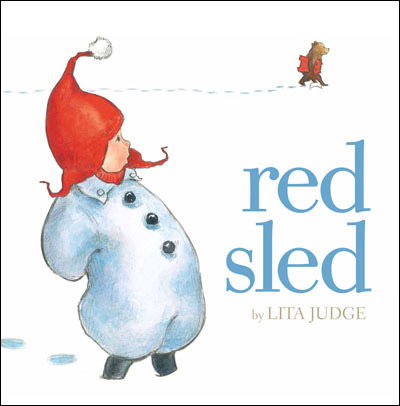
In celebration of picture books, I would like to recommend one. I’m cheating, though. This one is not nonfiction, but still, “pure genius” according to its Kirkus starred review.

Furthermore it was written by Lita Judge, an author whose books are mostly nonfiction including the lauded One Thousand Tracings and Born to be Giants.

Red Sled by Lita Judge is a whimsical dream of fun and magic. And that is a fact!

Monday, October 10, 2011

To Market, To Market

Twelve reactions to my latest nonfiction work:
• “[This] made me quite teary. [I]t’s a beautiful [story], and very nicely told”
• “A great conversation piece, and I think boys would particularly like it”
• “I have to say, I think the story is fantastic”
• “Not only is [the] story an interesting, little-known slice of history, but the writing is quite lovely as well”
• “We all had very positive reactions to it overall. What we all really loved, and what I am sure appeals to you, is that it is a war story but it’s one about reconciliation. That’s really both a lovely and unusual notion”
• “I have read the story several times, and it is an unusual one with lots of good themes and excitement”
• “[A] lovely paean to peace coming out of war”
• “I was very moved”
• “Compelling and well told”
• “I was fascinated by this story of forgiveness and redemption. It’s so touching!”
• “Haunting”
• “There’s no question this has some compelling marketing hooks—and it’s a pretty unbelievable story in the first place”

I would be proud to say that these twelve comments were reactions to MY latest nonfiction work. But this is actually the way that Marc Tyler Nobleman started off a very thought-provoking post at his own blog.

A little later in the piece, he revealed that each reaction came from a children’s book editor—who was rejecting his manuscript. It wasn’t that they were afraid to take a chance on a newcomer; Nobleman has written many, many books including the highly lauded Boys of Steel: The Creators of Superman. So, why? Doubtless many reasons, but he was often told that nonfiction—especially nonfiction about someone who is not a household name—doesn’t sell.

Okay, it’s no news that the economy is in trouble and if that weren’t affecting publishing, the changes in technology still would be. No news at all. But Nobleman's post isn’t whining about it. Instead he created his own news—and hopefully a bit of buzz to pitch and call attention to the story he loves and wants to tell in print.

He turned to illustrators—some kids, some old pros with hundreds of books among them. He asked them to create covers for his book. There are twelve on his blog (interestingly, the same number as listed rejections). You can go to the link below to see them all. Since I’m just picking one to share here, I'm loyally going for the cover by Tim Bush, who illustrated my own All in Just One Cookie.

I'll let Marc tell the rest of his own story at the link below. But at the end, he closes with two questions:

Librarians: Is this a book you can see adding to your collection?

Editors: Is this a book you can see?

For me, Marc’s post, http://noblemania.blogspot.com/2011/09/picture-book-for-sale.html, also raises many more:

What about the stories that need to be told precisely because they are about people, who aren't household names but perhaps should be because they came out of mist to be heroes or do the decent thing? People like, say, you or me or the kid that is reading the book?

What is the author’s changing role in these crazy transitional times? First it was just creator; now our roles are equal parts promoters and “publisizers.” The Internet also gives Marc and all of us a platform for another additional role. But what is that role and what will it entail?

And, what will happen when the iPad (RIP Steve Jobs) and its equivalents make illustrated books a realistic digital commodity; how will that shift the roles of publishers and authors even more? What are some of the best case scenarios?

Come on guys, do we have a shot at a discussion here?

Tuesday, February 15, 2011

Beautiful Back Matter

As children’s book writers we know that we are not writing only for children. We are also writing for the “gatekeepers”—the parents, teachers and librarians who help to put the right books in children’s hands. This is true less if we write for older kids. I think books for YA readers often, though not always, bypass the gatekeepers. But I would venture to say that with nonfiction we are almost always writing for more than one audience, as it is rare—not unheard of—but rare, that a teen will pick up a nonfiction book on his or her own.

In any case, this business of writing for multiple audiences is nowhere more important and challenging than in writing the back matter for nonfiction picture books. Especially, I think, picture book biographies. Because of the limited number of words, and the level, a picture book biography has to leave out all kinds of information not only about the person’s life but also about the world around that person. Often the writer has a lot she wanted to say and didn't.

So when we write back matter we seek to fill in some of the holes, to answer questions that kids might have. And also just to tell more because, as others have written about here on I.N.K., we research picture books about as much as any other book, and then do the hard work of paring down. It hurts to let go of so much good stuff!

Enter BACK MATTER.

I love back matter. Love reading it. I'm a nerd that way. (O.K., in other ways, too.)

Some picture book biographies are written at a second or third-grade level but then the back matter is written at a fourth or fifth grade level. This is because kids use them for reports—and although the main part of the book gives the story, the timeline or the author’s note gives them more—specific dates, or background information. Often, though, back matter is written for adults so that they have more information to share with their students and children.

Take, for example, Dave the Potter: Artist, Poet, Slave by Laban Carrick Hill, illustrated by Bryan Collier. Hill's text is simple, beautiful: a poem. It is a paean to this wonderful artist. Young readers know all they need to know from Hill's poem. But there are no dates or place names in the main text. It's not that we miss these facts in the text at all, in this case, but I can imagine a child, perhaps an older child, asking questions. Hill wonderfully uses the back matter to give us, the grown-ups, as much of a picture of Dave's life as he can. The back matter is so rich and complements the front of the book so beautifully that we come away feeling as though we have read a much longer book.

Back matter also shows how you did your research—which is almost always for the gatekeepers. It gives an idea of where the reader can go if he wants to learn more. Usually that’s called a Bibliography, or Selected Sources. (Selected because we use so many sources—both books, articles, and web sites, you might need a whole other book—or really, really small type—to list them all.) When you say For Further Reading instead of Selected Sources or Bibliography, that means these books are (or should be) appropriate for kids. Some picture book biographies have both—Selected Sources and For Further reading, or designate which books are good for which ages. I like back matter that has both.

We authors live (not a typo) to put in the back matter the stuff from the Cutting Room Floor. Often an editor (or even sometimes the author herself, or a critiquer) will pull things out for flow, level, or space. But fortunately you can put at least some of those juicy tidbits in the back. If you’re lucky, your illustrator will put some of the stuff you had to leave out into the art. Look at, for example. A River of Words by Jennifer Bryant, illustrated by Melissa Sweet. There is so much in the art! I don't know if these are things that Jen left out, or things that Melissa found out on her own, but the bits of poems and other details in the art greatly deepen the book. And Jen and Melissa also give great back matter: A timeline of William Carlos Williams’ life, an Author’s Note and an Illustrator’s Note (which I adore!) and a For Further Reading.

In M.T. Anderson’s Handel Who Knew What he Liked, a book I love, Tobin includes a discography of Handel’s music. Roxanne Orgill's biography of Ella Fitzgerald, Skit-Scat Raggedy Cat (illustrated by Sean Qualls) also includes a "Listening" section, which I love. I also like in Roxanne's back matter that she includes documentaries a DVD of a concert of Ella's as well as two web sites. (I love this book, too. I also love Ella.)

I love fun stories about the writing of the book, and notes about the author’s and illustrator's personal connection to the subject or person.

Some back matter seeks to extend the experience of reading the book, by having readers go back and look at math in the art, such as in Blockhead by Joseph D'Agnese, others have activities for kids to do on their own or with help.

I like back matter that shows the biographical subject in context of his or her world. I love how in Thank You, Sarah: The Woman Who Saved Thanksgiving Laurie Halse Anderson, tells us, in her very deep back matter, what else was going on in America in 1863. (She calls this section Vintage America, 1863.)

As you might have guessed, I'm looking at back matter for a reason. I have a picture book biography of a mathematician coming out in 2012 and while the artist is doing the sketches, I'm pulling together back matter. I'm looking at many books, including the ones I've mentioned here. (I have, on purpose, not included other I.N.K. authors only because I'm trying expand the coverage here. Trust me, I have a pile of I.N.K.er's books right next to me!)

Dear Gatekeepers: Would you please suggest other books that have back matter I shouldn't miss? And also please tell me: WHAT DO YOU WANT TO SEE IN BACK MATTER? Also what level would you like it to be: the same as the text in the book, slightly older, much older, or a mix? As always if you don't want to comment here, feel free to email me through my web site, or my name at gmail.

Now, I'm going back to The Cutting Room Floor.