Showing posts with label reading. Show all posts

Friday, January 31, 2014

BOOK BAIT: 10 Ways to Hook Kids On Nonfiction!

Authors, illustrators, and publishers put a great deal of effort into the quest to interest readers in their books. Ideally, every nonfiction book should have a terrific title, intriguing information, sensational sentences, and interesting images (and by all means alliteration...only kidding about that last one!?) 

Because of the great response to my last post about nonfiction activities, I was inspired to focus this time on how to entice students to read a variety of informational texts. Recommendations from their peers is one of the primary ways that kids decide to read a book, so with that in mind, ask students to:

1. Choose a nonfiction book to recommend, place it on your desk, then tour the room for new reading options.
 

2. Share one sentence that gives an idea of what the book is about.
 

3. Compile a class book of reviews then explore classmates’ suggestions.
 

4. Prepare and present book talks to the class in the form of posters, presentations, or videos.
 

5. After discovering a good book, create a display of more works by the same author.
 

6. Choose one page in a book and list the facts the words tell, then the information shown by the pictures.
 

7. Redraw an illustration or other image and add labels and other info.
 

8. Find a favorite cover and explain how it summarizes the book.
 

9. Design a new cover for a book to persuade more kids to read it.
 

10. Compare two or more books on a topic using a Venn diagram.

Click for my Pinterest board with nonfiction teaching ideas.

Enjoy!

Loreen
My web site

Friday, October 11, 2013

Pairing Fiction and Nonfiction: A Common Core Pleasure

It may seem strange to start a post for a nonfiction blog this way, but I confess that when I read for pleasure, I usually choose fiction. One of my very favorite things in the whole world is curling up with a good novel. So as I was exploring the Common Core website in hopes of finding an idea for this post, I latched onto the ninth "anchor reading standard." It calls for students to analyze how two or more texts address similar themes or topics. Asking students to compare and contrast different texts or genres (fiction and nonfiction, for example) is not a new idea, of course. But it gave me the perfect excuse to assign myself a work of historical fiction I’ve been meaning to read for a while, Chains by Laurie Halse Anderson.

If only all assignments were this gratifying! Chains is a gripping, fascinating story, and even if I had been totally unfamiliar with the subject matter I still could not have put it down. But my appreciation and understanding of the novel were deepened by my familiarity with some of the subjects Anderson explores: the day-to-day lives of enslaved African Americans in the 18th century, the destructive relationship between slave owner and slave, and the irony of waging a war based on the revolutionary ideals of “life, liberty, and the pursuit of happiness” at the same time people were being bought and sold. They are topics I address in my nonfiction book, Master George’s People.

Because historical records document that a great many of George Washington’s slaves ran away, I could confidently claim in Master George that Washington’s “people,” as he called them, “yearned to live their lives as free men and women.” Unfortunately, however, these people left no written accounts that we know of. Very few of them could read or write. So without evidence to back it up, I couldn't say how any of these men and women personally felt about being enslaved. Novelists, thankfully, are free to let their imaginations and their pens roam beyond the historical record. In Chains, Anderson's fictional heroine, Isabel, tells us just how it feels to suffer the indignities of slavery, to ache for freedom. And because Anderson makes us care about Isabel, we suffer and ache—and hope and rebel—with her.

Another wonderful historical novel I recommend pairing with Master George’s People is Jefferson’s Sons: A Founding Father’s Secret Children by Kimberly Brubaker Bradley. This moving, impeccably researched book explores what live was like for the enslaved people owned—and fathered—by the author of the Declaration of Independence. Like Chains—and, I hope, Master George—it raises fundamental questions about equality and freedom and the contradictions inherent in our nation's founding.

In a recent column in the Huffington Post, Vicki Cobb said that the Common Core standards are not in our books, but in the way our books are used. Pairing narrative nonfiction with top-notch historical fiction is an excellent way to use both. For more suggestions on matching fiction with nonfiction in middle grade classrooms, check out this Nerdy Book Club blog post by Susan Dee. What are your favorite fiction/nonfiction pairings? I hope you'll leave a comment and let me know. I’d love to include them in a future post.

Tuesday, July 2, 2013

HOW TO WRITE NONFICTION BOOKS THAT CAN’T BE BEAT


By the time I wrote the following post 13 months ago, nonfiction authors and nonfiction readers were getting a lucky break.  Check it out and then go have yourselves an outstanding summer that might even include some great reading and writing....
_________________________________________________

 Who woulda thunk it?  Nonfiction is on a roll!  And it’s largely because of a big game-changer called the Common Core State Standards. What in the world is that?  Well, it’s an educational initiative that has already been adopted by every public school in 45 of these United States and in 3 territories to boot.  In my humble but admittedly prejudiced opinion, the best part is this:  The Common Core requires that by senior year in high school, 70% of the books students read throughout their entire curriculum have to be nonfiction.  Hoo-hah!!  Ladies and gentlemen, it is about time.

And there’s more.  Instead of writing dreary papers that imitate the facts kids have to learn for testing purposes, they are now being encouraged to write some truly interesting and thoughtful nonfiction literature of their own.  Here’s just one small example.  To tempt the Youth of America to dip their toes into nonfiction waters, the New York Times is holding its Third Annual Summer Reading Contest, in which young people aged 13 to 25 are invited to submit blog posts for possible inclusion on the Times’ educational site.  Check out last year’s winning post by Elisabeth Rosenthal and tell me this isn’t a great idea.  Here ‘tis: “Answer for Invasive Species: Put It on a Plate and Eat It”

But what if students like Elisabeth get psyched by reading some truly outstanding nonfiction (insert brazen hint about INK books here).  And what if they get enough of a kick out of writing brief nonfiction pieces that they want to write an entire book of amazing-but-true tales?  Or come to think of it, what if you want to write a nonfiction book your own self? 

I recently helped a couple of fourth grade classes at Bogert Elementary School in Upper Saddle River, New Jersey, to do just that.  The challenge was to take certain bland basic material from the school’s curriculum and let the kids work together to write and illustrate an exciting (and accurate) page turner that they would actually love to read themselves.  The kids came through like champs and had a blast. And in the process, they soaked up the material in their curriculum like a sponge.

Of course there’s more than one way to skin a cat.  But maybe I can entice somebody out there to walk down the author path by offering a few small tricks of my own for writing nonfiction books that (I hope) can’t be beat. 

1) PAIR YOUR TOPIC WITH A GREAT HOOK 

Whether you pick a topic that you’d love to know more about, or whether a teacher has assigned your kids to write about dry subjects from the school curriculum, any budding authors out there should try hard to write stories that fascinate.  How? One way is to find a great hook!  I write about history, and here are just a few of the hooks I’ve used ever since time immemorial for readers in different age groups:
  • Drawing colorful, complex picture mazes in which readers have to wend their way through the accurate but amazing scenery of America’s Wild West, say, or Europe’s Middle Ages in order to reach the next pages in the story.  
  •  Telling true tales from two completely opposite points of view.  
  •  Picking a genuine hero from the past and telling his story via his 13 great escapes from danger.  

2) BECOME A SPY

Everything in a nonfiction book has to be 100% true, and you can never ever put your own words into other peoples’ mouths either.  So to find the facts and to figure out what really happened and what people really said, you have to do tons of research.  That's when you get to become a spy!  Snoop around till you can quote from the original letters, diaries, speeches, and journals of your protagonists!  Bravely interview people who were on the scene during a terrifying event!  Or rustle your way through dusty ancient tomes written by responsible scholars until you uncover hidden clues. 
 
3) USE THE MEAT AND SALT METHOD

“Meat” equals the facts.  Make sure you have them down pat. “Salt” equals a tasty sprinkling of all the humor, interesting tidbits, unusual facts, and clever or creative ideas you can lay your hands on in order to bring your book to life.  I love the salt part.

4) WRITE A PAGE TURNER

Every single sentence you write has to be carefully crafted so that your readers can’t wait to see what happens next. Read what you wrote out loud to find out. Does it sound compelling enough? You may be surprised.

5) ADD PICTURES PLEASE

Everyone loves pictures, even grownups.  It doesn’t matter if you can't draw your own cartoons in a graphic novel.  Try adding a bunch of your best photos from your cell phone or create very some clever, colorful graphs with fancy lettering on a computer instead. Or if you have the chops, make Like Michelangelo. In other words, just add your best pictures to the mix and more people will be likely to read your book. 

And speaking of reading, read and READ and READ the best nonfiction books you can lay hands on.  Then pick your faves and try to figure out what it was about the authors’ writing styles that clicked inside of your brain.  That’s it.

6 comments:

Melissa Stewart said...
These are great tips, Roz. I especially like your term "salt and meat method." I might steal, er, I mean borrow it.
Linda Zajac said...
Wow, I didn't realize the numbers were as high as 70% NF reading overall. That's supreme! Thanks for spelling it out and making my day.
creatingcuriouskids said...
What a wonderful post. I like the "salt" part too. There are so many ways to tell a story, and when I hit on the right one, it's a major rush.
Jim Murphy said...
Great post, Roz. I learned a lot and was inspired. But where are the recipes for these invasive species?
Unknown said...
It's wonderful getting inside a creative mind--even just scratching the surface. Thanks for the tips.
Ellen Butts

Rosalyn Schanzer said...
Thanks, everybody! And Jim, I dunno about the invasive lionfish in that award-winning blog, but there's a huge ugly invasive fish species from China called the snakehead that's taking over the waters near DC, so they recently had a contest to see who could catch the biggest one. This sharp-toothed fish is a delicacy in China, so chefs around these parts are coming up with all kinds of creative ways to cook it; you can even Google the recipes!

Thursday, May 10, 2012

Ancient Themes


Recently, I had the pleasure of hearing Sebastian Junger speak as part of the Portland Arts and Lectures series.  Junger is the author of several nonfiction titles, including The Perfect Storm. 

On this particular evening, he spoke about war.  Between 2007-2008, Junger and photographer Tim Hetherington embedded with an American infantry platoon in the Korangal Valley in Afghanistan, during a period of intense fighting.  (In addition to his book War, Junger and Hetherington made the documentary “Restrepo” about the soldiers’ experiences during that time.) 

During his lecture, he posed the question, Why do we read books and watch movies about war?  After all (and here I am paraphrasing—Mr. Junger is far more eloquent), war is awful—full of pain and suffering, senseless death and destruction.  So why would we sit in a comfortable chair and ‘go there,’ willingly?

We go, Junger says, because war taps into our most basic emotions, the most ancient themes of human existence—themes such as loyalty, courage, love, betrayal, fear, cowardice, and heroism.  We go because we are hungry to connect with those emotions—hungry to better understand those themes—through story.  And so, we will spend $12 to sit through a movie, or spend many, many hours reading a book, about war.

Theme is something I think about a lot when looking at a piece of writing (be it mine or someone else’s.)  Theme is the ‘so what?’ of a story, the ‘why should I care?’  Theme is the bigger, more universal truth that the story dramatizes.  Theme is what resonates long after you have shut a book and put it back on your shelf.  We speak of themes a lot when discussing novels.  I believe, however, that themes are an integral part of nonfiction writing, as well.

The best nonfiction deepens our understanding of the world.  And when we are lucky, our understanding of ourselves in the process.

Wednesday, April 18, 2012

Too Much Information?

When my first picture book was published in 1985, getting feedback from a reader usually happened via a fan letter or while I was visiting a school. In our wonderful new digital world, authors can interact with their readers by means of email, blog posts, comments, tweets, videos, review sites, and whatever the tech-genuises will think of next. The reviews so far for my new picture book Seeing Symmetry have been very positive except for one blogger who commented that the book has “too much information.” The image below shows the opening spread, which has fewer images than some of the other pages, but gives the general idea:
A 2-page spread from Seeing Symmetry ©2012
There are many possible reasons for the statement…the blogger was probably looking for a much simpler book for very young children. But hey, what about all the older children, what are they going to read? One very good reason for creating the book at a higher level (that I wasn’t aware of at the time) is that the Common Core State Standard for line symmetry is in 4th grade. Do you want to know what it is? Thought you’d never ask:
4.G.3 Recognize a line of symmetry for a two-dimensional figure as a line across the figure such that the figure can be folded along the line into matching parts. Identify line-symmetric figures and draw lines of symmetry.

The question of how much to include is always an issue for authors. We do the research, compile a zillion things, and reluctantly pare it all down as much as possible. I did “cheat” a little bit by having a couple of pages of notes in the back. And perhaps a Simple Symmetry book is in my future…wouldn’t want to leave out the little guys!

Getting back to the original complaint, that there is “too much” information in this book, I can see how it might be difficult to get through many nonfiction books that are loaded with factoids. Here is a blog post on the Children’s Books and Reading blog that has a good approach using sentence starter cards to help kids process the information better… Non-Fiction Books: Putting Words Into Their Mouths. In short, the adult makes cards with phrases such as “I can see…” and “I can hear…” The adult and child take turns pretending to be a person in the book, the idea being to put yourself into the page and take the time to observe what is going on. There is no need to finish the entire book in one sitting, perhaps one page at a time is just right.

If anyone would like further immersion in the wonderful world of symmetry, I have been having a fabulous time compiling all kinds of symmetrical images on Pinterest. Amazingly, over 800 hundred people are following my symmetry board:
From a rotational name activity to “squish paintings” to Mexican paper banners to student self-portraits, there are all kinds of great ideas to engage kids in the topic. To check it out, please click here.

Too much information…? That's impossible!

Loreen

Monday, November 14, 2011

Picture Book Month

There’s a new holiday in town. November is now Picture Book Month. Several picture book authors got together to create this event—and, good for them. As they said on their web site, Picture Book Month: A Celebration!, “We are doing this because in this digital age where people are predicting the coming death of print books, picture books (the print kind) need love. And the world needs picture books. There’s nothing like the physical page turn of a beautifully crafted picture book.”

I have written on this subject myself, a rebuttal to the attitude reported in The New York Times, of parents wanting children to leap past picture books to read chapter books in the quest to get them on the road to...what?

Each day on this site, another picture book author writes an entry titled, “Why Picture Books are Important.” Here are some excerpts from the entries so far:

I believe our first stories become part of our DNA forever. -Samantha Berger

Picture books are important because they are with us for life…No matter how many books we’ve read since, they will always have a place in our hearts…and a relationship that, whether we realize it or not, has shaped our lives. -Dan Yaccarino

When my now 11 year old girl, Eliana, was a preschooler, we bought the book, In My World, by Lois Ehlert. The illustrations are simple. The text is sparse. And yet, there is a magic about this book that completely captured her. It could have been the exquisite die cuts or the bright colors… It could have been. But it wasn't. It was the wondrous way the words and the pictures were married. One could not work without the other. Every night, Eliana read that book to me, putting her little hand, which fit perfectly, inside the die cut hand of the book. And every night I would tear up knowing that I was experiencing a magical moment in my daughter's life… -Diane de las Casas

Picture books have a special kind of magic in the hands of children. They open windows of opportunity — glimpses of new worlds — in the safest of places: in the library, in the classroom, or in their very own rooms. Kids can sound out one word at a time, breeze through full sentences or skip the words altogether to build stories of their own based on warm, vivid illustrations. Anything is possible… -Kelly Milner Halls

I have a sixteen-year-old niece, Sarah. A year ago my sister-in-law, her mom, died suddenly. A friend of the family gave my brother a picture book called Tear Soup to help with Sarah’s mourning.
One night, he walked into her room with the book under his arm. She took one look at him, rolled her eyes, and said, “Yeah, right. You’re going to read THAT to ME?”
“Yes,” he said. “Move over.”
She argued – what teen girl wouldn’t? – but grudgingly made room. They cuddled up and read the book. A couple of days later, Sarah asked, “Dad, whatever happened to all my picture books from when I was little?” My brother pulled a box out of storage and the next night came in with Caps for Sale.
A new tradition was born. For months, every night, he’d read a picture book to her from her childhood.
Picture books heal. No matter your age. -Katie Davis

I have looked up some of the other created holidays for November—International Drum Month, Peanut Butter Lovers Month, Aviation History Month. In my book, this one beats them hands down.

Spread the word.


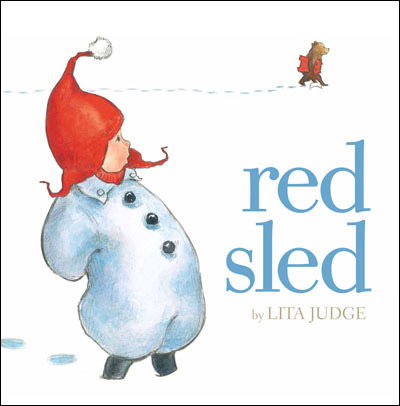
In celebration of picture books, I would like to recommend one. I’m cheating, though. This one is not nonfiction, but still, “pure genius” according to its Kirkus starred review.

Furthermore it was written by Lita Judge, an author whose books are mostly nonfiction including the lauded One Thousand Tracings and Born to be Giants.

Red Sled by Lita Judge is a whimsical dream of fun and magic. And that is a fact!

Tuesday, October 25, 2011

Prestige


A few weeks ago I was talking to a group of Korean parents about the education system in America. The topic started to stray, as things tend to do, towards books and reading. I asked how many parents read to their children. No hands were raised.

I began pushing them harder on the importance of reading to the youngest children as often as possible. No one seemed very interested in my point of view. One father started explaining how he used WII games to relate to his children and encouraged them to explore their curiosity. He mentioned how he played guitar hero with his two children and now one of them was taking guitar lessons. Nice, but not really my point.

Fast forward a few weeks later. Someone brought in a Korean newspaper that listed the top 200 colleges in the world according to said paper. They were very intrigued that my daughter is currently attending their so-called number eight. “I would like advice on how my children can attend such a prestigious university,” the guitar hero-loving Dad said to me. “How can I prepare them for admission to this university?” he asked.

Hmm. We’ve already been over this, I thought to myself, smiling ever so politely. Didn’t I mention the importance of reading to your kids? What kinds of reading passages will you find on the all required standardized test including the SATs? Mostly nonfiction. What is the most important piece of writing a student will do before college? A 500 word non fiction piece about themselves commonly called the college essay.

Korean students have even more pressure to perform well because the entrance exam is the sole determining factor for college acceptance. There are too many students for too few spots and the competition can cause parents to push their children to start preparing for the exam in after school classes as early as elementary school. With a secure career totally dependent upon the kind of college a student attends, prestige takes a surprisingly prominent role in early childhood development.

There are plenty of practical reasons for children to read, especially nonfiction, if prestige is your ultimate goal. But phooey on prestige. What kind of goal is that for your children’s ultimate well being? Reading a vast assortment of books to your kids encourages in them a love of reading, gathering and synthesizing information, and exploring fantasy worlds and far away planets. They will then read about things that intrigue them and things they knew nothing about. In other words, reading early and often will encourage their own intellectual curiosity. They don’t have rankings for that, but if they did, that would be a list worth aiming for.

Update: Last week I connived a way to fit a favorite children's book into my lesson plan. One student asked if she could borrow it for a few days. Today she returned it, smiling, and said her son had really enjoyed it. Slow but sure, one convert at a time. I'll take it!

Tuesday, May 17, 2011

A Writer's Stack O'books

My younger son is graduating from college today so while you read this I will be trying womanfully not to cry too hard in public. I will probably not be succeeding, so wish for me, please, that he does not witness my blubbering. It's all I can ask for.

That said, I do have a life beyond hankies and graduations and B and his brother, I swear I do...and in that life I am a writer and …

********** ********** **********

Lately people have been asking me to recommend good books to read about writing narrative nonfiction. I have a few personal favorite books about writing that I read years ago and dip into now and again. I couldn’t find all of them (I tend to lend them out), but here a few of my favorites among the many I have looked at (or at least bought) over the years:
If You want to Write by Brenda Uleand
One Writer's Beginnings by Eudora Welty
What If? by Anne Bernays and Pamela Painter
Writing on Both Sides of the Brain by Henriette Anne Klauser
Bird by Bird by Anne Lamott
Becoming a Writer by Dorthea Brande

I would say that out of all of these books the one that I go back to most often is Writing On Both Sides of the Brain because Klauser taught me something I need to be reminded of often. She says we have a critic inside our brains (no, really?) and that critic should be given her due, but not while you are in the creative process of writing a first draft. During that time you kick out the critic (send her to a relative's house) and tell her you will let her back in later. Then you write happily and uninterruptedly without a nagging voice telling you what's wrong with what you're doing. Later you invite that critic back (notice that this is by invitation). The critic is very helpful during your editing phase, but should be sent away again when you need to tap into the creative, UNcritical voice again. It does work that way for me: creative brain needed (right side) then analytical brain (left side) called in to help. Knowing this process makes it easier for me to silence the critic when she gets in the way. This simple piece of wisdom has saved me, my sanity, and my books many, many times.

I also go back quite often to What If for Bernay's and Painter's great writing exercises. Although these writing exercises are meant for fiction writers primarily, they are useful for nonfiction writers as well, especially those of us who want to use the techniques of fiction in our nonfiction: scene, character, plot arc, detail, where to place and how to use (real) dialogue. I often feel I should write those two woman a thank you note. So here it is: Thank you, Anne and Pamela!

I am rereading One Writer's Beginnings right now because we just read The Optimist's Daughter for our book group. I love this memoir. When you read it you not only learn about what it is to be a writer, you also come away feeling privileged to know Welty. One moment from One Writer's Beginnings I think the I.N.K. audience will love: Her mother goes into the library and says to the librarian (whom everyone ELSE was afraid of): "Eudora is nine years old and has my permission to read any book she wants from the shelves, children or adult." There was one exception she gave: a book about a little girl who practiced piano so hard she fainted and fell off the stool. She was just afraid that little Eudora would read the book and then she'd fall of the piano stool, too. Apparently she was quite impressionable. (A future writer!)

Another book that made a huge difference to me years ago and that I look forward to rereading is by William Zinsser, called On Writing Well. It's a must-have for nonfiction writers. But I'm letting my husband to take credit for that one.

I asked said husband, the Professor of Science Writing and master of narrative nonfiction writing, to weigh in for this post. He literally weighed in, bringing home from his school office a bag o'books--most of his favorites about writing narrative nonfiction:


On Writing Well by William Zinsser
The Art of Fact edited by Kevin Kerrane an Ben Yagoda
Telling True Stories edited by Mark Kramer and Wendy Call
Writing for Story by Jon Franklin
Literary Journalism edited by Norman Sims and Mark Kramer
The Triumph of Narrative by Robert Fulford
Writing About Your Life by William Zinsser
Writing to Learn by William Zinsser.

As I said, I loved On Writing Well by Zinsser, and have read parts of his other two books here. You will notice, by the way, a preponderance of books by Zinsser in Jon's pile. He is a master at the art and also an incredible teacher and nice guy. I once talked to him for five minutes and came away inspired for weeks.

I dipped into Telling True Stories a few months ago, and let me tell you this book is a gold mine! There are essays in there by Melissa Fay Greene and Katherine Boo and Nora Ephron and of course Tom Wolfe. There is advice about how to structure a piece, how to research and report, and even whether or not to tape your interviews. The rest of these are books I'm going to be dipping into this summer as I work hard on my current nonfiction project (when I'm not talking about nonfiction at ALA--come say hello if you're there!). I have been told by the professor that these books can live in my office for the summer.

So yes, that's my stack o'summer writing books.

I also have a stack and a wish-list of both nonfiction and fiction books for the summer. If you want to write great nonfiction for kids you should read nonfiction for adults as well as for kids. This should go without saying, but there, I said it. On my adult to-read list is the new Stacy Schiff book about Cleopatra, Jame's Gleick's Information, fiction titles that include Room and A Visit From the Good Squad, and of course, the shelves of books I'm reading for research for my project. I promise I will sneak in a beach read should I make it to a beach, or the equivalent.

In closing I would like to pass on a piece of advice from the Other Part of My Life. As a senior at Columbia my son was asked to answer some questions and give advice as part of the "Senior Wisdom" feature on bwog. Here's one of my favorite things he said:

"When someone asks you how it’s going, don’t tell them how much work you have, or how little you’ve slept. Tell them what you’ve eaten recently. They’ll be overjoyed."

Fresh strawberries and oranges with Wallaby vanilla and plain yogurt, topped with granola.

You?


Thursday, April 14, 2011

Reading (Again)

I got the nicest email the other day from a group of kids in Illinois who’d been reading my books in school. They sent questions. (And pictures! That was a treat for me to see all those smiling faces!) These kids are serious about wanting to write; they’re analyzing books they like and writing authors for advice.

One of the questions they asked was what writing exercises I’d recommend for young writers like them, and what kind of exercises I enjoyed doing.

I wrote back:

“I think one of the best things you can do as a writer is to REread other people’s books. When you read a book you like, read it again and look at how the author accomplished whatever it is s/he did so well. Satisfying ending? Well, how did s/he set that up? Exciting story? Well, what details or plot twists did s/he include? Characters you really care about? Well, how did s/he do that, specifically?”

I learned this tip years ago when I heard the wonderful author Nancy Farmer speak at a conference. She said when she was teaching herself how to write, she would read the same book three times. The first time she read it, she was so caught up in the story that she really couldn’t see how the author made it work so well. But by the third reading, she was able to step back, analyze what was going on, and learn from it.

I’ve been thinking about this advice every time I sink into the book I’m currently reading (or perhaps I should say, REreading). It’s a nonfiction book for adults called Game Change: Obama and the Clintons, McCain and Palin, and the Race of a Lifetime by John Heilemann and Mark Halperin.

The book is a fascinating look at the 2008 presidential race, and there is a lot a writer of narrative nonfiction can learn by rereading passages. (Be forewarned, however, if this kind of thing bothers you, or if you recommend books to teens: in spite of the measured, polite, authoritative stance the candidates strive to maintain during public events, in private, key players from both parties swear enough to make a sailor blush.)

Narrative nonfiction is all about telling a story, developing characters, and, for longer works especially, creating scenes, much as a novelist might—with the added caveat that everything laid down on the page must be true.

All narrative nonfiction books are a balancing act: you have to work in enough exposition for the story to make sense, but you have to keep the story moving forward. Game Change is a great big sweeping tale with enough characters to populate a 19th century Russian novel. So one of the challenges Heilemann and Halperin face is how to quickly introduce (yet another) character in a way that is engaging and memorable, so that they can get back to telling the story.

Here, for example, is our introduction to Republican candidate Mitt Romney:

“Romney was the guy on whom much of the smart Beltway money had been betting from the start. His résumé was impressive: former CEO of Bain and Company and founder of Bain Capital; savior of the blighted 2002 Salt Lake City Olympics; one-term governor of Massachusetts. His pedigree was glittering: his father, George, had been a governor of Michigan and a presidential candidate, too. His personal life was impeccable: he had married his high school sweetheart, Ann, with whom he had had five strapping sons. He was well spoken and terrific looking, with blindingly white choppers, a chiseled jaw, and a helmet of glassy dark hair.”

There is much to admire in this paragraph. Note the tremendous amount of information we learn about Romney in just a few short sentences: his viability in comparison to the other candidates; his relevant work experience, background, and personal life; and, as is all too important in an election, his physical presence.

And yet, in spite of the sheer weight of all that information, we are engaged and entertained. First there is the terrific rhythm that structures the paragraph, pulling us through what is in reality just a long list of facts:

“His résumé was impressive…. His pedigree was glittering…. His personal life was impeccable….”

And Heilemann and Halperin don’t just shove these facts down our throats; they make the facts tasty. One of the main themes of the book is how important a candidate’s image is during an election, and this description of Romney is pitch-perfect for capturing the sense of a candidate whose image is of an all-American hero who can do it all. Just look at all the smart vocabulary choices being made:

Romney, the “savior” of the Olympics, with his “glittering” pedigree. His sons are not just ate-their-vegetables healthy, they are Paul Bunyan “strapping” (and, by extension, so is their dad). Romney is not just good-looking, he is movie star handsome, with his perfect “choppers” and “chiseled” jaw. And that “helmet” of hair? It could crown the head of a star quarterback.

In one skillful paragraph, they have captured the sense of one of the characters in their story—and now, they can get back to telling it.

The story itself is largely told in scenes.

In his book Scene & Structure, Jack M. Bickham defines a scene as “a segment of story action, written moment-by-moment, without summary, presented onstage in the story ‘now.’”

A vivid scene pulls the reader into a story—we feel as though we are right there, in that spot and at that moment, standing in the character’s shoes. (And, as you’ll see in a moment, they are very nice shoes, indeed.)

Take, for example, the opening of a frantic scene to get Sarah Palin—John McCain’s last-minute pick for a running mate—ready for the national stage:

“Cloistered in a suite on the twenty-third floor of the Hilton, Sarah Palin barely noticed the storm raging outside. Not that the atmosphere of anarchy didn’t penetrate her quarters. Quite the contrary. The place was a freaking madhouse, a Grand Central rush hour of aides, kids, and minions….

“Boxes of Manolo Blahniks were piled up four feet high and stretching twenty feet along one wall of the living room. Neiman Marcus bags were everywhere, along with several rolling garment racks loaded with suits and dresses—maybe sixty outfits, beautiful threads…. A fleet of Hollywoodish stylists in tight black jeans and high heels were hovering and strutting.”

Heilemann and Halperin set up a scene of chaos far worse than the storm “raging outside.” Inside is “anarchy,” a “freaking madhouse” with a crush of people swarming like harried commuters at rush hour.

Having set the scene, the authors use specific details to bring it to life: the wall of shoe boxes, the piles of shopping bags, the racks of expensive clothes, the “fleet” of stylists milling around. In the midst of this chaos, Sarah Palin prepares for her convention speech, and we are right there with her.

Skillfully developed characters? Check. Well-crafted scenes? Check? A book worth REreading? Indeed.
Thursday, January 13, 2011

Finding New Books -- In Your PJs and Slippers

My mom (retired librarian and all-around great person) just told me about this cool thing (thanks, Ma!) and since the coolest people I know read this blog, I thought I’d pass it along.

It’s called wowbrary. It’s a service libraries can use to let patrons know about the newest books, movies, and music coming into their library system via weekly email updates. (Patrons can also sign up for RSS feeds or check Facebook posts.)

It’s kinda like if you went down to your public library and browsed the new arrivals shelf—only with wowbrary you can see the new books that someone else currently has checked out (and thus wouldn’t be on that shelf if you were standing in front of it) and you can browse in your pjs and slippers.

I looked at the sample email newsletter for my mom’s library system in Fairfax County, Virginia. The new titles were listed by category: adult nonfiction (broken down into subcategories like biography, history, and business); recreation (cooking, sports, travel, and more); personal growth (parenting, health, religion—it’s all there); fiction; large print; non-English; and even books for young people (children’s books, graphic novels, and teen. Fellow INK-ers Kathleen Krull and Jim Murphy will be pleased to know that the Fairfax County libraries are carrying your new books, Charles Darwin and How George Washington Saved the American Revolution.)

Next to each listing is a little button to see “more info” about the book, and another button to “borrow” the book—which takes you directly to your library’s website so you can place a hold. Is that easy, or what?

According to the website, wowbrary is “a project of Interactive Sciences, Inc., a California nonprofit 501(c)(3) public-benefit corporation that uses technology to help with social needs.”

To sign up for this free service, you just type in your email address (which according to the wowbrary website is never sold or shown to any other entity—no spam) and that’s it. They don’t know your library card number and don’t keep track of what you check out.

A cool service for cool cats like us.

Monday, December 13, 2010

Wishes for the New Year

‘Tis the season for both gifts and good wishes. Sometimes the two are one and the same. Still good wishes don’t always sound so pretty.

1. I, like so many people, am confused and outraged by the article in the New York Times about certain parents deciding to bypass picture books as quickly as possible to move on to chapter books. (Full disclosure—I write picture books.) This reported trend reminds me of a past fad using flashcards with quasi-verbal kids in an attempt to catapult them into SAT courses about the same time they finished toilet training. Hey, I’m a parent too; I worry all the time about my kids being well and happy and getting ahead. BUT COME ON!

My first wish? I wish that parents will realize that snuggling with their young child and a picture book, looking at it together accomplishes more than the chapter books I write as well. The child hears words she could never read at her age and enjoys a sophistication of story, relationships and ideas he could never read about by himself. The pictures act as an artistic dictionary, helping that young reader equate the look of a word and the word itself with its meaning via a drawing. Why be one of the seven blind men trying to define an elephant when you can just look at a picture of one? Furthermore we live in an increasingly visual age; why deprive a child of a model of using word and image together from the start?

And finally, we not only learn by doing, we learn by liking what we do. Kids love spending undistracted, interactive time with their parents (at that age, anyway) when the parent and a book are guides into new exciting worlds. They love reading picture books. And once they’ve practiced decoding letters and become used to bunches of them together with spaces between them, they love reading chapter books.

So I wish you guys would just calm down, then sit down and read a picture book to your kids.


2. Many writers here at I.N.K. have blogged about evolution and its detractors. They have been as impassioned and eloquent as I could ever be. So I’ll just start this wish/rant by saying, “ditto,” and move on to the general principal that we have never had better access to good, accurate information.

I wish we would value it more. Enough with “truthiness,” Mr. Colbert! And enough of cherrypicking facts or factoids that simply support our previously held views. I wish people would work harder to dig for this accurate information, find it, actually THINK about it, and use the results to create their opinions. Then let’s talk about how to reduce the deficit or raise our students’ math scores.

In other words, I wish we’d all start ascribing to a wise thought attributed to everyone from Bernard Baruch to Daniel Moynihan: Everyone is entitled to his own opinion, but not his own facts.


3. I mentioned in a previous blog that I am currently an author-in-residence in a Boston school located in the middle of a public housing community. There is nothing like extended time in a school to remind you that teachers are heroes. They’ve got a hard job that is everyday and most of them try their best to do it well. I wish society appreciated them more.

As an author, I also wish they would/could use better hand-crafted books (nonfiction and otherwise) in their classrooms. I now understand better than ever how hard it is for teachers to use initiative and personalize the lessons they teach. There are seemingly endless mandated tests beyond the required state exams. Grade level curricula have units that must be covered from, say, October 11th to November 7th and others that pick up on November 8th. Where is the time for spontaneity? For the magic that comes from an inspired lesson or experiment or book?

I wish that we can somehow figure out how to slip more want-to’s in with ought-to’s. I can see from my time at the Perkins School that sparks do get kindled in kids and we just have to have a sufficient variety of kindling around to reach the future poet and scientist alike.


4. Besides all this, I wish we all could have world peace and a Happy New Year.

Tuesday, October 19, 2010

Letting Content Dictate Form

I had the pleasure of attending and the privilege of speaking at the Rutger's One-on-One Plus Children's Literature Conference this past Saturday. It's a wonderful conference, and I always learn a lot. For example, there was a great panel on social media, given by Deborah Sloan, Alvina Ling, and Katie Davis. If you want to read tweets about the conference, follow #rcclbuzz.
(O.K., how cool and in the know do I sound?)

I was a mentor to a young woman who is working on a non-fiction picture book. She has a great idea, but is struggling with the form. (Or at least I think she is!) As I sat there giving her advice, I realized that the advice I was giving her was advice that I am giving myself as I dive deeper into a huge nonfiction project that has me at times excited beyond belief and at other times terrified beyond beyond. In fact, the advice I was giving her, as well as some tips I wanted to give in my speech (I ran out of time), are kernels of wisdom I have gleaned from others over the years. Although I have written this post to writers, I am hoping that teachers and librarians can use it with their students, not only to help them with their writing, but also to help them read and analyze books. Why did the author choose this format? Why is it a picture book? Middle grade? YA? Why did she structure the book in the way she did? For example, why did she start in the middle of the story and work backwards? What is the climax of the story? Did that happen in the middle of the story or is it just in the middle of the book? Why are there sidebars? Photos or illustrations? And of course, what sources did she use? How did she get her stuff?

Herewith, advice to writers who are feeling caught in the jungle of a new or confusing project, hoping that it will help writers and readers, too:

*Isaac Bashevis Singer asked himself a series of questions before he began to write any book. Although Singer was a preeminent fiction writer (if you haven't read him, please do), I think his questions are essential for narrative nonfiction as well. Here are his questions: Is this a story with a beginning, a middle, and an end? Do I have to write this story? Am I the only person to write it?

I think if you answer yes to the first two, you should write the book. If you can also answer yes to the third one, you should write the book and feel blessed the whole time you are doing it.

*When I was first starting the project I'm working on now, I panicked because I was worried that the way I wanted to structure the book wasn't going to work. I was not finding the information I needed to structure it that way. When my editor asked me how it was going and I told her, she said, "Don't let the form dictate the content, let the content dictate the form." Further, she encouraged me to read wide, and keep open about the structure and even the content. So that is just what I am doing, and I although I still don't know how the book is going to be structured, I am trying to stay loose and relaxed about it. (If you know me, stop laughing, please.)

*Recently I read a fantastic interview with John McPhee in the Paris Review and he added to that advice: "Structure is not a template. It's not a cookie cutter. It's something that arises organically from the material once you have it." If you want to read some more John McPhee brilliance, go here. And better yet, buy or borrow the hard copy because I'm not sure it's all on line. He talks, in this article, about what to do if you are reporting something and the best thing happens at the very beginning of your reporting. This could happen, and has happened to me, in researching history as well. You can't change the order of how things really happened, but you can structure your book or article in the way you want to so that the exciting thing happens where you want it to.

*When you find yourself trying to make stuff up in non-fiction, it means that your story isn't deep enough. You don't deepen it by adding a fictional voice, you deepen it by doing more research. I told my "mentee" that for a picture book of 1,000 words or so, she might have fifty pages of typed notes from her research. Strong young woman, she, she just kept nodding. There were no tears (thank goodness).

*I leave you with this; it's a window into my world right now and is just another way of looking at this process. For my new project I read a memoir by an early 20th century policeman. He wrote: "I've always gone to a sudden death prepared to regard it as a possible murder. But I don't go with the conviction that I've got to make it a murder, and there's a wide distinction. The years have shown me that no officer has the right to accept the first evidence as conclusive."

I have to go now, and see where this project is going to take me next. Let's hope it's not down a dark alley.


Tuesday, October 5, 2010

BACK TO THE SOURCE

OMG. I turned on my car radio the other day and wafting in through the ether was an NPR panel discussing the importance of reading first-rate literature in school classrooms. So that’s a good thing, right? But as usual, every single book the group mentioned was fiction. C’mon, radio people. And it gets worse; the panelists all agreed that nonfiction was totally boring! To add insult to injury, one guy said there was no such thing as Nonfiction that’s also Literature. Then he defined nonfiction as Original Source Material that kids hate because it all consists of formal documents and speeches written in an arcane style nobody can understand. (Think Gettysburg Address or the Bill of Rights, said he).

Gimme a break, sports fans. You and I could blog all day long about great literature that just so happens to be nonfiction. There’s a reason that the majority of books sold to American adults are nonfiction; the subject matter is fascinating and the quality of the writing can be absolutely superb. And guess what? The exact same standards hold true for the best children's nonfiction books these days too….and they’re related to the kids’ curriculum to boot. Besides, original source material (all those diaries, journals, private letters, songs, articles, speeches, sketches, and artifacts that were created by people who were on the scene at a given time and place) is fabulous stuff.

So let’s meld some very cool original source material with nonfiction stories kids might like to read. Here are a few surprising examples I’ve tied into the stories in my own books—you could never make this stuff up and every good nonfiction author has plenty more.

EXAMPLE 1) Quotes from people who went to the California Gold Rush:

MAN TRAVELING TO THE GOLDFIELDS BY SHIP: “The water is becoming bad. I don’t mind it much. I have a way of killing the bugs before drinking them.”

MAN TRAVELING BY LAND: “Hail exceeded anything I ever saw, being as large as pigeon’s eggs. Found our cookstove full of water. There may be fun in camping, but we haven’t discovered any.”
IN NEWSPAPER ARTICLE ABOUT THE GOLDFIELDS: “Chickens were persistent gatherers of small nuggets of gold, and their gizzards were regularly searched by the cooks who prepared them for the oven. At Diamond Springs one was killed for Sunday dinner whose gizzard panned out at $12.80.”

EXAMPLE 2) Comments from the journals of Lewis and Clark as they crossed the West:
“The mercury this morning stood at 40 degrees below 0. An Indian man came in who had stayed out all night without fire, and very thinly clothed. This man was not the least injured. Those people bear more cold than I thought possible.” “This evening Sacagawea was delivered of a fine boy. This was her first child and Mr. Jessaume informed me that a small portion of the rattle of a rattlesnake had never failed to hasten the birth of a child. Having such a rattle, I gave it to him. He administered two rings broken in small pieces and added to water. Whether this was the cause or not, she had not taken it ten minutes before the baby was born.”

EXAMPLE 3) Two quotes that help uncover both sides’ points of view during the American Revolution.

PATRICK HENRY, furious that England’s naval blockade of Boston Harbor enslaves Americans by denying their right to govern themselves, famously says:
“Our chains are forged! Their clanking may be heard on the plains of Boston…I know not what course others may take, but as for me, give me liberty, or give me death!”

SAMUEL JOHNSON, the greatest English writer of his day, retorts:
“How is it that we hear the loudest yelps for liberty from the drivers of Negroes?”

EXAMPLE 4) From young Charles Darwin’s diary the day he set out on his voyage round the world:

“With every sail filled by a light breeze we scudded away. Soon became seasick. Raisins the only food the stomach would bear.”


Folks, I got a million of ‘em. A great nonfiction book for kids can work magic with the very Original Source Material that the radio panel hated so much. Were they kidding about how boring it is? Original Source Material is the juiciest stuff out there and it can make the people who wrote it or said it spring vividly to life. Sometimes I write entire books that fill every page with this stuff and relate an exciting and cohesive story at the same time. Bah, humbug, panel people. Let's put great nonfiction Literature and great original source material in school classrooms today! So there.

Friday, September 10, 2010

Why Our Books Can Save Education

Teachers are living in fear these days. Their administrators are equally fearful. Here’s why: ASSESSMENT TESTS. And why are their knees shaking so hard? If students don’t measure up, a school’s reputation suffers, real estate values in their district suffer, taxes go down, there is less money for education, school budgets must be cut and people (teachers and administrators) can lose their jobs. So everyone frantically focuses on THE TESTS.

The top educators have been thinking hard about what kids need to know. Each district/state, even the nation has developed standards and content strands—the so-called scope and sequence of what kids need to know and when they need to know it. They make their scope and sequence—their lists— available to the public and to the people who create educational materials, including textbook publishers and others who produce product for the very lucrative (and highly competitive) school market. These publishers take the lists as written, use them as outlines and hand them to writers. “Cover this material” are their instructions. And their efforts are there for all to see in heavy tomes, in wikipedias, and in Google search results.

The expository prose created in this way is flat at best and positively boring and insulting to the reader at worst. How do I know? I was once asked to write a text book and was handed THE OUTLINE. Yes, I can write a decent declarative sentence. I’m not a bad speller and I know the rudiments of punctuation. But, much as I needed the money, I turned down the job. Why? I told them that I don’t write their way. I tried to ‘splain it to them (as Desi Arnaz would say): They could hire Shakespeare and give him THE OUTLINE to follow and they might get something they’d want to publish, but they wouldn’t get Shakespeare. They didn’t get it. I moved on.

Meanwhile the test creators are cooking up THE TESTS. One of their main focuses is on reading comprehension. A typical question involves giving kids three or four paragraphs to read and then asking them about what they’ve just read. But the test manufacturers aren’t hiring writers to create these paragraphs. They are searching high and wide for samples of excellent writing—literature—so that they can write questions like “What is the author’s point of view?” And just where are those test makers finding their writing samples? Are you ready for this surprising insight? FROM OUR BOOKS!!!! How do I know? I have a file full of permissions I’ve granted to test publishers over the years as do my I.N.K. colleagues.

So my questions to educators are: Why teach from inferior reading materials to prepare for tests that are based on literature? Why not teach from our books in the first place? How can kids develop the critical thinking skills to answer questions like “What is the author’s point of view?” when they are learning from materials where the author has no point of view? This is particularly true of reading in the content area—science, math and social studies. Don't you get that "covering" the material is not the same as teaching it?

There’s a leap of faith here that must be taken. I’ve read the standards. They are NOT LIMITING. There’s a lot of room for many voices, a myriad of approaches, and a variety of topics within curriculum guidelines. EVERY STUDENT DOESN’T HAVE TO LEARN EXACTLY THE SAME CONTENT. (Not that every student ever did). Education is not about an assembly line approach. Each child is hand-crafted. It’s about respect; respect for the learner and respect for the teacher. A formulaic, limited, strict interpretation that becomes simply teaching to the test doesn’t respect either. And that’s what sets literature apart. We authors have nothing but respect for our readers. We assume that the children we write for are intelligent human beings capable of comprehending the subject matter that gets us excited. The evidence is there in every sentence we write. And if you're worried about meeting the standards, use our free database, with each book aligned to the standards by the authors themselves who have a deep understanding of how their work fits into these broad definitions.

So my challenge to educators is to abandon the training wheels of prescribed texts. Do what the high-scoring schools have done for years. Liberate your teachers. Use our books to bring the joy of learning back into the classroom. Believe that learning happens when kids are engaged. Then, give them a few practice tests the week or so before the big bad assessment tests. You might be surprised at the results and wonder just what all the fuss was about.

Thursday, June 10, 2010

The Power of Books

One of my favorite treats every week is to settle in with The Week magazine. My mom got me a subscription a few years ago as a birthday present (Thanks, Mom!) and I’ve been renewing ever since.

The Week is a weekly summary of current events, with balanced reporting on how those events were covered in various print media outlets. (For any given topic, for example, you might get how it was covered by The Washington Post, the San Francisco Chronicle, The Atlanta Journal-Constitution, The Sacramento Bee and Slate.com.) The summaries are smart, often infused with a sense of humor, and leave me feeling like I’ve been exposed to both sides of an issue. (And how often does that happen, these days??)

The Week also provides the latest in everything from political cartoons to book reviews to theater openings. They even have a recipe each week. (I’ll admit, I’ve never actually cooked any of them, but they are fun to read.) The Health & Science page is always of particular interest to me, as it spans such a broad range of topics. In the latest issue, this page covered: the likelihood of a large earthquake in the Pacific Northwest, the sex-appeal of lowering your voice, plant-killing earthworms, the distracting effect of overhearing only one-half of a phone conversation, and the correlation between having a potbelly and getting Alzheimer’s.

And this study: the surprising effect of books in the home.

According to a 20-year study led by Mariah Evans, an associate professor of sociology and resource economics at University of Nevada, Reno, a home filled with books has a significant impact on how many years of education children will ultimately attain.

The exciting part of the study was the finding that even barely literate parents (defined as having 3 years of education) can increase the level of education their children will attain by having as few as 20 books in the home. “Even a little bit goes a long way,” Evans said. The finding offsets the commonly-held assumption that having highly-educated parents is the greatest predictor of what level of education children will attain. It turns out that parents who have a limited education can achieve similar results simply by filling their home with books.

Evans's study collected data from 27 countries, including the United States. On average, having a 500-book library in the home was just as influential as having university-educated parents—both factors increasing children’s educational levels by 3.2 years.

Few of us, to be sure, have the resources to buy and store 500 books. But anyone in America (and in many other countries) has something just as powerful: a library card.

Monday, April 26, 2010

To Be a Writer: Read, Read, Read. But...

Last week, I had the pleasure of working with Linda Sue Park and Ed Young at the American Embassy School of New Delhi, India. We were the featured authors at AES's annual Authors' Week. During one of our many dinners together, Linda Sue and I talked about the importance of reading children's books as a prerequisite to writing children's books. Linda Sue is a Newbury Award-winning novelist and picture book author. Although she is essentially a fiction writer, the crafts of writing fiction and non-fiction probably have more in common than they have differences, and the need for reading is surely a commonality.

Linda Sue has posted something about reading for writing on her website, www.lspark.com. I am traveling in India this week, checking email intermittently at internet cafes (and wondering why they call themselves cafes when they serve neither coffee nor tea nor anything else one can drink or eat). For this post -- if I can squeeze it out before the power goes off again -- I am going to quote this portion of Linda Sue's website, and then comment upon it briefly.

The Importance of Reading

Read. That's the single best thing an aspiring writer can do for his or her work. I once heard an editor say, "Read a thousand books of the genre you're interested in. THEN write yours."

I was astonished and pleased to hear her say this--because that's exactly what I did. During the years when I had no thought of writing for children (see About the Author), I read and read and read. Middle-grade novels. Hundreds of them--easily more than a thousand. Then I wrote mine--and it sold on its first submission. Luck? Coincidence? Maybe...but I doubt it.

My personal reading list draws from a wide variety of genres. I love middle-grade novels best, but I also read Young Adult novels and picture books. I read adult literary fiction, mysteries and nonfiction. I read poetry. I love books on food and travel. Whether a wondrous story or a hilarious passage of dialogue or a beautiful sentence or a memorable image, every bit of reading I do helps my own writing. The rhythm of language and the way words combine to communicate more than their dictionary meanings infuse the serious reader's mind and emerge transformed when that reader sits down to write.

That's really the best possible advice I could give any writer--read. But I find that folks are often disappointed with this advice, so I'll offer a few more basic tips.

Please do read Linda Sue's valuable tips (www.lspark.com/writing.html) but that's all I will quote here. I agree with absolutely everything she says on this subject and I would encourage any writer, whether previously published or not, to read extensively. But there is a "but." The "but" has to do with my own early experience as a writer. Question: How many children's books in the mathematical genre did I read before writing my first book, How Much Is a Million? Answer: none.

This is only in part because there weren't many back in the late 70's and early 80's when I was working on the disorganized morass of handwritten and typed pages that eventually coalesced into that book. Mainly it is because I didn't think of myself as a writer and I guess I didn't take my project seriously. I had no idea if what I was working on would ever become a book. I simply had an idea that went back to my childhood fascination with big numbers, and I wondered if I could turn it into something anyone would want to read. In writing it, I just went with my instincts.

Perhaps -- though I'm not really sure-- this had something to do with the content of the telephone call I eventually got telling my that my manuscript was going to be published. "It's so original," said Barbara Lalicki, senior editor at Lothrop, Lee & Shepard Books. "We've seen plenty of number book manuscripts, but we've never seen one like this."

Original. Would my manuscript have been considered so original if I had read a thousand books before reading it? Maybe. Maybe not. I don't know but I have a hunch that my naivite had something to do with the ultimate product.

Yet I completey agree with Linda Sue. And here's an irony. In preparing to write the 50 books since that one, I have always read as extensively as I could. But is any of these books as original as my first one? I have no idea. Please feel free to weigh in with your two rupees. I have to sign off because they're about to close the internet cafe. Namaste.