In the classroom:
Blog Posts and Lists
Friday, October 18, 2013
Common Core Connections: In the Classroom
In the classroom:
Thursday, April 4, 2013
Believe It or Not! (A Guest Post by David Elliott)
The jaguar’s back is flowering
as if she’s grown a garden there...
And who knew that a female sea turtle has to reach the ripe old age of thirty before she can lay her first clutch of eggs?
(She) swims the seven seas
for thirty years,
where she was born
then finds the beach...
Dear Orangutan,
Three cheers to you man of the forest
You arrived here long before us...
Orangutan is a Malay word. It means man-of-the-forest.
The more I wrote, the more I discovered that hard fact expanded the world of my imagination. This was never more true than when writing about the prehistoric creatures featured in the forthcoming In the Past.
I was excited about the opportunity to write the poems, partly because the idea had come during a school visit. I was standing in the cafeteria, haplessly blinking at the very, very yellow trays of macaroni and cheese, when a second grade boy came rushing up to me. “You have to do a book of poems about dinosaurs,” he panted, tugging on my sleeve. “You just have to!” My editor agreed. (Okay, maybe she didn’t think I had to, but she liked the idea.)
When I sat down to write about dinosaurs though, I found that the only thing I could think of was that most of ‘em were big. Not a very interesting book. But by the time I had finished with my research, I had become a kind of annoying know-it-all junior paleontologist on the subject of prehistoric fauna. I had a homemade chart of the geologic eras taped to the wall, along with a timeline of the animals I wanted to feature. Brachytrachelopan tripped off my tongue as if it had been my first word. And in every single poem there is a fact, though it may sometimes be hidden. Here’s an example:
Trilobites
So many of you.
So long ago.
So much above you.
Little below.
Now you lie hidden
deep in a clock,
uncountable ticks
silenced by rock.
A nice poem. I think (if you’ll allow me to say
so), but it becomes a better poem when you learn that trilobites are, in fact,
the ancestors of that modern day scourge – the tick.It has been a lucky surprise, too, to see the way the blending of fact and poem seem to fit so nicely with the language arts standards of the Common Core --“Research to Build Present Knowledge” for example, with “Craft and Structure” and/or “Integration of Knowledge and Ideas.”
On a more personal level, I feel just as lucky that the process of writing these books has opened me to the poetic possibilities contained in a single fact.
Believe it or not, one day I may even try to write some prose non-fiction. But one thing is certain: I’m not going to eat any stinkin’ truck.
Monday, May 9, 2011
Creativity--On the Couch
This past Saturday, I attended a seminar at the Boston Psychoanalytic Society and Institute called Three Poets on “Creative Writers and Day-Dreaming.” It was a blockbuster lineup: Poets Gail Mazur, Robert Pinsky and Louise Gluck (two of them Laureates) and Sigmund Freud, who was abundantly present in spirit, within the audience of 60-odd analysts and in his essay, “Creative Writers and Day-Dreaming.” Each poet read a poem and talked about how his or her writing related to points made by the Master in this essay about creativity.Evidently Freud was both fascinated and puzzled by artistic invention. The program notes said creativity was “a mystery he admired, and likely envied as well. Freud wrote that poets had always known what psychoanalysis had discovered, and that it just fell to him to systematize and theorize it.”
And theorize it he did in this essary that searched for its underpinnings. As best as I could tell, Freud believed that creativity's roots lay in childhood (Duh. Where else did he ever look?). Specifically in childhood play. The child constructs a fantasy world in which the elements of the real world are reordered to please him, in part by defusing or dealing with unsatisfactory realities. And since the child is the father of the man, the adult writer continues on the same path.
Here’s the problem, Sigmund. This hypothesis—right or wrong—addresses the poet, novelist and playwright. What about the writer of creative nonfiction? Our job is to deal with, often even embrace the realities of life, not avoid them. And to do it creatively. Take the facts and make something new of them—or why bother?
So do we get our own developmental theory?
Is the creative nonfiction writer born as the kid who is just burning to know? Maybe she watches the first snowfall and wonders what happens to the butterflies. She asks her father who changes the subject because he doesn’t know and induces trauma by answering NO questions. Then she gets sent to a shrink who asks the little girl TOO many questions instead of answering any. Then she asks a librarian who hands her a copy of Under the Snow by Melissa Stewart. Just like Goldilocks, everything is finally just right. Anxiety over. That feeling of relief and its cause is imprinted upon her psyche and determines her future.
Or maybe he started on the Freudian track, building a world filled with purple dragons. Then he discovered that once the world was home to animals called dinosaurs. Everything changed. Yes, yes, he’d say dismissively, I know dragons can fly. Pterosaurs can too—and hey, did you know that a T Rex had teeth the size of bananas? The idea that dinosaurs once walked the Earth, that his wildest fantasies could be REAL, is what fueled his creativity.
Maybe one of these children grows up and asks another question. This time she can search for the answer herself, talk to people who’ve spent their lives wondering about the same thing. She asks enough and they know enough so she can know enough too. And she finds the way the world works so beautiful that when she explains it, she makes music.
Or when he seeks the truth, he finds a sliver of a story that manages to tell the whole thing. His creativity is to hone in. His tale uncovers the core and it echoes and reaches so far that questions his readers don’t even know they have get answered.
Perhaps they even answer yours, Dr. Freud.
Thursday, May 5, 2011
Voice, Verse, Veracity
After years of trying to find a way to write my mother’s story of living as a Jewish girl in Nazi Germany in the 1930s, the universe gave me a gift: the discovery of Mom’s poesiealbum from 1938. A poesiealbum (po-eh-ZEE album) is like an autograph book or friendship book. Poesiealbums were popular among European pre-teens and teenagers in the mid-20th century.
This wasn’t one of these up-in-the-dusty-attic discoveries. No, my mother herself brought the poesiealbum out of her bedside table when she got together with six of her childhood friends from Germany for the first time in 62 years in 2000. (You can read about how that reunion came to be here.) I was there, too. Without even knowing what the poesiealbum entries meant—they’re mostly in German and Polish—I was moved by this beat-up little book full of handwritten poems and proverbs from my mother’s friends and relatives that she brought across the Atlantic Ocean when she left Germany at the end of 1938.
I had the album translated (some entries more than once), studied it, and laid out photocopies of the pages on the floor. What I found was that each entry contained a truth or sentiment that related directly to the goings-on around my mother, from January through November of 1938. And so, nearly every chapter in The Year of Goodbyes (Disney-Hyperion 2010) opens with a poesiealbum entry. Arranged chronologically, these poesies give shape to that one fateful year in Nazi Germany and in my mother’s life.
Now here comes, from the I.N.K. perspective, the interesting part: I wrote the book in my mother’s 11- and 12-year-old voice, narrating the last year of her life in Germany. In this, I was fortunate to have my mother—who has an outstanding memory—and I have her still, as a living resource behind the book. And I wrote the book in free verse. An introduction explains the book’s “voice” and structure. Back matter tells what happened to those who make an appearance in the poesiealbum, includes a timeline, photographs, and other historical information, and discusses my research.
What with the free verse and the first person and the poesiealbum excerpts, the book has been categorized in a variety of ways. It’s been called “historical fiction” by some, including the good people who gave it a Parent’s Choice Award. It’s been called a “verse novel” by some reviewers. It was nominated in the “poetry” category by the ALSC Notable Children’s Books Committee. But Kirkus included it on its list of best children’s “nonfiction” books of 2011, and many others also refer to it as nonfiction.
I, too, say it’s nonfiction. The book tells a true story, based on scrupulous and redundant research. (I believe in redundancy in airplane safety systems and in research.) This is not simply my mother’s memoir channeled through me. The events, interactions, people, places, and documents are not made up or dramatically enhanced. But I’m not distressed by the variety of labels attached to The Year of Goodbyes—so long as readers understand that the book depicts actual events, and is not an invention “based on,” “inspired by,” or “adapted from” them.
Recently, I’ve read thoughtful articles here on I.N.K. and elsewhere sparked by the Horn Book’s March/April 2011 issue, “Fact, Fiction, and In Between.” I’ve read about “new” and “old” nonfiction,” “speculative,” “straight,” and “creative” nonfiction. What resonates most for me in this debate is Tanya Lee Stone’s description in her Horn Book article of the work of nonfiction writers:
“We balance the role of historian and storyteller by making sure we don’t interject tension or emotion or events without thorough knowledge. We do it by employing fiction techniques without ever making a single thing up.”
By writing The Year of Goodbyes in the first person, I intended to make the reader feel as close as possible to the tension, emotions, and events experienced by my mother as a pre-teen. I wanted the reader to experience this real-life person as someone with a young person’s voice. I think this is consistent with nonfiction. I’m not sure I would have felt comfortable doing this if I had not worked in close collaboration with my mother. But I was lucky enough to have her at my side.
As for the technique I employed—writing in verse—this was a way of mirroring and honoring the poesiealbum entries. I also think that free verse excels at capturing something essential about the way we think and react, especially under stressful conditions. And I think that verse is perfectly compatible with telling a true story in which nothing is made up.
I didn’t write The Year of Goodbyes the way I did for the sake of novelty. I just tried to find the most immediate and accurate way to depict my mother’s last year under the Nazi regime, which in turn, I hoped, would illuminate the shared experience of others who have been persecuted.
Fellow nonfiction writer Cathy Reef recently shared with me this wonderful pithy quotation from V.S. Naipaul:
“Great subjects are illuminated best by small dramas.”
Some of those dramas will be nonfiction. Some will be fiction. And we writers will keep on parsing the two forms because of a shared commitment to bring our readers truth (as we understand it) as well as also art.
Friday, April 29, 2011
PINK~ Poetry Interesting Nonfiction for Kids
Last month on INK, Kelly Fineman introduced National Poetry Month with a fabulous poetry-related post comprised of poetry books to complement a classroom’s curriculum. As National Poetry Month ends, I’d like to add to Kelly’s list with my arty, creativity-focused spin on poetry books for kids.
This month, while perusing nonfiction books on inventing, I found and fell in love with a new book. My find is a collection about inventions told through poems - and the poems were selected by Lee Bennett Hopkins - and the illustrations are by my new favorite illustrator, Julia Sarcone-Roach.
Incredible Inventions
By Lee Bennett Hopkins (Selected Poems)
Julia Sarcone-Roach (Illustrator)
Greenwillow 2009
♥♥♥
Can be paired with:
Eureka! Poems about Inventors
By Joyce Sidman
21st Centrury 2002
♥♥♥
Incorporating poetry into art appreciation classes is one way to reach out to the right-brain and complement the lesson.
In one class, while children were drawing cats during part of a lesson about the wonderful Franz Marc, I read to the class a book on cats in art and poetry.
Curious Cats: In Art and Poetry
By TK (author)
Atheneum 1999
♥♥♥
Book paired with a lesson on Jacob Lawrence:
Words with Wings: A Treasury of African-American Poetry and Art
By Belinda Rochelle
Amistad 2000
♥♥♥
Actually have two copies of this book in my personal collection:
Heart to Heart New Poems Inspired by Twentieth-Century American Art
By Jan Greenherg (Editor) also INK contributor
Harry N. Abrams 2001
♥♥♥
Paint Me a Poem: Poems Inspired by Masterpieces of Art
By Justine Rowden (author)
Boyds Mills Press 2005
♥♥♥
Finally, I have to mention a new 2011 Golden Kite award-winner for Picture Book Illustration:
A Pocket Full of Posies
by Salley Mavor
Houghton Mifflin 2010
The illustrations are wildly creative and amazing. Please check this book out!
♥♥♥
Poetry, art and creativity just seem to go hand in hand.
I know I missed some of our INK readers' personal favorites. Please feel free to add suggestions to the comments.
And remember, THINK PINK!
Thursday, March 31, 2011
Whither Poetry? (an update)
One of the things I've noticed during school visits at both the elementary and middle school level is that kids really respond to poetry. The most interesting thing about that? The kids who are the school's "problem" kids often pay the closest attention. They are able to follow long poems such as "Casey at the Bat" by Ernest Lawrence Thayer, and can sort out what's going on in poems with obscure (or nonsense) words in them, such as "Jabberwocky" by Lewis Carroll.
There's no reason that poetry has to be relegated to a one-week unit, assuming that the teacher has time to get to it. And this is because there are poems and poetry collections that fit extremely well into existing school curricula.
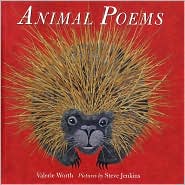
Studying animals and/or habitat? Try Valerie Worth's Animal Poems, illustrated by I.N.K. blogger Steve Jenkins, The Seldom Ever Shady Glades by Sue Van Wassenhove, If Not for the Cat by Jack Prelutsky, Vulture View by April Pulley Sayre (again illustrated by Steve Jenkins), Feathers by Eileen Spinelli, The Company of Crows by Marilyn Singer, The Cuckoo's Haiku: and Other Birding Poems by Michael J. Rosen, or Mites to Mastodons by Maxine Kumin (or one of many more books on the topic).
Studying natural science? By all means, pick up one of these books by Joyce Sidman: Ubiquitous, Dark Emperor: And Other Poems of the Night, Song of the Water Boatman, Butterfly Eyes: And Other Secrets of the Meadow. Or try something like Shape Me a Rhyme by Jane Yolen or Chatter, Sing, Roar, Buzz: Poems About the Rain Forest by Laura Purdie Salas.
Is it history you're after? Try The Brothers' War: Civil War Voices in Verse or VHERSES: A Celebration of Outstanding Women by J. Patrick Lewis or America at War, edited by Lee Bennet Hopkins
The point is that for nearly any area of study, a poetry collection can be found that relates to it. And it should be found, because kids who have a hard time sitting still for prose lectures pay attention really well to poems. I suspect it's because of the use of lots of imagery and active verbs, the rhythm and, when used, rhyme, that grabs and holds the attention of kids who don't or can't always listen to prose.
Wednesday, September 15, 2010
Time for prehistory
When my longtime editor, Margery Cuyler at Marshall Cavendish Children, suggested doing a book of dinosaur jokes, that seemed like a fun project. It’s hard to pinpoint exactly what happened, but let’s just say things escalated a bit. After browsing through a few books, it became clear that I had missed out on a lot of wonderful fossil discoveries and insights made in recent years. (For a post about some of the resources used, click here.)
An aspect that jumped out at me was the number of books available and what topics are covered. Here are some very simple “infographics” to illustrate. In general, most nonfiction (and fiction) books take place within the context of recorded history, right?
Fine, now let‘s compare the quantity of Prehistoric time vs. Historic time:
Obviously these are not mathematically accurate proportions, but it conveys the idea. Prehistory is far bigger than History, in terms of the sheer number of years.
Then, when we look only at prehistoric time, the dinosaurs showed up 250–200 million years ago, then dominated the Earth for a relatively small chunk of Earth’s entire 4.5 billion years (minus 65 million years since the asteroid fell.)
However, when we look at the actual books written about prehistoric topics for children, it looks more like this:
This is my (perhaps long-winded) way of saying that there are a heck of a lot of books about dinosaurs, but the rest of prehistory? Not so much. I felt compelled to include the whole shebang in my book, or at least the highlights that would fit into a mere 48 pages. Without any further ado, here is my fall book, My Teacher Is a Dinosaur and Other Prehistoric Poems, Jokes, Riddles, & Amazing Facts...
It begins with the newly-formed Earth under a hail of comets and asteroids, then deluged by millions of years of rain. The next spread shows the era of volcanoes, huge tides, and a moon so large it would almost require sunglasses (moonglasses?) Life appears in the form of microorganisms, with cyanobacteria being the most important because they made oxygen. Many pages and many incredibly diverse lifeforms later, the book winds up in the Ice Age.
Along the way, each spread has cinquain poems and/or longer rhyming verses, silly but topical jokes, riddles in the form of limericks, fun facts, and of course, full-color artwork of the fantastic array of plants and animals that once populated this planet, or in some cases still do. (Such as the coonties growing in our yard, a cycad plant whose ancestors grew during the Permian period.)
The poems include:
The Bad Old Days
Plant Pioneers
The Fish That Wanted Legs
Reptiles on the March
How to Stay Alive
Did Hadrosaurs Quack?
Doodlesaurus
A Warning from the Mammals
About the poem My Teacher is a Dinosaur...there was some opposition from the publisher about using it for the book’s title (too young? too insulting?) so just to be sure I read it aloud to a group of reading teachers. My editor did the same, and both groups overwhelmingly urged us to keep this title, so yay! While I intended the title to sound a little subversive, the poem itself negates the idiomatic meaning of dinosaur (i.e. old or outmoded) and favorably compares teachers to various dinosaurs. The first couple of lines should make it clear:
My teacher is a dinosaur, but I’m not sure which one—
could she be Gallimimus, who was always on the run?...
It took much more time to create this book than I originally expected, but (with all due modesty) it turned out to be unique, entertaining, and informative. My hope is that it will entice reluctant readers to explore its pages as well as enlarge the perspective of dinosaur-loving kids (aren’t they all?) For a peek at a spread featuring Brachiosaurus and Archaeopteryx, click here. To preview and download a coloring page of Allosaurus, click here.
Happy back to school, everyone!
Monday, March 29, 2010
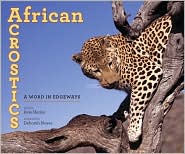
African Acrostics by Avis Harley, photos by Deborah Noyes
In addition to providing spectacular photographs of African wildlife including elephants, hippos, crocodiles, giraffes, zebras, impalas and more, the poems include factual information about the animals, all in the form of acrostic poems - a form known by many teachers and children, and one that usually results in rather simplistic poems. Not so with Harley's work - she takes acrostics to a whole new level of clever.
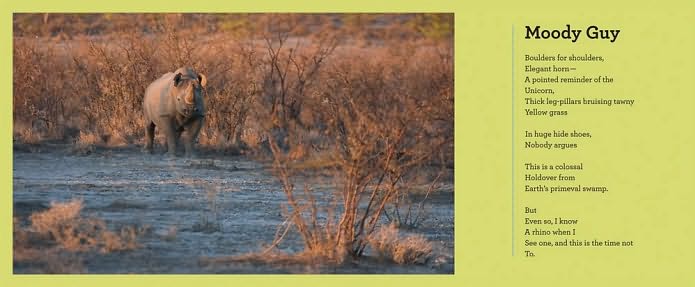
To write an acrostic, you take a word (or phrase) and write it down the left-hand side of the page, then you start each line with the applicable letter. In the case of the poem entitled "A Croc Acrostic", the acrostic is the name of the profiled animal: "CROCODILE". Harley, however, got creative with other animals. The poem about the rhinoceros is not a 10-line poem based on the animal's name. Rather, it is a 16-line poem based on the acrostic "BEAUTY IN THE BEAST".

Interior spread showing the rhinoceros photo
The accompanying poem:
Moody GuyThe book includes fabulous back matter, including an explanation of what an acrostic is and how to write one as well as short, factual paragraphs on each of the species profiled in the book. A must-have for libraries, poetry lovers, and animal lovers - particularly those interested in the wildlife of Africa.
by Avis Harley
Boulders for shoulders,
Elegant horn --
A pointed reminder of the
Unicorn,
Thick leg-pillars bruising tawny
Yellow grass
In huge hide shoes,
Nobody argues
This is a colossal
Holdover from
Earth's primeval swamp.
But
Even so, I know
A rhino when I
See one, and this is the time not
To.
Thursday, October 29, 2009
TALKING UP: What Does Age Appropriate Mean Anyway?
When the question of age appropriateness arose on our new Web site, http://www.inkthinktank.com/, I wish I had listed a broader age range. Some of you already have and hats of to ya! Material that is strong and fun and well presented is manna from heaven to a creative teacher. Kids, young and old, are savvy creatures who can handle big vocabulary and big ideas.
Step back: For years I’ve been trying to capture the voices of the participants who rule my subjects. Early on, in a book for young children called When I See My Doctor, I included the words “stethoscope,” “otoscope,” “sphygmomanometer,” and “hemoglobinmeter.” The copy editor wanted these words deleted because they were too difficult for kindergarten-age children. But four-year-old Thomas, the subject of the book, learned them from his doctor and shouted them proudly into my tape recorder.
It was a bit nerve wracking to argue with an editor because I was new to the field, didn’t have kids, and never studied early childhood education. But I trusted Thomas, my subject. Later, at school visits, children called out the words, teachers beamed, and I felt vindicated. Sophisticated language, one teacher said, encouraged the children to be students.
Jump to now: A few weeks ago I had the pleasure of doing a presentation with Marilyn Nelson, the poet whose picture book I recently illustrated. I had invited her to watch me shoot her book, using students from the Dance Theatre of Harlem as my models, but scheduling didn’t quite work out. Now that the book is published, we were asked to appear together in front of a large group of students. I was anxious. How would a classroom filled with both boys and girls react to my gals in tutus? What helped the most was the teacher. She greeted me with an enthusiastic bear hug and a huge – I mean huge – smile. That alleviated trepidations until I saw the kids. The first to arrive were the boys – big, boisterous boys who spread out in the front rows. Gulp! This is a book about ballerinas for goodness sake! Too late now to back out. Besides Marilyn had just arrived looking fabulous. There were more hugs as Marilyn whispered, “How shall we do this?” If she didn’t know we were in deep do-do land.
“You go first.”
“No, you go first.”
“No, you go first.”
Marilyn, the AUTHOR, went first. She described how and why she wrote the poem and revealed a few literary secrets, such as a riff on Yeats. [“Beautiful ballerina, you are the dance.”] She read her poem to a rapt audience and talked a little more.
My turn! Following Marilyn Nelson may have been a mistake. But I have a few secrets of my own, ones that surprisingly complimented her poetic structure. Showing photographs, I pointed out my secrets, historic balletic points of reference. There’s an homage to Swan Lake, to Degas, and to George Balanchine.
[The photograph above is a typical Balanchine shape.] There were no giggles, squirms or snickers from the audience. Instead, there were great questions and a very happy teacher. Oh, did I tell you who made up the audience for our picture book? Students at the University of Connecticut.
What experiences have you had, dear teachers, librarians, and colleagues, breaking the "age appropriate" barrier?
Jete’ to future: The next visit will be with third graders. I will not change one word in my presentation.
Thursday, April 16, 2009
Like Peanut Butter & Chocolate--Nonfiction & Poetry
The Surrender Tree: Poems of Cuba’s Struggle for Freedom by Margarita Engle (Holt, 2008). School Library Journal called this Young Adult book “hauntingly beautiful, revealing pieces of Cuba’s troubled past through the poetry of hidden moments.” This incredible book won a Newbery honor.
Doug Florian, what can I say? Color me a fan of Comets, Stars, The Moon, and Mars: Space Poems and Paintings (Harcourt, 2007). I love the variety here, including the concrete poem about a galaxy in the shape of a spiral. This reader can feel his passion for the topic on every page. And if you’re looking for fun nonfiction, you need go no further than his Insectlopedia (Harcourt, 1998). Insectlopedia brings to mind another wonderful book—Paul Fleischman’s Joyful Noise: Poems for Two Voices (HarperCollins, 1988). This title, with illustrations by Eric Beddows, won the Newbery in 1989. The collection is written in the form of verbal duets, which are stunning, creative, informative, whimsical, and a ton of fun to work on with students. I did these with a group of 8th graders a few years ago and the more they recited them, the more excited they became, spinning like water bugs and clicking like cicadas.
For younger readers, also try Judy Sierra’s Antarctic Antics: A Book of Penguin Poems (Sandpiper, 2003), with illustrations by Jose Aruego and Ariane Dewey. Little ones will laugh and learn as they read about the world of emperor penguins. So celebrate National Poetry Month with a pairing of nonfiction and poetry, and enjoy!
Wednesday, December 17, 2008
Another Gift Idea
But not just any pencil. Relatively recently I discovered the joys of writing and sketching with a mechanical pencil... no sharpening is required and a worn-out eraser can be replaced. It seems odd that I had a full blown computer system a decade prior to adopting a mechanical pencil. Guess they need a better marketing program. I like a .5 mm HB lead. Anyway, why use one at all?
• Taking notes and sketching by hand is the best way to imprint something on my memory. When gathering and processing information, what I write or draw is retained much more vividly.
• When brainstorming, using a pencil allows a much more rapid, fluid, non-linear process. It’s easy to switch between writing and sketching, and erasing irrelevant stuff allows additional ideas to be inserted near related topics.
• When a project hits a roadblock, it’s best to stop wrestling with the computer, sit down with my magical pencil and rethink things. Strangely, doing this while watching TV can be very productive... perhaps it shuts down the usual brain pathways and engenders out-of-the-ordinary thoughts.
• For some reason it’s easier to see the glitches when editing a hard copy. When working with a collaborator, it's convenient to pass a printout back and forth.
• Pencils are very portable and hardly ever break down.
• Last but certainly not least, there is great power in putting things down on paper. Not only books, but great nations have been started that way. A personal or professional goal, no matter how large or small, gets closer to being achieved the moment it’s put into writing (or doodled).
Of course, you need something to write in. I used to scribble on loose sheets of bond paper, then toss the sheets into folders. The problem with that system is the papers get scrambled and tend to throw themselves into inaccessible cracks behind bookcases.

A notebook or journal helps to capture the swirl of ideas and creates at least a semblance of order. I try to date each entry, but since I feel free to go back to add or delete things, it’s certainly not a precise timeline. A spiral binding that lets the book open flat and gives a convenient place to stash the pencil is my preference. These “sketch books” can be found in art supply stores in various sizes. The photo shows a small 6" X 8" one that is great for taking on the road. For stay-at-home journals, I like the large 9" X 12" ones. Be sure to get one with reasonably heavy paper that won't ripple and show through too much from the other side.
This is a section of a journal page when I was working on Missing Math, attempting to work out part of the verse. By the way, that little dog turned into a calf for some reason. (If I had written it down, I would remember why!)So, during this season the best gift for some people just might be a book they create themselves.
Happy Holidays to all!
Wednesday, July 30, 2008
Whither poetry?
There's no reason that poetry has to be relegated to a one-week unit, assuming that the teacher has time to get to it. And this is because there are poems and poetry collections that fit extremely well into existing school curricula.
Studying animals and/or habitat? Try Valerie Worth's Animal Poems, illustrated by I.N.K. blogger Steve Jenkins, The Seldom Ever Shady Glades by Sue Van Wassenhove, If Not for the Cat by Jack Prelutsky, Vulture View by April Pulley Sayre (again illustrated by Steve Jenkins), Feathers by Eileen Spinelli or Mites to Mastodons by Maxine Kumin (or one of many more books on the topic).
The point is that for nearly any area of study, a poetry collection can be found that relates to it. And it should be found, because kids who have a hard time sitting still for prose lectures pay attention really well to poems. I suspect it's because of the use of lots of imagery and active verbs, the rhythm and, when used, rhyme, that grabs and holds the attention of kids who don't or can't always listen to prose.
Tuesday, March 25, 2008
Poetry in Non-Fiction?
I never asked "Why poetry in non-fiction?" until I had written (with my wife, Yael Schy) a science book containing a series of poems about camouflaged animals -- Where in the Wild? Camouflaged Creatures Concealed. . . and Revealed. Yes, the book was already finished before it occurred to me to wonder why I had wanted to do most of it in verse instead of strictly in prose, like all of my other books. If someone had asked, my answer would have been similar to that of the proverbial mountain climber: because it was there. Poetry was a new peak for me and I wanted to see if I could climb it to enter a new literary realm. I didn't think much about how entering that realm could improve the book or affect its readers.ADVERBS work terrifically
(You really must see Ruth's illustrations to appreciate the fullness of her genius.)
on a STAMEN
to a STIGMA
on a STYLE
POLLEN
grains
must
travel
and
stay
a
little
while.
And
then
you'll
see
the
reason
for
each
FLOWER--
even WEEDS.
The reason for a FLOWER is to manufacture. . .
SEEDS
Now we know the reason for the flower, and I am beginning to know the reason for the poem. I can't stop reading it! It's fun! It has captured me, latched onto some nerve center in my brain and it doesn't want to let go. The delicious rhymes and rhythms of verse do that. Neuroscientist Daniel J. Levitin explains how music triggers pleasure sensors in the brain in his 2007 book, This is Your Brain on Music. My hunch is that poetry works in a similar way. Reading can be for information or pleasure or both. If poetry helps put the checkmark in both columns, how can we -- why should we -- resist?
It worked that way for Lucy, the 8-year old daughter of the creators of over 200 podcasts about children's books published on the website http://www.justonemorebook.com/. In their podcast on Where in the Wild?, Mark Blevis and Andrea Ross mention that on a recent ski outing, Lucy could be heard scooting down the slopes reciting the opening lines of our poem "Grayish, Greenish," about the tree frog that can virtually disappear on the similarly-colored bark of a tree:
The colors you see are the colors of me.
Grayish, greenish, blackish bark,
I'm bumpy and blotchy, part light and part dark.
Joy Hulme is another author (and another friend) whose non-fiction verse impressed me long before I considered trying my own hand at it. Looking for insight, I reread Sea Squares, Joy's poetic introduction to the mathematical concept of square numbers. Using a marine motif, Joy "counts" in squa
res. Here is how she greets the reader:Where the ocean meets the shore.
We'll count some creatures that crawl and creep
Or grow on the ocean floor.
Some flop, some dive, some swim and swish,
Some fly where the breakers roar.
Shrieking and swooping and pecking up things.
2 white gulls with 2 eyes each,
Have 4 bright eyes to watch the beach.
precious life within
You may think I'm lizard-like.
But I'm no reptile -- think again!
I'm really an amphibian.
In thinking again, I begin to wonder why more non-fiction is not written in verse. I invite readers of this post to contribute selections from their favorite works of non-fiction poetry (or just to recommend book titles)... and to add to the list of reasons for a poem.