Showing posts with label Dorothy Hinshaw Patent. Show all posts

Thursday, March 27, 2014

Inspiring students to write

This winter, and now thank goodness spring, I've been working by videoconference with two classrooms in Missoula, Montana, helping them with their writing projects, through iNK Think Tank's Authors on Call program, posted publicly at http://district1missoula-dorothyhinshawpatent.wikispaces.com/.  At Franklin School I'm working with fourth graders, and this month they are sidelined by testing.  But the third graders at Lewis and Clark School have finished their project.  My book, "When the Wolves Returned: Restoring Nature's Balance in Yellowstone," is their guide to writing well, and they have been working very hard at it.

In our first videoconference, I talked to them about the importance of beginning a story with something mysterious or exciting, with a beginning, middle, and end, just like a little story in itself.   Each student is writing about a member of the deer family.  Here is Oliver's first paragraph:

"Imagine walking through the woods.  You see something with fangs.  A lion? A wolf? A sabertooth tiger?  No.  It is a musk deer, the only deer with fangs."

Another student wrote:

"On an early foggy morning you can hear distant clanking in the air. As the fog clears you can see two kudu. You come closer and can that their horns are interlocking. They are pulling and tugging but can't get separated."

Wouldn't you want to read more?


In our second videoconference, students were able to read their beginning paragraphs to me, and I gave them specific advice on how to improve the writing.  When an author makes suggestions, the students accept them very easily, while sometimes if it's a parent or teacher making suggestions they aren't as willing to make the changes.


The students are carefully studying my writing and noting down the "powerful" words I use and looking them up if they are unfamiliar with them.  Then they compare them with "ordinary" words I could have used:


I'm very proud of these young writers who are working so hard to do their best, and I think having a "live" author work directly with them to help them with their  difficulties can lead not only to rapid improvement in their work but also in increased enthusiasm about writing and reading.

If you want to know more about our work with students in the classroom, go to www.inkthinktank.com/authors-on-call .

Thursday, February 27, 2014

Growing from our Work

At the end of March, I’ll be flying to Michigan to receive the Mitten Award from the Michigan Library Association.  The award is for a book (“Dogs on Duty: Soldiers’ Best Friends on the Battlefield and Beyond”) that does a good job of communicating information to its target audience.  I work hard to achieve that goal, so I feel honored to receive this award.  At the conference I will also be giving a keynote address, which has gotten me thinking: What topic is especially appropriate for a keynote?  This question has been wandering around in my head for a while, and I’ve finally decided on the answer for me, at this time in my career.

A nonfiction writer is a person who loves learning new information and feels the urge to communicate the fascinating information she/he has learned to other people.  We go through the years finding intriguing topics, enjoying our research, and putting it all together in a form we hope will inspire and engross our readers.  We learn a lot, meet all sorts of experts, and probably visit some fascinating locales.  But I realize now that we do so much for ourselves in the process of being dedicated to looking for truth and communicating our knowledge to others.
This work helps make us be more open in a number of ways.  We learn to explore all sides of a topic, to investigate different versions of the “facts,” and to communicate the complexities of “there are no simple answers” to our audience in clear, nonjudgmental language.  I think nonjudgmental is a big part.  Years ago I wrote “Where the Wild Horses Roam,” about wild horses in the West.  There were, and still are, big controversies about these animals.  To some, they are a symbol of wildness, an integral part of the history of the American west that must be honored and protected.  To others, like ranchers who purchase grazing leases on the public lands that house the horses, these equines are not just a damn nuisance, they steal the vital and sometimes sparse food their cattle need to fatten up and provide income for the ranchers.

I did my best to express the concerns of both sides and shrugged.  “If both ranchers and horse advocates hate me after reading this, I’ll know the book is good.”  But I was wrong—both sides appreciated what I wrote because I stated each side of the story accurately and without any evaluative language.  They just wanted to be heard.  I try to keep that lesson in mind whenever I write about a potentially controversial topic.  “Just the facts, ma’am” has become my mantra.


That's just one example of the unexpected bonuses I've received from this work. Now, after more than 40 years in this business, I realize how much of value I’ve learned, not just the facts and theories, the interactions and exceptions, but also the variety of it all—so many cultures, so many ways of seeing the world and of being in the world, so much glorious variety in Nature.  So, as you can imagine, I’m nowhere near finished yet.  I want to continue learning and communicating as I keep finding more and more intriguing stories available for exploration.

Thursday, January 30, 2014

A Change of Scene

My home is in beautiful Missoula, Montana, but my husband Greg (a food writer) and I decided to try something new.  We became snowbirds, leaving home in late October and planning on returning in early April.  At first we condo-hopped in Hawaii, but now are settled in Oceanside, CA, across the street from Del Mar beach.

Some writers need to work in their own familiar space or settle at a table in a familiar cafe near home to write.  But Greg and I feel fortunate that we can write anywhere, as long as we have a few reference books and our trusty MacBooks.  My nephew recently did some consulting for Microsoft and presented Greg with a sticker for his computer that declares "This is my office."  I want one too!

I find working in a new location has its own rewards.  The phone rarely rings, as no one knows this number.  Our cell phones stay mostly silent, since we don't use them that often.  That means fewer distractions.  We don't have the usual social engagements either, or other appointments, so we have more time to write.  The new location also means new experiences, like a variety of farmers' markets in surrounding communities with gorgeous greens and succulent citrus fruits, foods we can't get locally grown in Montana during the winter.  We both feel healthier, not only from the food but also the sunlight and relative warmth.

There's also the stimulation of the writing instinct in a new place. Greg is inspired to devote his blog (www.thebakingwizard.com) to "unplugged" recipes, ones that don't require a food processor or mixer, since we don't have those things here.  I find myself obsessed with photographing birds and brilliant sunsets over the Pacific, with the damp sand creating magical reflections of the glowing colors.  Maybe I'll write a book about sunsets!  Or about gulls, or maybe I'll revive my out-of-print book on pelicans.

When I take my afternoon break walking along the damp, firm surface of this beach, I feel I could walk forever.  It's a form of meditation for me, allowing my mind to clear and to settle down.  Then I can focus on prioritizing the many tasks large and small that go along with being a writer, or just "be."  I can't do this at home in wintertime Montana, where it can be too icy or too cold to walk and where the sky during the short days is almost always an uninviting gray.  But as I enjoy looking out over the silvery sparkles of reflected sunlight on the waves, I look forward to Montana in the Spring, when fresh green sprouts push forth from the earth and the familiar birds, "snowbirds" like us, return to enjoy new life and creativity in that special place.


Friday, November 29, 2013

Fresh Angles Create Interest

One of the big advantages of using nonfiction trade books in the classroom is the variety of approaches we authors use for our topics.  We don't just write the usual straight and often boring chronology of events the way a textbook does.  We choose a fresh angle on a familiar topic, which allows us to integrate the basic information into a new framework that can inspire a child's curiosity or lead her into an important fundamental topic through a different door, one that she wants to open because of her own interests.


Vicki Cobb's book, "Science Experiments You Can Eat," teaches children fundamental principles of physical science through something everyone is interested in, their food.  This book has been so popular that it has remained in print since its first publication in 1972.  Readers discover that science doesn't need to be serious or daunting--it can be lots of fun, and the book encourages them to pursue the subject matter even further.  Vicki is hoping to expand and revise the book within the next year.  With this book, readers can have lots of fun as they learn about important principles that they won't easily forget.


Elizabeth Rusch's book, "For the Love of Music," informs children about life in Europe during the last half of the 18th century and about classical music through the story of Mozart's older sister, Maria Anna, who was also a child prodigy.  She had to live in Wolfgang's shadow once she was of marriageable age.  She did her best to stay in touch with music even after marrying and taking care of stepchildren as well as her own children.  Girls today who struggle with traditional family expectations will identify with Maria Anna and enjoy reading about her life and times. learning about music in the process.


Rosalyn Schanzer's wonderful book, "George vs.George," presents the historical facts behind the American Revolution through the personalities of George Washington and King George III, which gives readers the historical context of this pivotal event in our history.  They learn the British point of view as well as the American one, which helps anchor the revolution in its times and deepens understanding of what life was life back then.


Because I'm a zoologist by training and interest, my history-related books often present a topic through an animal-related theme.  For example, my two books exploring western Native American Indian culture and how it intertwined with the Westward Expansion Movement both use iconic animals for their focus--"The Buffalo and the Indians: A Shared Destiny" and "The Horse and the Plains Indians: A Powerful Partnership."  The curiosity of a reader interested in wildlife could be stimulated by the buffalo book while a horse lover would pick up the horse book instead.  Both would learn a great deal about Native Americans and the Westward Expansion Movement as they learned more about the animals they love.

These are just a few examples of nonfiction trade books teachers can pull off the shelves of their school libraries to engage their students with learning by way of books that take a fresh look at subjects that can seem boring when approached by way of textbooks' dry and uninspiring approaches.

Wednesday, October 16, 2013

Common Core: Main Points & Key Ideas

Since reading standards can be such a drag, I’ve come up with some easy-to-read tables that make them seem almost friendly. Here’s an example:

Key Ideas and Details #1
Kindergarten
Grade 1
Grade 2
With prompting and support, ask and answer questions about key details in a text.
Ask and answer questions about key details in a text.
Ask and answer such questions to demonstrate understanding of key details in a text.
Grade 3
Grade 4
Grade 5
Ask and answer questions to demonstrate understanding of a text, referring explicitly to the text as the basis for the answers.
Refer to details and examples in a text when explaining what the text says explicitly and when drawing inferences from the text.
Quote accurately from a text when explaining what the text says explicitly and when drawing inferences from the text.

Key Ideas and Details #2
Kindergarten
Grade 1
Grade 2
With prompting and support, identify the main topic and retell key details of a text.
Identify the main topic and retell key details of a text.
Identify the main topic of a multi-paragraph text as well as the focus of specific paragraphs within the text.
Grade 3
Grade 4
Grade 5
Determine the main idea of a text; recount the key details and explain how they support the main idea.
Determine the main idea of a text and explain how it is supported by key details; summarize the text.
Determine two or more main ideas of a text and explain how they are supported by key details; summarize the text.

You can find similar tables for the other K-5 Reading Informational Text (RI) standards on my pinterest page. I like them because they show how skills scaffold from one grade level to the next.

The tables above highlight the first two Common Core for ELA RI standards. Basically, they say that after reading a nonfiction book, your kiddos should be able to identify the main topic and key details in of the text.

This certainly isn’t a new idea. In fact, it’s pretty basic. What’s the point of reading if you don’t understand or remember the content? But as we know, this isn’t always easy for kids, especially beginning readers.

One great way to help students build their fluency and comprehension is Reading Buddies. You can find a comprehensive article about the benefits of programs with multi-age reading partners here, but here's my special twist: Instead of using books at the younger child’s reading level, use books with layered text.
 
The simpler text is perfect for the young child, and the more complex text will challenge the older child. So both students are learning. And after they finish reading a spread, they can discuss the art and content—a practice that will certainly address CCSS for ELA RI #1 and #2.


My new book No Monkeys, No Chocolate is perfect for this kind of Reading Buddies program. Here are some other books with layered text. They are also good choices for a Reading Buddies program in which both students participate fully.

Actual Size by Steve Jenkins
Beaks by Sneed B. Collard (illus. by Robin Brickman)

The Bumblebee Queen by April Pulley Sayre (illus Patricia J. Wynne)
A Butterfly is Patient by Diana Hutts Aston (illus. Sylvia Long)

An Egg is Quiet by Diana Hutts Aston (illus. Sylvia Long)
Here Come the Humpbacks! by April Pulley Sayre (illus. Jamie Hogan)

Meet the Howlers by April Pulley Sayre (illus. Woody Miller)
Move! by Steve Jenkins & Robin Page

My First Day by Steve Jenkins & Robin Page
A Place for Bats by Melissa Stewart (illus by Higgins Bond)

A Place for Birds by Melissa Stewart (illus by Higgins Bond)

A Place for Butterflies by Melissa Stewart (illus by Higgins Bond)
A Place for Fish by Melissa Stewart (illus by Higgins Bond)

A Place for Frogs by Melissa Stewart (illus by Higgins Bond)
A Place for Turtles by Melissa Stewart (illus by Higgins Bond)

Prehistoric Actual Size by Steve Jenkins
A Rock Is Lively by Diana Hutts Aston (illus. Sylvia Long)

A Seed is Sleepy by Diana Hutts Aston (illus. Sylvia Long)
Snowflake Bentley by Jacqueline Briggs Martin (illus. by Mary Azarian)

What Do You Do with a Tail Like This? by Steve Jenkins & Robin Page
When the Wolves Returned  by Dorothy Hinshaw Patent (photos Dan and Cassie Hartman)

Wings by Sneed B. Collard (illus. by Robin Brickman)

Thursday, September 26, 2013

Pleasures of a Wild Child

I wasn't a "normal" girl.  I loved frogs instead of dolls and golden-colored butterflies instead of pink ruffles.  As a matter of fact, I actively disliked dolls and abhorred anything in pink--for me, pink meant prissy, and that was the farthest thing from what I was.  I spent my summer days zipping around on my bike looking for adventure or trying to keep up with my older brother and the other boys and stuck my nose up at the neighbor girls carefully rolling a baby carriage down the sidewalk with their dollies inside.

But a kid can't be outside every day in Minnesota, where I lived until the age of 9--it's often too cold or too wet or too snowy--so books had a big role in my life.  I wasn't interested in made-up stories, unless they were about a horse, a dog, or a wolf and sounded "real."  For me, books meant a way to find out about the amazing world of nature.  After all, I wasn't in a position to head off to what is now called the rain forest but then was the "jungle," a much more evocative term, to pursue 25-foot long anacondas or bizarre frogs that carry their eggs on their backs, but I could read about them, thanks to great adventurers like Roy Chapman Andrews.

Perhaps my very most favorite and inspiring book was "Nature's Ways: How Nature Takes Care of its Own," by Roy Chapman Andrews himself.  Andrews was a well-known public figure at the time who travelled all over the world but was especially famous for his dinosaur discoveries in Mongolia and the Gobi Desert.  "Nature's Ways," however, was quite a different sort of book.
In a way, it was very modern in format, with each spread featuring an amazing example of how nature works, accompanied by lovely color art.  Unfortunately, my childhood books got lost along the many moves of myself and my parents, but I remember some of the most amazing stories in that book.  For example, Andrews described the archer fish (on the cover of the book), a creature with two parts to its eyes, a lower section adapted to seeing underwater, and an upper section that could see above water.  These fish lurk at the surface.  When an archer fish spots an insect close by, it shoots a blast of water right at it that wets the prey, causing it to fall into the water.  Gulp and it's gone!  What a great story!  Then there's the yucca moth and the yucca plant, perfectly adapted to one another.  The adult moth drinks nectar from the yucca blossoms, helping to pollinate them.  It then lays its eggs on the plant, and the caterpillars feed on the yucca.  What a beautiful synergy.

My love of such stories from nature has helped me in my writing as an adult.  I'm always on the lookout for the special "gee whiz" elements of a topic, knowing that there will always be kids like me out there, who can be blown away by nature's  adaptations.  Nature's wonders are all around us, not only in far away places, and when children can learn about the amazing life that surrounds them every day, they can be engaged in their own lives and will be motivated to read and to have fun learning.

Thursday, June 27, 2013

Reading and Thinking


There’s been a lot of talk recently about the Common Core State Standards and how important they are in creating a market for nonfiction writers.  That’s nice for us, but I’m excited about this new approach to teaching way beyond its effects on my pocketbook.  I’ve seen too many examples in my life of how our citizens don’t know how to read for information content and how to evaluate what they read.

My first exposure to this problem occurred when I worked as a teaching assistant in a basic zoology class while in graduate school at the University of California, Berkeley.  More than once after an exam, a student who received an inferior grade would come to my office very discouraged.  “I came to all the lectures and I read the text but I only got a C on the exam—what’s my problem?”  I’d ask them about their reading techniques and it would turn out that they had no idea that there was more than one way to read.  Of course they’d learned to read in school, but as has been the practice for decades, they learned by reading fiction, which requires a totally different reading style than nonfiction.  You can ‘fast read’ fiction by skimming lightly over some sections and focusing on following the plot and the emotions of the characters.  That kind of reading will get you nowhere if you are reading to learn.

Reading to learn requires a form of close reading in which you carefully follow the text with your thinking brain engaged at all times.  Here are some questions to ask yourself as you read nonfiction text.  Does this make sense to me?  Am I “getting it” as I read, or do I need to reread this more carefully?  Am I examining all the illustrations, reading the captions, and checking to see if I understand what the author is trying to convey?  Do I stop frequently and review in my mind what I’ve just read to see if I’m absorbing the information?

This kind of focused, concentrated reading takes time, and people like me, who have always read a lot of informational nonfiction can have a hard time reading fiction.  We become so accustomed to reading carefully, paying attention to every word, that it’s difficult to finish a novel in a reasonable amount of time.  I, for one, haven’t learned how to flip an internal reading style switch, so a novel takes many hours to complete.

The other problem associated with learning to read through fictional texts is not learning how to evaluate what one reads critically.  What kind of reading do adults need to master in order to be successful in the world?  Nonfiction, not fiction!  They read the paper, either on ‘paper’ or online; they have to be able to read all sorts of forms such as for income tax and contracts for work.  They need to be able to spot propaganda-style writing and to recognize when they are only getting one side of the story.  The internet has only made this skill more important than ever, since anyone can put up a snazzy looking website and fill it up with misleading nonsense or misinformation.

If a student plans to be part of society’s middle class, he or she also needs to be able to write coherently in order to apply to college, to apply for jobs, and to communicate within the work environment.  I’ve spoken to many college teachers who need to devote vital time to teaching their students how to write when they are supposed to be teaching them economics, science, psychology, or some other academic subject.  The CCSS are designed to improve students' writing skills, too.


We can hope that the application of the CCSS will help to alleviate these problems so that Americans will be able better to cope with the challenges of our complex new world in which communication has become even more important than in the past.

Friday, May 31, 2013

A Glimpse at my Process--Beginnings

My recent visit to the Montana prairie got me thinking about how an author organizes ideas and chooses what to include in a piece of writing and what can be left out.  Any new subject presents so many possibilities, and possibilities are what writers thrive on.  Each of us has her or his own ways of working through this process of considering alternatives and then focusing in on some topics while passing over others—here’s an example of mine.

I already have the main focus for my book, the life of bison on American Prairie Reserve (APR), a developing project that aims to protect a parcel of an ecosystem that once spread from north to south across the middle third of America.  Already, enough land is protected by APR so that the bison and other wildlife have a significant area to roam.  My book will focus on the life of one bison calf born there and will have sidebars featuring various aspects of the life of bison and their habitat.  What topics should I include and what can I pass over?  A 48-page book can only have so many words!

A lone bison bull on the American Prairie Reserve


While I bounce along in a sturdy four-wheeler with my driver and guide, Dennis Lingohr, my mind scans possible topics as my eyes scan the landscape.  Our vehicle climbs up a steep slope and heads down the other side, and I know there’s one point I’ll be sure to make—the prairie is far from being a rolling plain.  It is a wrinkled landscape, with hills and valleys, nooks and crannies, streams and ponds.  Some areas seem quite barren, while others are lush with spring grass. 

 Dennis explains how this variety of habitats reflects both the geological history of the area and the human usage of the land.  For example, glaciers scraped some of the land of its topsoil, while flood irrigation by ranchers created grassy swaths that provide good forage for the bison.  The landscape will play a major role in my book.
An alert prairie dog checks out the intruders

Penstemon on the prairie
We pass through a prairie dog town—the bison and the prairie dog are both key ingredients in a healthy prairie ecosystem, so I’ll be sure to include the prairie dog.  But what about the wildflowers?  They are beautiful and visually appealing, but do they play an important role in the life of the prairie itself?  Do the bison nibble on them or leave them alone?  I’ll need to find out.  Then there’s the weather—just this one day we are experiencing some of its variety.  The day starts out with broken clouds and a light breeze.  As we lunch sitting on an overlook, the sun peeks out, disappears, and comes out again.  The storm clouds gather in the distance, and I get nervous about the possibility of rain, which can make the roads impassable.

As I ponder my experience, my mind begins to make lists of possibilities.  I remind myself that the topics I include must spark the interest of  young people.  Luckily, my book is not a textbook that has to include certain facts.  It’s a collection of tidbits and stories that, taken together, will introduce this complex ecosystem from the viewpoint of its largest and most powerful inhabitant, the bison.  But before even one word is written, I must sort and balance, take on and discard, until I reach a point where I’m confident my book will both inform and inspire.


Now that I’m back home, where the streets are paved and the landscape is dotted with houses, I think back to my prairie experience of wildness and openness, lonesome landscape and companionable creatures, and I look forward to the challenge of organizing and presenting this quintessentially American animal and its complex habitat to young readers.


Monday, April 29, 2013

Endings and Beginnings


As we are so often reminded, for everything there is a season.  And when the season of intense work on writing a manuscript and choosing dozens of photos to illustrate it ends, it’s time for a season of renewal.

Lucky me—I sent off my next manuscript and photos just a day before flying off to a beautiful spa in Mexico called Rancho La Puerta.  I get the best deal there is—for my husband’s efforts in planning and carrying out three cooking classes using ingredients from the rancho’s amazing garden, I receive a free week to do as I please in this lovely environment.  Opportunities to participate in all sorts of activities abounded, but I promised myself I would just live day by day, moment by moment, during our visit.  Time and experience have taught me this lesson.  As children’s fiction author Bruce Coville reminded fellow author Jeanette Ingold when she worried about not having any new ideas following submitting a manuscript, the well gets emptied and must be filled again before we can proceed.

Garden and dining hall at Rancho La Puerta
I believe this principle is in play for nonfiction writers just as much as for fiction creators.  We fill our brains with facts and images.  We struggle to find the best way to organize our material to present it to our readers in logical, easy-to-follow sequences.  We get tired!  Our minds need to rest, to clear out what we no longer need to remember and make room for the new information.  And perhaps most importantly of all, we need to let the enthusiasm for the next project grow and let the “old” enthusiasm for the previous project fade.

This gradual process actually serves a dual function.  Not only does it set in motion a new enthusiasm, it helps us distance ourselves from the previous project, knowing that soon an editor will be pouring over our manuscript with a highly critical eye, suggesting changes, preparing queries, and, most dreaded of all, making cuts.  We authors must be able to distance ourselves at least a bit from that “old” project so we can react calmly to our editors’ reactions.
"Iris" awaits her mate on her Montana nest

And while we await that inevitable pain, we plunge into the next project, becoming increasingly involved and excited as we see the new possibilities involved with a fresh, open-ended topic.  I want to share my enthusiasm right now with a new project, a book about osprey research.  To me the most exciting aspect so far is learning about wild bird web cams.  I’d known they existed but hadn’t paid much attention until I got going on this project.  Two of the osprey nests in the study have web cams that allow anyone in the world with internet access to “spy on” these birds as they conduct their daily lives. (http://tinyurl.com/6mcdgst and  http://tinyurl.com/dyj5ddf)

http://www.unavitaverde.net/webcam-black-stork/
 Such cameras are working in countries around the world on many bird species, not just ospreys in Montana.  As I write this blog, I’m watching a pair of rare black storks in Estonia and listening to the unfamiliar calls of European forest birds in the background.  For a person like me, who identifies so strongly with the natural world, it’s the perfect background music for writing—one bird chirps a lovely song as a dove calls sweetly, then passing geese honk overhead.

Writers like me are truly blessed by the opportunities of delightful discoveries that our work gives us.

Wednesday, January 16, 2013

The Joy of Noodling


Okay, I admit it, I’m a research junkie.  My favorite activity associated with my work is not crafting brilliant sentences or feeling triumph when I figure out how to organize a huge amount of material so that my manuscript doesn’t have “too many words” (the mantra of many editor these days).  It happens much earlier, when I’m in the 'finding info' stage.

That work used to involve driving to the university, miraculously finding a parking spot, and heading into the stacks after thumbing through card catalogs or, later, computer listings of holdings.  Now, I rarely go there.  The internet has become the ‘go to’ place for most of my research, for a couple of reasons.  First off, there’s just plain so much information online, and I know how to ferret out the accurate sites.  Secondly, my books now are often on less scientific topics than before.  But once I get going, it’s hard for me to stop.

I’ve found that I need to find a balance between following thread after thread until I’m lost in a tangle far from where I meant to be and allowing myself to wander hither and yon on the net and stumbling onto something I didn’t know existed.  A perfect example of the latter happy coincidence came while researching my most recent book, “Dogs on Duty: Soldiers’ Best Friends on the Battlefield and Beyond.”  Because of my love of canines, I’m on an email list or two, and one had a link to the American Kennel Club Hero Dog Awards.  I clicked through just for the fun of it and ended up finding a great dog who became one of my favorite profiles in the book.  His name was “Bino,” and he was really a double-header hero.  First, he had worked in the military keeping bases safe and sniffing out explosives in Iraq.  After he retired, Bino was adopted by Debbie Kandoll, an amazing woman who realized that Bino didn’t’ want to be retired and lounge on the couch.  He wanted to keep working.  So she employed him as a helper to train service dogs for veterans suffering from PTSD.  Debbie and Bino would take the vets and their dogs into noisy malls, riding narrow escalators and navigating crowds of shoppers, showing them that there was nothing to fear.  Bino died last year at the age of 12, working almost to the end of his life.  What a true hero hound!

Now I’m working on yet another dog book and have a confession to make.  Today I was supposed to edit some documents for the Authors on Call branch of iNK, and I was supposed to get busy writing this blog.  But instead, I started on a quest for photos for my next book—another doggy topic.  I went to Google photos and got lost in the plethora of appealing photos of working dogs, then clicking on the articles in which the photos were imbedded.  I’ve found that while Wikimedia has photos that are usually available to use for free, Google photos makes it easy to access the information that accompanies the photos by ghosting the articles behind the images.  One click on the background and the article appears.  I’ve found it’s an easy way to do targeted research.  Today, I downloaded some potentially useful photos, discovered a dog who can sniff out buried 600-year-old bones and added five new bookmarks to my already bloated list--and I’ve only gotten halfway through the photos!

One of these days, I may find the balance between hoping for serendipity and being disciplined about my research—after all, you can only fit so much information into a 40 or 48 page book!  But I’m in no hurry for discipline; noodling around on the internet is just too much fun.

Wednesday, November 14, 2012

Connecting to Nature's Rhythms

Jim Murphy's recent post connected us to the familiar and mundane aspects of our daily lives, those frustrating moments that can crush our creativity.  When we can get away from our routines and experience something different, our creativity can be inspired and renewed.

This Saturday, my husband and I traveled from our home in Missoula, MT, where the temperature was 19 degrees, through Salt Lake City, where the snow fell fast enough to delay our flight by 1 1/2 hours, through sunny LA and on to the Garden Isle of Kauai'i, where it rarely gets below 75 degrees or over 84.  Jeans are traded in for shorts and shoes for sandals.  The phone doesn't ring, and meals become simple.  The seashore calls, and the warm breeze welcomes.  Nature is up close and personal.

The natural world is both my personal beat and my professional one, so I really 'dig' this place.  I believe that when we are close to nature we are closer to our fundamental, creative selves.  On this island, residents and tourists alike are drawn to the natural rhythms of sun and sea, moon and tide.  Every evening, people flock to the sea wall on the west side of the island in hopes of seeing a great sunset.

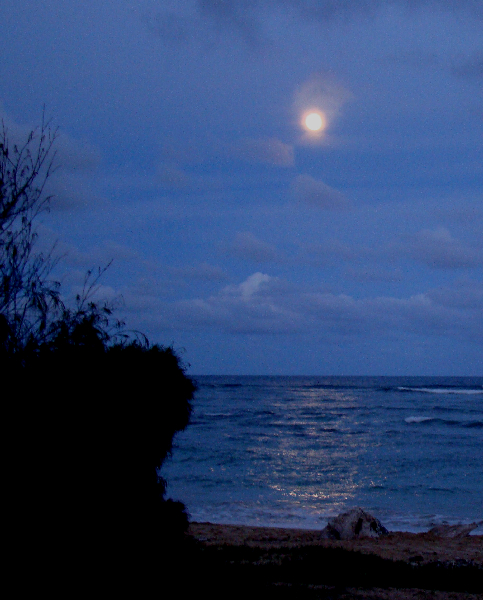
 And when the full moon rises out of the ocean, families and neighbors gather in the park to watch as the moon spreads its silver mantle over the dancing waves.  No wonder this island is home to many artists and writers.

I don't write about Hawai'i, but I do renew my creative batteries here, not only because of the closeness of nature, but also because being here brings a shift in my daily life, and being jogged out of our routines helps nudge our creativity.  At home in Montana, summer days stretch on deep into what is black night in Hawaii, and winter days end while the tropical sun is still shining.  Here in Hawaii, the record high and low temperatures throughout the year don't vary as much as they do over a normal 24 hour span at home.  Everything is different, and the differences bring about a shift in my being.  I do work here--one of the perks of being a writer is that you can carry out your craft wherever you are--but I try to keep that to a minimum.  I want those batteries to be chock full of creative energy when I return to the deep, dark cold of winter, when writing is the one thing I can do, no matter what nature has to offer my spirit.