Showing posts with label picture books. Show all posts

Wednesday, May 21, 2014

Stretching, Soaring and Singing, by Marfé Ferguson Delano

 In this, my last blog for I.N.K., I'm happy to announce a first, a couple of firsts, actually. They're my first picture books for the 3- to 6-year-old set, Butterflies and Frogs. Never before have I written for such a young audience. It was so much more satisfying than I expected it to be! It was also much, much harder than I thought it would be. But hard in a good way, in a stretch-your-wings way, in a let-your-heart soar way, in a let-your-words sing way. All while sticking to the facts.

 Of course, writing these books wasn't all stretching and soaring and singing. There was a lot of sighing and groaning and wheel-spinning, a lot of self-doubt and frustration. There were lots of half starts and restarts and false starts. There was a lot of popcorn and chocolate. Not that there's anything wrong with that.


 But back to the soaring and singing. I got back to nature and paid attention to it. I visited butterfly gardens and spent hours in my own back yard, watching swallowtails and monarchs and fritillaries flutter and feed on Joe Pye weed, which is rightly called a butterfly magnet. I listened to spring peepers chirp peep-peep-peep and bullfrogs bellow jug-o-rum. I kept my eyes peeled for frogs snuggling into squishy, squelchy mud by streams or ponds. I looked and I listened. And I marveled.

Linda Salzman, thank you for creating this marvelous I.N.K. blog and for inviting me to be a part of it. I have learned so much from this experience and all the I.N.K. contributors. It's been great. Bye, y'all.


Friday, April 11, 2014

Drawing it True


Today’s guest blogger is Cynthia Levinson.

With my first nonfiction picture book under development, I’ve begun to think about—and look hard at—the illustrations in nonfiction books for younger readers. Although it was challenging to ferret out photographs, pamphlets, legal documents, and memorabilia for images in my first nonfiction middle-grade, We’ve Got a Job: The 1963 Birmingham Children’s March, they served at least two purposes. Above all, as primary sources, they informed me about the times and events I was writing about. In addition, placed in the book, they broke the text and provided both visual interest and verisimilitude for readers.

Illustrations, I’m realizing, are very different. They’re not artifacts. They’re the artists’ imagined representations of time, place, events, and mood. Although they can be very precise and accurate, water colors, collages, oils, etc., don’t necessarily show the reader exactly how the spur attached to the boot, say, or that the temperature was 99 degrees. They can be more atmospheric and still be valid—not just valid but also emotionally true.

I’m beginning to think of the artwork in nonfiction picture books as the visual voice of the book. And, just as I struggled to make the textual voice in The Youngest Marcher authentic, even when I wasn’t quoting someone, I’ve been looking at illustrations for authenticity—even if they’re not photographically accurate.

Here’s a range of pictorial styles, in recently published and lauded picture books, from the concrete to the imagistic. (Warning: I am not an artist! These are merely my impressions.)

Brian Floca’s illustrations in Locomotive are as precise and detailed as those in any Richard Scarry word
book. After looking at the end papers’ labeled diagrams, I’d recognize a piston rod, throttle lever, and Johnson Bar anywhere! And the accuracy of those drawings tells me that every other illustration must be right also, even the water-colored elevation map of the Great Basin in the frontispiece and the sketch of a man chasing his horse, who must have been spooked by an approaching train. Floca not only conveys depth of information but he also gives the reader confidence that he knows what he’s writing—and drawing—about.

Similarly, many of Melissa Sweet’s illustrations, such as the medical drawings, in Jen Bryant’s A River of Words: The Story of William Carlos Williams seem to be completely accurate. Other, blurrier ones, however, appear metaphoric, which seems appropriate for a book about a man who was a poet as well as a physician. Sweet’s blocky collages display a conglomeration on each page of neat facts and lyrical tone.
 
To Dare Mighty Things: The Life of Theodore Roosevelt, written by Doreen Rappaport and illustrated by C. F. Payne, takes the realistic cum impressionistic approach a step further. Clothing is appropriate to the times, of course, as are saddles and ten-dollar bills. Furthermore, Payne might well have drawn the faces of politicians and bystanders by copying them exactly
from contemporary sketchbooks or photographs. Today’s facial recognition software could practically identify them! Yet, snow falling in the Dakota Territory looks like unnaturally soft polka-dots, and Teddy sometimes appears unrealistically eyeless behind his spectacles— appropriate for someone who was hard-of-seeing. And, in a spread of young Teddy’s dream, he seems to float along with a butterfly and a polar bear. As with Sweet’s illustrations, both accuracy and mood prevail.

There are many superlative nonfiction picture books I could focus on. Georgia in Hawaii: When Georgia O’Keefe Painted What She Pleased, written by Amy Novesky and illustrated by Yuyi Morales, must have been particularly challenging for Morales because it needed to convey both the truth of the paintings by its artist-subject and also the mood of O’Keefe’s lush surroundings.

Possibly at the furthest extreme of dispensing with concrete accuracy while maintaining recognizability might be On a Beam of Light: A Story of Albert Einstein by author Jennifer Berne. Most of illustrator Vladimir Radunsky’s images are sweetly cartoon-like. Yet, Einstein is obvious with his brushy mustache and distracted gaze.

I’d like to round off my exploration of visuals in nonfiction picture books with Grandfather Gandhi by Arun Gandhi and my friend Bethany Hegedus and illustrated by Evan Turk. Cloth and paint collages of the Mahatma’s posture and emaciated frame make him instantly recognizable, even in crowd scenes. The vivid background coloration sequence from beige to yellow to orange to red and back to beige again conveys not only India’s searing heat but also young Arun’s moods, from awe of his famous grandfather to anger and back, appropriately, to peace with himself and his family. Readers will sense the place, the times, and the moods without the need for photographic detail.

I’m curious to see how Vanessa Brantley-Newton, the wonderful illustrator of The Youngest Marcher, will choose to visualize its voice. Will she portray scenes of, say, jailed civil rights protesters by drawing hundreds of them packed into a cell, just the way they endured those stifling conditions? Or, will she take a more atmospheric approach?

The Youngest Marcher focuses on one of the people highlighted in We’ve Got a Job. While the books address the same topic, the readership is entirely different. Seeing them side-by-side will further inform me about the various ways that text and visuals can enhance each other. Check back in in January 2016 to see how she accounts for the same facts for a different audience.

Tuesday, March 25, 2014

VERY SAME TOPICS, VERY DIFFERENT BOOKS Rosalyn Schanzer


It's pretty impressive to see how many different ways nonfiction authors can present the very same subject matter or the very same people in their books. To get the gist, today I thought it might be fun to compare some examples of books on the same topic--mostly (but not entirely) by our own INK authors and illustrators. I'll be brief, I promise.  


So how about starting with our foremost founding father, George Washington himself. Each of these 3 authors has come up with entirely different hooks to pique your interest, so a young audience could get a pretty well-rounded view of our guy by checking out these true tales.


First up is The Crossing: How George Washington Saved the American Revolution by Jim Murphy.  His hook is to focus on Washington's growth as a leader, obviously leading up to the famous crossing of the Delaware on Christmas in 1776. He's used some very interesting artwork from the period to enhance the tale.

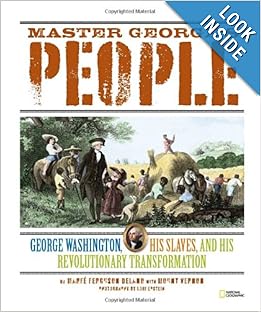
Next comes an entirely different take on George from Marfe Ferguson Delano. Her book, Master George's People, tells the story of George's slaves at Mount Vernon, and she has collaborated with a photographer who shot pictures of reenactors on the scene. 


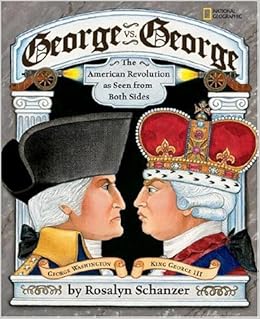
And this one is  (ahem) my version. George vs. George: The American Revolution as Seen from Both Sides shows how there are two sides to every story.  I got to meet George Washington and King George III and paint their pictures myself.
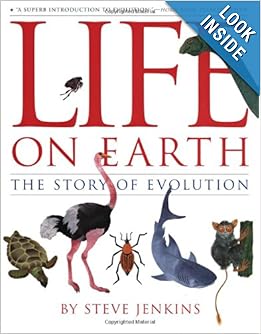
OK, on to the second set.  In one way or another, the next 3 books are all based upon Charles Darwin and his Theory of Evolution. Let's start with Steve Jenkins' handsome book Life on Earth: The Story of Evolution.  With a nod to Darwin, Steve has created a series of stunning collages along with fairly minimal text in order to focus on the history of all the plants and animals on the planet. 
And here's yet another nod to Deb Heiligman for her celebrated true tale of romance between two folks with opposite views of the world. Despite Emma's firm belief in the Bible's version of life on earth, she and Charles enjoy a warm and loving marriage.
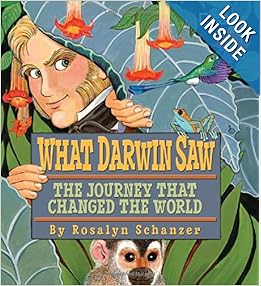
Mine again. What Darwin Saw: The Journey that Changed the World, tells about Darwin's great adventures as a young guy while traveling around the world. We're on board In this colorful graphic novel as he picks up the clues that lead to his Theory of Evolution and then does the experiments that prove it.
And here's series number 3.  Apparently these authors and illustrators were hard at work at the very same time on three very different picture books about the very same person; her name is Wangari Maathai, and she won the Nobel Peace Prize for bringing Kenya's trees back to life after most of them had disappeared. 

The artwork in all three books is outstanding, and each version is truly unique. The writing styles vary enormously too. I strongly recommend that you look at them side by side to prove that there's more than one way to skin a cat.  

Planting the Trees of Kenya was written and illustrated by Claire A. Nivola.


Wangari's Trees of Peace was written and illustrated by Jeanette Winter. 
And Mama Miti was written by Donna Jo Napoli and illustrated by Kadir Nelson.  
I'd bet anything that these folks didn't know they were creating books about the same person until all 3 versions were finally published....writing and illustrating books is a solo occupation if there ever was one. 

OK, that's it--though we could easily go on and on.  Here's hoping that if any kids examine a whole series of books on the same topic written and illustrated in such different ways, they can come up with some unique new versions of their own....and have some fun at the same time. 

Monday, March 10, 2014

Picture Books and Middle Grade Readers: A Perfect but Uneasy Mix?


You can’t judge a book by its cover?  Rightly or wrongly, we all do.  In the children’s book market, trim size matters too.  And, when you’re a nonfiction picture book author, these two criteria create a complicated mix.

Here’s why I’ve been thinking about this subject.  Last year, Penguin’s paperback imprint, Puffin Books, approached me and illustrator Elwood H. Smith about combining our books, The Truth About Poop and Gee Whiz, into one digest format edition for the middle grade market.   Why not?  Where Elwood’s original illustrations were vivid and lovely, they were just as funny in black-and-white and worked well in this 5 x 7 ½ trim size.  

 
                          PLUS


EQUALS


Furthermore, this new edition was in a format that says to kids, “You’re older now, grown up enough for a big person’s paperback.  Welcome to middle grade and the road to adulthood.”

The Truth About Poop is remaining in print; in fact, it’s soon celebrating its tenth anniversary.  I’m happy to say it’s still selling, being reviewed on Amazon and hopefully offered in brick-and-mortar bookstores around the country.  But I realize that these two versions, that share the same text and drawings, are for different audiences.

There comes a day in every child’s life when it’s no longer okay to carry a teddy bear outside or hug Mom in public.  For most kids, there’s also a time when reading landscape-format or square-shaped picture books with bright illustrations becomes taboo—at least in public or outside the classroom.  The same material that can amuse, amaze and be shared in black-and-white and portrait-shaped rectangles doesn’t cut the middle grade mustard when it’s in color.

But, here’s the rub.  So many nonfiction picture books in these sizes and shapes are written for this age group and even older.  This short length is just the right sized introduction to an idea or subject that can become an abiding interest.  Beautiful pictures or photographs not only bring these subjects gloriously alive, they are a “working vacation,” providing additional information while they also give respite, letting a young reader stay involved while absorbing what was just read. And our readers may need this rest.  We often write about complex situations or questions with high level language and abstraction.  We talk about the ingenuity of Ben Franklin, the eccentricity of mathematicians and Thelonius Monk, the stuff that stardust is made of. 

The Truth About Poop and Pee just came out on March 6th and I couldn’t be happier.  It translates well into its new format, and snuggles comfortably into its new home on bookstore shelves where every book is the same dimension.  If it reaches new readers this way, I’m very delighted.  I’m glad I can nurture an interest in biology, chemistry, sociology, history while kids just think they are reading about poop and pee.

But I also hope these same readers won’t be so ready to “put away childish things” and will still be willing to explore the wonderful world of nonfiction picture books in living color.

Wednesday, May 8, 2013

When Facts Change...Again!

New information can be tough to swallow at times. I wrote previously on I.N.K. about my picture book based on the USDA Food Guide Pyramid that had to be updated due to a change in the graphic (see middle image, below). It happened again in 2011 when the MyPlate program was introduced. Actually, I prefer the plate graphic to the pyramids, which were visually awkward to work with.
My ever-alert editor at Holiday House, Mary Cash, sent me an email the day the news appeared in the New York Times. It was a surprise, but there's no sense crying over spilled milk, right? Obviously my 1994/2007 book The Edible Pyramid, which was set inside a pyramid-shaped restaurant, was instantly defunct. Or was it? More about that in a second. 

A new approach was needed, so I began to noodle on it. For some reason, the idea of having big images of various foods with a small main character popped into mind. Have bugs as characters? Hmmm...obvious downsides to that. How about if the food is accidentally put into a machine that enlarges it...sounds implausible at best, or just plain dumb. Oh! I know who it's gonna be: that classic character Jack, who climbs up the beanstalk! So I wrote the story, yada yada, made a dummy, yada yada, digitally painted the illustrations, and yada yada, here it is:
Or will be, soon. It's technically a Fall title, but books have a way of getting around before their official birthday, you know? The story starts out like the traditional fairy tale, but instead of eating Jack, the giant cooks him a healthy meal. The giant, Waldorf, is definitely a good egg.
The book is designed to be a fun introduction to MyPlate and hopefully to a lifetime to healthy eating for kids. The goal for the illustrations was to show an abundance of fresh, appetizing foods, the best starting point for good meals. No processed factory foods here, except at the end under the Empty Calories section.

What about the leftovers, the existing copies of The Edible Pyramid? I was surprised to find out that some educators are still using the pyramid system, because the main difference is the presentation rather than the content. It can take awhile for some organizations to make the transition, apparently. So it's still selling, if not like hotcakes.

In any case, I'm looking forward to cooking up some activities to go with the book. Okay, I'll stop with the food and eating sayings now. Stick a fork in me, I'm done!

Monday, March 18, 2013

Hear Me Roar/In Numbers Too Big to Ignore

As I write, it's the Ides of March, official anniversary of Julius Caesar's deathday (44 BCE) and the 246th birthday of cantankerous  Andrew Jackson. That is, if this U.S. President No. 7 hadn't been dead for years.  But this post  goes live on Monday the 18th and seeing as I'm a nonfiction author, given to enthusiastic bouts of looking things up – man oh man, the things there are to FIND OUT.   It turns out that a Scottish MP was born 18 March 1891. And on a September night in 1954,  during Alice Cullen's time in Parliament, hundreds of her young constituents (ages 4 ~ 14) had to be calmed down, and told to take their knives and sharp sticks and leave a huge old cemetery in Glasgow.  Why were they there?  Hints: 1. Vampires. 2. Comic books, 

In any event, if you're reading this, you may well know that Black History Month grew from the strong and certain belief of such African American scholars as Dr. Carter G. Woodson and  Dr. W.E.B. Du Bois that the history of their race was a rich subject for deep academic attention.   Out of this devout certainty came Woodson's brainchild, the first Negro History Week, born in February 1926.  Why shortish, mercurial February? Because African Americans had long been celebrating Lincoln's birthday and the one which Frederick Douglass chose for himself: February 14.  In 1976, America's Bicentennial, after 50 years of progress, protests, violence, and breakthrough civil rights legislation, the week was expanded to a month's worth of study, commemoration, and celebration. 

So how is it that March was set aside for making the citizenry aware of women's history?    Because of history, as you might expect.  Or "herstory," as we might have said back in the 1970s, if it hadn't seemed so pretentious, stilted & weird.  On March 8, 1857, just a few days after James Buchanan's inauguration,  New York City needleworkers  so badly needed to work fewer hours (10 hrs. per shift) in better working conditions, that they went on strike. Heavy-handed policemen, under orders, busted it up.  Even more violent was the garment workers' strike in 1908 - on March 8, in honor of those who'd gone before. So it was that the Socialists attending their International Congress  in Copenhagen, Denmark, chose March 8, 1910 as the first International Women's Day.   So, after 60-some years of parades, protests, the Vote, the Pill, and doors forced open, a group of Californians launched an official "Women's History Week" for the week of IWD, 3/8/1978.   That week grew to an entire month, to be proclaimed presidentially and noted nationally, as of 1987, by way of a joint U.S. Congressional resolution. (It's said that a Republican and a Democrat - Orrin Hatch and Barbara Mikulski – actually co-sponsored the legislation. Those were the days, my friend; we thought they'd never end.)

I Am Woman 

Check out these books ANY time of year, but especially now, in Women's History Month,  do avail yourself of this dozen-or-so books (to name but a few) about those who came into the world as girls.

•    Ballet for Martha [Graham], by Jan Greenberg, Sandra Jordan, and Brian Floca.    •   Lives of Extraordinary Women: Rulers, by Kathleen Krull and Kathryn Hewitt     •   Minette's Feast: The Delicious Story of Julia Child and Her Cat  and Clara Schumann: Piano Virtuoso, both written by Susanna Reich    •    What To Do About Alice? How Alice Roosevelt Broke the Rules, Charmed the World, and Drove Her Father Teddy Crazy by Barbara Kerley and Edwin Fotheringhan   •   Write On, Mercy!: The Secret Life of Mercy Otis Warren and  Jeanette Rankin: Political Pioneer, both by Gretchen Woelfle   •   Elizabeth Cady Stanton and Susan B. Anthony: A Friendship That Changed the World, by Penny Coleman   •   Bylines: A Photobiography of Nellie Bly, written by Sue Macy   •   Helen's Eyes: A Photobiography of Annie Sullivan, Helen Keller's Teacher, written by Marfe Ferguson Delano   •    Remember the Ladies: 100 Great American Women and  Rabble Rousers: Twenty Women Who Made a Difference,  both by Cheryl Harness      
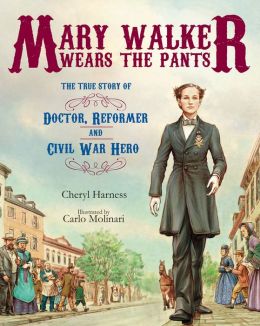
By the way, if it happens that you don't read my newest, Mary Walker Wears the Pants,  DO read someone's book about this real, live, courageous, idealistic, stubborn-as-all-get-out,  high octane woman, whose history is well worth the knowing. Pretty well summed up in the subtitle: "The True Story of Doctor, Reformer, and Civil War Hero."  DO read up on Dr. Mary Edwards Walker,  a valiant, eccentric Medal of Honor winner (only woman to whom it's been awarded), best known in her time as a cranky, outrageous  female, who was determined to free those of her sex from genteel purdah.  From steel-boned corsets and their long, heavy, unwieldy skirts and petticoats.   (Fun to wear once in a while - a reenactment deal or a school visit - like being a transvestite in a time tunnel. But every day? Just. Shoot. Me.)   

 So, regardless of their race or gender, grateful I am to those souls who braved the storms, walked the walks, and fought the fights.  They all deserve a medal.


Dr. Mary Edwards Walker


Tuesday, March 5, 2013

ALERT THE MEDIA – YOU ARE ABOUT TO BECOME A FAMOUS AUTHOR AND ILLUSTRATOR


 Hey teachers!  Kids too!  Are you writing any nonfiction stories in class these days?  Lots of schools are trying out this approach to writing in general, and they’re studying the different ways good nonfiction books are written in particular, especially in light of the CCSS.  So what different kinds of writing might work nonfiction-wise?  There are plenty.


Try doing live interviews or writing a journal, for example—they both count as nonfiction. A few ideas:

Maybe your class can interview various folks who were on the scene during a great or terrible historic event, such as the Summer Olympics or even 911. Or try interviewing somebody who has an unusual job; maybe the old Santa Claus at the mall  or a fireman (naturally) or your mayor or a local musician or a TV personality or your own bus driver. 

And maybe you can pen some truly amazing journals during a field trip to a museum or a festival or an historic site. (Of course if you aren’t going on any field trips, you can always write some pretty entertaining journal entries about the food in your cafeteria.)

Or take a stab at uncovering the true story of how your own family came to America. Whether they got here last Wednesday or 300 years ago, doing the research is a hoot…and be sure to ask your parents or grandparents. You'd be surprised what they know and what you don't.

Or you can write research papers about things you’re learning in class—some examples might include compiling all sorts of comments about the frogs (living or dead) in your science lab, or researching and writing about a disterous Civil War battle for your history class, or making like a professional critic who’s writing book reviews for your English class, or examining the statistical issues behind today’s economic crisis in your math classes without putting anyone to sleep.  Now there's a challenge for you.
 
IT IS OK TO HAVE FUN WHILE YOU DO THIS…YOU DON’T NECESSARILY HAVE TO GET ALL SERIOUS (UNLESS YOU WANT TO.)

Yup, your writing has to shine; that’s a given.  But here’s an outstanding tool that lets you spice up everything you write, gets people interested in your stories and papers, helps you learn faster, makes sure readers remember your most complex material in a flash, and entertains your own self at the same time:
 
JUST STIR IN ALL KINDS OF PICTURES AS YOU GO ALONG.

Really?  Most definitely!  After all, just think about it.  Whenever you go online or watch movies or TV or play video games or look inside certain books, they’re all about the pictures.  Lots of you are probably taking pictures yourself today by using a cell phone, or you’re adding pictures to online sites like Facebook.  So while you’re busy writing papers and journals and stories at school, why not think the way you do in the real world…whenever you write, stir plenty of artwork and photos and other visuals of your own into the mix.

Here are a few tiny examples of the gazillion ways to add pictures to your writing:

TAKE THE JOURNALS, FOR EXAMPLE:
 
When you bring your journal along on a school field trip – or even on a regular day – be sure to bring some colored markers or colored pencils or just regular lead pencils. Then draw the coolest things you see.  Try to show the real world and still use your artistic imagination at the same time.  Put pictures next to the words you just wrote or use pictures to make a rebus or spread pictures into the margins or make them into cartoons or make them extremely realistic.  Let some of the pictures fill a whole page or two or three of their own.  They can most certainly be funny. They can most certainly be serious  or scientific. Doodling is just fine.  Cartoons are just fine.  Beautiful pictures are, well, beautiful and wonderful.  And of course you can draw all kinds of fancy lettering in your topic headings along the way. 
 
Trust me, people will want to see what you wrote if it’s illustrated.  When explores like Lewis and Clark or scientists like Charles Darwin wrote journals, they did these exact kinds of things. Their writing was incredibly fun to read and was informative to the max at the same time.  Yours should be too.
 
Another idea is to take photos during the day, print them out, and tape them in later.  Or collect small stuff you find and glue that in too—for example, add brochures or cut them up and tape some of the picture into your journal. Or add small parts of the plants you see on a farm visit. Or leaves you pick up on a hike during the fall.

AND HOW ABOUT ART FOR YOUR INTERVIEWS?
 
One idea is to draw the person you are interviewing yourself! Or take your own photos of them doing something verrry cool and then paste or tape them into your written work. Or if they have any pictures taken when they were kids, make photocopies and add them to the mix. Even if you write your interview (or any other stuff) online, you can scan in your pictures and imbed them. 

GEOGRAPHY CAN BE MEMORABLE IN SPADES:
 
Make colorful illuminated maps of the places you’re studying and add them into the mix.  To see exactly how this works, go here and check out the pictures
 
MORE TIPS:

Think of cool and colorful pictures you can add to your charts and graphs:
 
If they look great, they can offer readers a fast and entertaining way to learn a lot of boring stats in a single glance.

Try putting the quotes inside of talk balloons that point at a picture of the person who's being quoted.  Maybe this person is a new cartoon character of your own creation (kind of like the one Jeff Kinney made up for his Wimpy Kid), or maybe you can research what the people you quoted really looked like and what they really wore, and then draw them accurately.

FAMOUS LAST WORDS:
  

YIKES! Art is in danger of disappearing from our schools, and that would be a DISASTER.  Help bring it back by adding artwork to your written work in school.  

Paint pictures on wood! 

Rough canvas! 

Pebble board!  

Write words on all kinds of unusual paper.  

Try playing around with paint, scraps of cloth, cut paper, or scratch board, and then add them to your written work.  

Experiment with your photographs.   

Make collages using buttons, flowers, seeds, or leaves picked up off the ground....if your essay or journal is lumpy, so what? Your writing will end up being a keeper, and you will learn to think, be creative, do research, and remember what you wrote about for a very long time.