
Showing posts with label author visits. Show all posts

Wednesday, October 9, 2013

Common Core Connections

Over the last year, the schools I’ve been visiting have been a-buzz over Common Core. Like other INK authors, I have had many educators exclaim “What you do fits in perfectly with common core!’  Frankly, at first, I had no idea what they meant other than perhaps what I’ve been doing for years, apparently, is suddenly in vogue and has new buzz words for it. 

But the more I’ve learned about it, the better it sounds. We as a country definitely need to “up our game” in teaching and comprehension of these fields. My math teacher friends are generally pumped about the common core standards for math. 

A great librarian, armed with his/her resources, is the heart of inquiry in a school. Information and resources come and go from that library and feed into all subject areas.  The idea of “library circulation” goes far beyond books. It has to do with feeding inquiry and information, books, whatever it is, coming and going from the library. So, here we are diving into Common Core, when many schools have laid off the very experts in this kind of inquiry: highly trained librarians. I think folks don’t really understand what today’s librarians do. So, I interviewed one about what she does. (By the way, she has freed herself to do this by coordinating an army of parent volunteers who do all the checking in and out of books and such...all those things one thinks a librarian does.) 

Where else have I seen Common Core, librarians, books, and nonfiction authors working in harmony? One surprising place was in my work last year with Authors For Earth Day, a program founded by Brooke Bessesen. Authors volunteer to donate a portion of their school visit fee to an environmental cause the students choose by vote. 


The librarians at schools I was visiting during Earth Week jumped on the idea, practically wrestled for the right to do it. And it wasn’t just for the feel good aspect of helping the environment. They immediately knew this was a Common Core bonanza which tied right in to nonfiction research and persuasive writing.   Here’s Hella Rumschlag, the librarian who booked me for the visit.

In advance of the visit, I chose five organizations for them to consider:  American Bird Conservancy, the Elephant Listening Project, the Nature Conservancy, the Pollinator Partnership, and the Rain Forest Conservation Fund. These are favorite organizations of mine and relate to my books such as The Bumblebee Queen and Secrets of Sound: Studying the Calls of Whales, Elephants, and Birds. I tried to choose organizations that would give kids a sense of the wide variety of environmental issues and approaches to solving them. Initially, I had chosen a sea turtle organization among the candidates, but the librarian informed me that the turtle is their school mascot so it would have an unfair advantage in swaying the students.

The 5th grade students researched the five organizations. Because Common Core emphasizes evaluating text, especially with regards to who authored it, the fifth graders could really look at the news about these organizations with a critical eye. They wrote persuasive essays on behalf of whichever organization they had. Some students appeared on the schoolwide television broadcast to advocate for their cause. Students in all grades voted on Google docs in order to avoid any paper waste associated with the project. 

When I arrived, the students were excited about the vote that day. When the winner, Rain Forest Conservation Fund, was announced, the surge of joy from the students was so tremendous, tears rushed to my eyes. It was clear that the students felt a sense of ownership; they had done something great for the planet. 

I gave my donation to Rainforest Conservation Fund and told them how it had been generated. They wrote an incredible thank you letter to the school. The letter added an additional layer of education to the project because it delineated, in detail, where the money went and taught about some fascinating new approaches to grassroots conservation in South America and Africa. The kids were read the letter on their morning school television show.

Next, the event was shared districtwide in an education newsletter.  The librarian was thrilled with the results of the program. The kids were so invested in their research, analysis of texts, and their persuasive writing because, as the librarian says, it had “real world consequences.” As for me, I felt like my donation from my school visit fee had been multiplied manyfold in its positive impact on the earth and education. 

How else have I seen creative educators extend nonfiction to fit the needs of science standards and common core? Actually, many of the activities educators have done with my books over the years would fit perfectly with Common Core. It’s a new framework but this kind of text study and math analysis has been done by dedicated teachers and librarians for years. Over a hundred of those earlier activities are on my website, www.aprilsayre.com. Below are some links to common core standards and lessons that have come up in the last year. (Folks just send me links related to my books but I’m sure many nonfiction authors have terrific lesson plans and activities that educators have shared with them about their books, as well. Feel free to add some links in the comments section if you have some in mind.) 

A science unit lesson with common core aspects from AAAS, the same folks who give those wonderful awards for best science books of the year:
http://sciencenetlinks.com/lessons/april-pulley-sayre/

An article in School Library Journal about Nonfiction as Mentor Texts (It includes my whale book, Here Come the Humpbacks.) 

One of my most widely used books worldwide is One Is a Snail, Ten Is a Crab.  It’s easily extended to fulfill common core math standards at many levels.  Here are some related resources for that:

Initial list of Common Core Standards for One Is a Snail, Ten Is a Crab.

As you can see, Common Core is a natural for librarians, teachers, and nonfiction authors who have been involved in inquiry for years. I say, let's embrace it and expand on it. The ideas seem solid and the thinking aspects of these standards are deeper than most previous mandated curricula. The bureaucratic aspects of how it is implemented are the sticky points and those will be fought in districts all over the country. Most of all, we just need to give our teachers more respect and better tools. And bring back librarians—the champions of deep inquiry!


Thursday, June 13, 2013

Being an Introvert


A few months ago, I wrote about heading out into the world to write, and the little teashop I sometimes visit when I’m stuck or stalled—to shake things up and help me see my ideas from a new perspective.

But most of the time, I do my best work at my desk in my very quiet office, all alone, preferably with the dog snoring quietly at my feet. I don’t play music, even music without lyrics. I can’t think with external noise going on. The noise distracts me from what I am trying to hear.

I usually know the basic idea I’m poking/prodding/massaging into life. I pretty much know the what.

What I’m trying so hard to hear in my little quiet office is the how. How do I express this idea in writing most authentically mine?

In her wonderful TED Talk, Susan Cain affirms the importance of solitude, how introverts like me should embrace our need for quiet time. I learned long ago that I need quiet time and even a quiet life (a modest social calendar without too many distractions) to find my writing voice.

But Cain also talks about how introverts should not try to force themselves to be extroverts, and this applies to the other side of a writing life: going out into the world to talk about my books to other people. 

This has to do with authenticity, as well.

When I first started presenting, almost 20 years ago, I tried to be more ‘out there’ than I usually was—bigger, badder, louder—the kind of author who quickly has a room full of first graders shouting back responses in a happy chorus.

I LOVE authors who can do this, and kids love them, too.

But every time I tried this, it felt like a false note, a lukewarm imitation of someone else. What I needed instead, I realized, was to be the best version of myself I can be.

For me this means sharing my passions: the importance of following your curiosity, the importance of being open to new people and new experiences. It also means sharing my enthusiasm for being in awe—of the amazing things people have accomplished, of all the possibilities out there for all of us.

And I don’t have to do headstands while playing the ukulele to do this. I can be this passionate, enthusiastic, amazed and awestruck presenter, quietly talking to kids, teachers and librarians. I can be my little old self: Thoughtful. Engaged. A good egg. And an introvert.

Tuesday, May 7, 2013

ARE WE HAVING ANY FUN YET? TEACHING TO THE TEST


So today (I’m writing on Monday) I was supposed to do a 9:00 AM test call for an upcoming video conference with some seventh graders.  Lo and behold, at 8:30 AM, my screen lights up and a harried-looking tech person appears amidst stacks of boxes.  “Sorry,” she says, “but we have standardized tests all day long today so I’m in a hurry.”  Since our upcoming video conference is based on a book I wrote about the Revolutionary War, I ask her if the students have studied that period yet.  “Not much,” she says.  “All we do in this state is test, test, test, so the kids don’t learn a thing.”

Hmmmm….I think she was in such a hurry that she was accidentally thinking out loud in front of a total stranger.  But she’s definitely not alone.  I hear this same complaint from teachers all the time when I visit schools. 

Ever since the No Child Left Behind Act first reared its head in 2002, kids in have had to take tons of standardized tests, and if they don’t do well, their schools pay the piper.  They stand to lose federal funding and free tutoring and worse.  These tests cover a very narrow part of the curriculum, but they supposedly show whether kids are learning or not, whether their teachers are any good, whether students have to take even more mind-numbing skill-and-drill classes in summer school, and whether they will stay awake long enough to pass to the next grade. Cheating is common—even some teachers and principals cheat by upping the test scores because teachers and principals can get fired or get a fat raise depending upon the results. Kids are bored to death or stress out over these tests. And nobody is having any fun. 

The worst part is that so much invaluable class time is spent teaching to the tests at the expense of every single thing that can get kids excited about learning.  Who wants to sit in a chair all day long and study from some dry-as-dust standardized test prep book just to keep their school out of trouble?  And as updated more “interesting” tests get progressively harder, even more test prep is in the works. 
 
Ahem. Ladies and gentlemen, there are better ways to teach and there are better ways to learn.   Why would anyone want to give up creative hands-on activities or ignore great music and art and foreign languages and amazing stories from history just so that they can mark the right box on a test form?  Who want to cut out class trips, whether they’re to the school library (to find some great nonfiction books, of course) or to some outstanding museums or to the great outdoors?   What is happening to young peoples’ health when physical education and even recess give way to studying for the tests? What if a class wants to explore a certain topic in depth?  In many schools, plenty of such worthwhile and beloved activities are on the chopping block.

Even the best teachers have trouble raising test scores under certain conditions. In some places kids can come to school hungry. Some neighborhoods are like revolving doors where students come and go all the time. Plenty of parents are overworked or jobless or have other problems that keep them from getting involved with their kids’ education in any way. If students have recently moved here from foreign countries and are not fluent in English, they will fare poorly on the tests no matter how smart they are.  But the tests reflect none of this.  They don’t show a thing about individual student progress or whether kids can think creatively or whether they have good critical thinking skills or whether they love to learn. 

But at least someone is thinking creatively out there. I loved this article entitled Eighth grader designs standardized test that slams standardized tests. Its your homework, so of course you have to read it.

Monday, April 15, 2013

Confessions of a Sissypants

"Adventure is just bad planning." Roald Amundsen

"Adventure is worthwhile in itself."  Amelia Earhart

So, okay, I've written about many an adventurer. 

Seafaring pioneers, living in close, seriously smelly damp quarters, offering up prayers and rationing their limited quantities of foul food and beverage down below the decks of the pitching, tossing Mayflower.  

John Adams setting off on horseback [me, I sat astride a horse exactly once, when I was about 9 years old, feeling as if I'd been plunked atop a the broad, warm ridgepole of a living house] to Philadelphia, not quite 400 miles from his Braintree, Massachusetts farm. Picture this earnest, talkative lawyer and his 11-year-old son daring their voyage to France in the winter of 1778. Crossing the Atlantic, whose waves were thick with the ships of His Britannic Majesty, who had less than little use for John Adams or any of the rest of his treasonous buddies at their upstart Congress. 

Teenaged Ben Franklin on his own, a runaway apprentice, hiking across NJ to PA.  Or stranded in London.

Sister Sojourner, long in years (47 or so), poor in pocket, rich in conviction, setting out on foot to speak the Truth.

Teenaged express riders, each alone but for his pony and mochila full of mail, pounding away through the wilderness. 
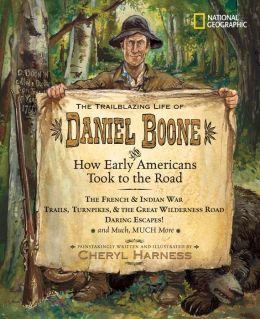
Dan'l Boone, Adventurer
Daniel Boone. Need I say more? No, I think not. 
Teddy Roosevelt.  Ditto.

True, setting out to write about someone, some long-gone event is a voyage of discovery. There are suppositions to be challenged. Facts to be discovered and verified.  True, one must travel to walk about where others have walked before. Photographing. Sketching. Envisioning the vanished past. Thanks be to all that is holy for historic sites and practitioners of living history at such places as Plimoth Plantation and Williamsburg

 Grateful as all get out am I that I got to do it but it occurs to me that I've not been entirely worthy of writing and illustrating stories about these valiant souls.   I'm afraid that my feelings regarding adventures are more aligned with those of Bilbo Baggins:  "We don't want any adventures here, thank you!..."nasty disturbing uncomfortable things! Make you late for dinner!"   That being said, I'm awash with pre-travel oogly-booglies because way too early tomorrow morning I'm off on one those beastly things. By the time any of you read this post, what I hope won't be part of any posthumous noting of my final efforts, I will have well and truly had an adventure to the Brent International School in Manila.  About which I'll write and have pictures for next month's post, God willing. 

I'll have had moral support from fellow INK-sters Deborah Heiligman and Susan Kuklin, bless 'em, regarding changing planes in Tokyo.  They could have advised me to put on my big girl panties and deal with it, for crying out loud, but they knew to be kind to a rattled soul standing, bags packed, upon a ledge and/or brink.  More to the point of this blog, for these 3rd, 4th, and 5th graders on the far side of the world, I shall be conducting writing workshops. Certainly I have done these before and have been charmed, sometimes chagrined, and knocked out more than once by the work of young writers. But because my presentations have generally consisted of 1. my being entertaining and instructive – about history, about writing about history, about finding the facts because making the past come alive but not in some horrid zombie way– before the convened, silent but for their laughter. And 2. a boatload of jolly Q & A.  Working with young writers is a comparatively foreign country. An adventure.

 In preparation, I'm finding a wealth of information gathered by those who manage classrooms every single day – wait. I must go put on a hat so I may take it off to those who daily convey the nuts and bolts of commas, indenting one's paragraphs, and constructing clear narrative to newbies in acceptable forms of written communication. It occurs to me once more that writing is one skill set, acquired by years of writing and reading; teaching writing, quantifying traits, all six, is entirely another.  And nothing is more instructive than preparing to instruct. I'm so eager to meet these young writers, who've been reading my take on the Pilgrims, the Pony Express, Daniel Boone, etc.  Oh to BE there, listening, sharing, guiding, and applauding their efforts. If only I didn't need to GO there.

to be continued.... 


Monday, December 10, 2012

Ingredients for a Great School Visit

I had another I.N.K. post just about finished when Kelly Milner Halls' plea for school librarians and a package pushed me in another direction.

The mailer came from Carol Sweny, the Henniker Community School librarian, in Henniker, NH, where I had recently talked to kids, K-8.  The disc of photos recording my two days there included all the ingredients of a great school visit and reminded me how often a school librarian is at its core.

In the school visit's section of my web site, I have a version of what most authors say on theirs: I find that when kids are prepared for a school visit, they get more out of it. So I ask that students have access to some of my books beforehand, and read (or are read) at least one of them.  I also have downloadable pictures of me and book covers to make a poster for your hallway.  These efforts alone will invoke kids’ interest and enthusiasm, making the visit more memorable for them.

Remember you can click on all these pictures to make them larger.

This statement isn't an ego thing or a plea to buy more of my books beforehand.  When kids know I'm coming, when they have read or heard some of my books, they are psyched to see me.  They have had time to think and wonder about things, they listen more attentively, they ask more questions.  They get more out of the experience.  It's not that I can't grab an uniformed class or auditorium's attention; I can.  But time after time, I notice that prepared kids have a better experience. 

Like Kelly, I know that classroom teachers and principals are overloaded.  Some may not even know an author is coming in time to prepare.  Besides they are trying to get through their curriculum and whatever enrichments they have planned, let alone teaching to whatever state test is coming up next. PTO parents work hard to raise money for author visits, but their role doesn't usually extend to the classroom or library.  The school librarian is the perfect person to rally the troops: to prepare the kids in library class, to suggest and facilitate related classroom exercises, to organize book order forms, to generate excitement.

The Henniker has one author come each year, and Carol Sweny makes the most of it. I'm not suggesting that every school or school librarian wants or needs to put in the time and effort she did.  Perhaps showing how she rallied her school, however, will remind people how important it is to have school librarians and how much their efforts, with school visits and everything else, help kids learn and grow.

Here is part of the flyer Carol made to pass around to the teachers.


As you saw, grades K through 4 saw a presentation based on my book On This Spot, which takes New York City back in time to when it was home to forests, glaciers, dinosaurs, towering mountains, even a tropical sea.  This presentation included, among other things, kids taking many different objects and sorting themselves into a timeline.

Carol asked the teachers to have their classes use timelines to supplement normal learning.  They did so in different and wonderful ways. The school's corridors were festooned with examples of this interesting way to think about time and history.


The kindergarteners made timelines of their days.   

First graders created a timeline that would record a whole year of learning month by month.

The 2nd graders made illustrated lifelines.
Third graders did their lifelines too.
 
Here's a new way for a 4th grade class to think about the making of the Statue of Library. 

The 5th grade concentrated on learning new computer skills while doing their personal timelines.

The 6th grades' timeline of our presidents was perfectly timed since my visit occurred shortly after the election in November.


The 7th graders learned research and computer skills creating a timeline of Henniker's history that took up an entire hallway.
 
The 8th grade's timeline cascading down the stairway brought their study of the Harlem Renaissance to life.


As Kelly so wisely said, school librarians (any librarians) are teachers. They build relationships, spark imagination.  We should fight for them.

I would fight for Carol Sweny.  Besides a great school visit, she gave me a moment of feeling like a rock star.  Check out what greeted me when I pulled into the school parking lot.

Friday, May 25, 2012

Author Presentation - All Tied Up


Last month, I wrote a somewhat tongue-in-cheek post titled Lessons Learned - Author Presentations. The comments and suggestions from readers of that post were fantastic and very helpful. Today, I thought that I’d share a little about my recent Author Visit -mixing it up with knowledge I learned and information I shared, all wrapped up with some very touching and creative thank you cards.

 During my Introduction while described my childhood, I explained that I liked to read, make stuffed toys for my brother, and secretly write and illustrate stories in my closet. And, I liked cotton candy. These elements were woven throughout my presentation.


Of course, cotton candy got a huge reaction.

During my Writing portion, I showed them how I feel some days, while I am writing.


I think all the students could relate.
(Also, I shared, "The fact that I'm talking to you instead of writing is yet another way that I'm procrastinating.")

The only problem I had was my throat became dry while talking for all that time. I brought my trusty water bottle with me. But, like I shared to a friend, “When I stopped to take a drink, I had 60 pairs of eyes glued on me.” There’s got to be a secret to being able to speak and not get a dry throat.

Though I’ve done classes and presentations, this was my first go at a Powerpoint presentation. The previous week during a sold out show at a large, local theater, the speaker’s Powerpoint presentation continually got the “spinning ball of death”. I was so scared that was going to happen to me. The teacher and I tried to match our schedules so I could to go in a day or two early and check to see if the presentation ran okay. But, in the end, I had to cross my fingers and arrive at the school 45 minutes early to get everything working. Let’s just say that the presentation finally got on the screen five minutes before the students came in. Lesson learned: buy a projector!

The teacher told me later that the students were talking about my presentation and writing the entire rest of the day. She said, “The students were so excited about your visit and now inspired to write their own stories!”

Here’s a few nuggets from the cards and letters:
“You inspired me to draw and write.”
“I will probably buy your book it sounds really good.”
“I want your book so badly.”
“You rock, Mrs. Lewis.”
“I think your presentation was awesome.”
“You have inspired me to become an author! I’m sure The House that Jill Built will be awesome.”
“I will read the book right when it comes out.”

Would love to share all 60 wonderful comments. But, I’ll stop at those. Gotta love 'em.

The one thing that strikes me while I’m rereading all these cards is they are all extremely creative and unique. Our schools are truly filled with some amazing talented and creative students. They are the creators of our future.


Friday, April 27, 2012

Lessons Learned - Author Presentations

This week, I was schooled by a third grader.

I’m in the middle of an art lesson. Bryson says loudly, “No, dude. The planet.” I stop and look over at him. Then, I get the joke. They got me. All the boys are on the floor laughing. I’ve lost them, again.

Thanks to my magazine articles and an upcoming nonfiction book, I’ve been getting requests to talk to local classrooms. What am I going to say? How can I keep them interested in all the knowledge that I want to share? Is there any thing I can do to prevent losing them?

I’ve created and presented Art Appreciation lessons for over 12 years. I’ve created and taught several After School Enrichment classes for the past 6 years. Most cases, the teacher or a mom helper has been in the room. I’ve taught for an after-school Art program for almost two years - teaching at several schools each week and subbing all around the western Chicago suburbs. In those classes, it’s just me. I’ve had my share of challenges. After one class, a teacher walked by as I was putting up the artwork and said, “That must be Michael’s.” I said, “Yes, it is. Are you his teacher?” She responded, “Yup, and good luck with that.” The class was full of Michaels. 

This week, I discovered several websites and blogs filled with information on how to give classroom presentations. Children’s book authors and illustrators are so giving of their time and expertise. The town I live in has hosted several Author festivals. I was fortunate to be able to sit in on many classroom presentations; even made a few author friends through the years, too. When possible, I watched presentations in my own child’s class - my own personal focus group. (One very popular author totally “bombed” according to my son, an eight grade student at the time. The author’s talk was geared for elementary school students not middle schoolers... or, at least, we thought third graders might have laughed at the jokes.) I’ve been a guest at several career days, talking to several eight-grade classes at a time - always an attentive and engaging audience.

Other lessons I have learned:
  • When the power goes out in the building, the whole class screams. (I thought turning the lights out quieted them.) 
  • When one student has to sharpen a pencil, the whole class does, too. (Yes, my pencil box has all sharpened pencils.)
  • When one student has to go to the bathroom, the whole class does, too. 
  • When one student asks to hand out papers, the whole class does, too. 
  • When Gracie jumps up and down and shouts “Mrs. Lewis, Mrs. Lewis, Mrs. Lewis”, she’s going to say, “I like pumpkin pie... and lemon pie... and strawberry pie...” 
  • If there is any way they can glimpse at your lesson, they will see it - and tell the class what you are going to teach before you start. 
  • If one child asks to erase the board, they’re all going to drop everything and race up to help. 
  • And, finally, there’s always one child who you think is going to be handful who winds up totally surprising you - and that makes you smile all the way home. 
Would love to hear from other seasoned veterans of author presentations. Any interesting stories or humorous antidotes that you would like to share? I need help. I need to be prepared for the Brysons, Michaels, and Gracies.

While telling a friend about my trying day, I said, “The entire class was driving me nuts.” Argh. Another word to delete out of my brain. Wish me luck.

Thursday, February 9, 2012

My John and Tom (Part Almost 3)

I was all set to post the third installment of my FoundingFathersPalooza—an exploration into how I conceived, researched, and wrote Those Rebels, John and Tom, my book about Adams and Jefferson. And I’ll post the final installment next month.

But something wonderful happened a few days ago that fits in so nicely, I couldn’t resist talking about it. You see, in a couple of weeks, I get to meet John and Tom.

In person.

I’ll be participating in the John F. Kennedy Presidential Library and Museum’s “Presidents’ Day Family Festival” at the JFK Library in Boston, on February 21st.

And John and Tom are going to be there!

OK, technically, John Adams will be played by Thomas Macy and Thomas Jefferson will be played by Bill Barker – but take a look at the links. Don’t they look fabulous?! Both men are real history buffs and I know will do Adams and Jefferson proud.

We’ve been doing a bit of emailing, setting things up. Under the signature line for Thomas Macy’s emails are the quotes:

"Querulous, bald, blind, crippled, toothless Adams."
- Benjamin Franklin Bache
"I'm not crippled." - John Adams


And Bill Barker signs his emails:

Yr' hm'bl sr'vt,
Thos. Jefferson


I think this is going to be fun…

I am geeky excited. For someone who spent over a year working on the book, this is the next best thing to a time machine.

If you will be in Boston on Feb 21st, please join us, won’t you?

Wednesday, October 5, 2011

A Leap of Faith


Years ago, when publishing was in its heyday, established authors could sell from concept. Here’s how it worked. An author and an editor did lunch. (The publisher picked up the tab.) They discussed possibilities for future projects. When the editor liked an idea s/he said, “Write me a proposal.” That was it. There was trust that the author would deliver a book that they would be happy to publish. The author walked out of the lunch confident of an assignment with money to follow. That was then. Now even established writers have to do proposals complete with a marketing analysis, detailed outlines, maybe a few well-written chapters, and loads of background material. Then they wait for the proposal to be reviewed before a full committee, which seems to be more dedicated to why they shouldn’t do a book than why they should. In these hard times, the beleaguered publishers must constantly consider their bottom line when investing in a project.

The best editors, however, still know how to imagine along with authors. We all know that every book starts with a vision—a fleshed-out idea of how to create a work. Other parts of society are not quite so visionary. As much as we would like to think otherwise, most people don’t “get” innovative ideas. The popular show, Mad Men, about the advertising industry back in the sixties understood this. Fully articulated and illustrated presentations were required to in order to leave nothing up to the imagination of their clients. They knew that even when a concept has merit and is worth a try, every innovative venture, every work of creativity, requires a leap of faith in order to turn a concept into a reality.

What, then, is innovation? I have defined it as: Creating something new from disparate existing elements used in novel ways to solve a contemporary problem while forecasting its own future growth and development. In my
outside-the-box proposal published last month in this blog I proposed using nonfiction literature in the classroom (nothing new here), combined with professional development from the authors themselves (nothing new here) to help teachers use their books effectively, and ending up with an author visit with the students after they’ve studied the books (this doesn’t happen often but there’s nothing new here, either.) What makes this program innovative? Its scale (school-wide, many authors and many books) and the timing of the professional development—just before the books are to be used by the teachers, so they can immediately apply what they’ve learned and the timing of the author-visits with kids (just when they’ve completed studying a book). The technologies that makes such an ambitious program possible and even more importantly, affordable, are interactive videoconferencing—face-to-face conversations between the authors and the school participants and a wiki, a collective online document that chronicles contributions from all the participants and serves as a written record of the project. The authors don’t need to travel and schools don’t need to pick up the travel expenses and the in-person personal appearance fees. All of us authors know the excitement of a school visit. It is often the highpoint of a school year. I’ve always wondered how the teachers took advantage, back in their classrooms, of the energy and enthusiasm generated by these visits. I believe that my program for Authors on Call does just that. What we’re really offering, beyond expertise and excellent writing is inspiration and excitement. My problem: I needed to find a school willing to test this idea.

Dave Kaplan, principal of the
Edith A. Bogert Elementary School in Upper Saddle River, NJ is willing to take that leap of faith. I met him last spring when I did the traditional author’s visit at his school. Right away, I noticed something unusual about Dave: He was truly interested in me. He attended all my presentations, including my lunch with some of the children. (You should know that this is very rare. Most principals say, “Hello,” and disappear.) I mentioned that I had this idea of a huge collaboration between authors and teachers. Was he interested? He said, “Yes.” But he didn’t get back to me until July when we could make an appointment for him to hear me out.

After our conversation, Dave emailed me: “I just typed up my notes from this morning and as I was typing, I felt my excitement really mushrooming! I'm so thrilled about this venture.... Again, I'm so pumped about this innovative journey on which we're about to embark, and look forward to working with you!” When he introduced the concept to his faculty, he asked for nine volunteers (one to work with each author). He got 28! The entire school! So far, so good. We are currently in the book selection process, where the teachers are doing the choosing. This has only fueled the excitement. The teachers had no problem “getting” the idea and realize that they are part of an experiment; that no one has done what we’re doing. Ultimately, the measures of our success will be from the students and the books themselves.

We are mid-air in our leap of faith.


Monday, June 13, 2011

Author-in-Residence: A Dream Assignment

I have had a great gig this year: author-in-residence at the Michael J. Perkins School in South Boston, a small elementary school set right in the middle of Old Colony Housing Project. Old Colony is being renovated and I was hired to work with the Perkins kids on a blog about being in the middle of a construction zone. I described more about the situation in last October's post.

As the end of the school year approaches, it's natural to look back and access the experience. Having done school visits for many years, I have always been in awe of classroom teachers. Now, I bow down to them. To see what they do every day, day after day, is amazing. To see the pressure to fulfill a state's curriculum--teach X from October 12 to November 3rd and then segue to unit Y on the 4th. To understand more fully how my coming to the classroom with extras means extra resources and richness but extra work squeezing to fit everything in, however worthy it all is.

But some great things happened this year, from K to 5. Some of the highlights:

When the kindergarteners read Mike Mulligan and his Steam Engine, they wondered what the workers on the site had named their machines. They were amazed--maybe a little horrified--when they realized those excavators and dump trucks were just called "it" or "they." That's when the Name That Crane campaign was born--the two kindergarten classes each nominated names, ran campaigns and voted for the name to call the huge crane that lifted the steel (they also learned the democratic process in the bargain, which made the See How They Run author very happy). Voting Day was very exciting, take a look.


Here are the kindergarteners at the naming ceremony--with the Big Giraffe, the newly dubbed 400-ton crane in the background. (A fine name, but I was personally rooting for Mr. Lifty! That's democracy for ya--besides I didn't get a vote.)


For National Poetry Month, one first grade class experimented with acrostic poems, which use the letters in a topic word to begin each line. Then all the lines of the poem relate to this topic. Given what was going on outside their class window, they used the word, CONSTRUCT. This poem above was one of my favorites.
One second grade class is collaborating on a book about the day in the life of a construction worker and what these men and women must do to stay safe. For one week, they spent an hour a day observing the construction site and writing down what they saw.

Then they did interviews; two workers came to their classroom to answer their questions about safety. The kids got to touch and try on the equipment so they could really understand what they were going to write about. In other words, these young kids were learning to research exactly the way we professionals do.


The fifth grade teacher asked me to come in to talk to her class to kick off their nonfiction book writing unit. While I was there I mentioned that I've found that when I'm really interested in my subject, I find that my book turns out better. So this intrepid teacher decided to abandon the "everybody writes about a person in history or an animal" assignment and let the kids pick. Pretty brave for a school where the kids have computer class once a week and no school library, really.

But the next time I came back, the kids were running with it. Give kids a choice and what do they come up with? Books about cancer, profiles of each of the ingredients in pizza, why tears are salty, the history of video games, snakes that swallow their prey whole, New Jersey's role in the Revolutionary war, and a profile of a favorite teacher--among others. Oh, and the Big Bang Theory.

Today I'm going in to show them about dummying up a book. The teacher says it's tough, it's a bit chaotic, but the kids are running with it and have never been so excited about a project. Isn't it the way it should be? Aren't they lucky? Aren't I?

Can't wait for the publishing party.

For anyone who is interested: www.michaeljperkinsschool.blogspot.com