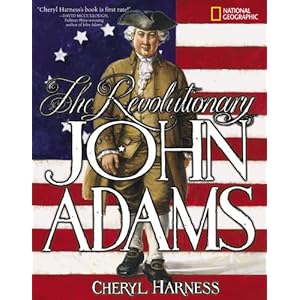
Dear John Adams, you've got a birthday coming up, on the 30th of this month, to be exact. On the 19th, by the old reckoning, set aside when you were not quite 18. It will be your 275th. Wait – let me imagine the glorious light of 275 candles, set into a spice cake, and the breath required to extinguish them. Make a wish, I'd hope you would, for this governing machine that you helped to invent, this ongoing experiment in participatory democracy. I'm imagining what an old Braintree lawyer/farmer/orator/public servant such as yourself would make of the republic for which you and your 'Dearest Friend,' – please pardon me the liberty for thus referring to Mrs. Adams – gave so much. I'm imagining what you'd look like now. I'm thinking of Sam Jaffe as the remarkably well-preserved High Lama in the 1937 Frank Capra film, Lost Horizon.
I doubt you'll read this, having other things to do in the Blue Beyond, but you might wish to know that, though there's no great stone monuments or temples to you in Washington, D. C., you've been the subject of many a heartfelt book, including a couple of mine. More about them later. I was introduced to you, your ebullience and stubborn earnestness in a fine work of historic fiction, Irving Stone's Those Who Love (1965; A book club sent it to my folks when I was 14.) and in Catherine Drinker Bowen's 1950 biography, John Adams and the American Revolution, found in a used bookstore. These as well as Jos. J. Ellis's The Passionate Sage (1993) and David McCullough's John Adams (2001), but how about books for young citizens?
There's John and Abigail Adams:An American Love Story, by Judith St. George (2001); certainly Abigail Adams: Witness to a Revolution, by my friend Natalie S. Bober (1998); and this year's handsome Picture Book of John and Abigail Adams, written by David A. Adler, illus. by Michael S. Adler. But allow me to write a bit about how I went about writing and illustrating the pair of books I did about the Adamses.
In 1994 Bradbury Press published Young John Quincy (Out of print it's been for years, the title being unclear and the world being unfair, as you well know.) It was followed nine years later by The Revolutionary John Adams (National Geographic). The happy problem, in the latter, was distilling your long adventurous life into 48 pages. I pored over said bios along with Esther Forbes' book about Paul Revere - excellent for the feel of your time and place. Not being able to go to your time, I did manage to go to your place, your house, which still sits beside your folks' house, in which you were born.
They were farmhouses in the 1700s. Folks walked or rode their horses or jostled along the country road between Boston and Plymouth. Now they're surrounded by every sort of business, jammed side by side in modern Quincy, Mass, cars, trucks rumbling by. Still, a big fat thrill it was to walk about in your quiet, empty house, straining to imagine your family there, especially in those months and years that you were away. I drew out a floorplan. I drew out a grid: 48 squares and planned out the pages, envisioning which part of your story would go on each page. Such a book as this, I was telling a bunch of kids just day before yesterday, is an imagination/education combination. In the outlining, one is already imagining the writing. It took me a couple of weeks to write. One must be accurate, concise, and engaging. Make it snappy. The illustrations took ever so much longer. They always do.
I studied the paintings and engravings of you, your times, and books about clothing and transportation, as these were fashioned in the 18th century. I set to drawing, in pencil on tracing paper, on which I'd drawn the margins. Reference books clamped open with bulldog clips, propped on the edge of the table, an old oak library table (used furniture store in Colorado Springs.) One has to write first, I tell kids, so you know what the words say AND so you know how much space the words require on the page. It's as if you're choreographing a dance between the words and the pictures.
I photocopy the drawings. Mr. Adams, how you would have reveled in the ease of a copy machine! I tape the copies together into a dummy, transfer the drawings to illustration boards. Watercolor. Ink. Colored pencils. I use them all, mostly the paints, each painting taking a full week of 12 to 18-hour days. In particular I remember your book, Mr. Adams, of all the books I've illustrated. There was an ice storm, knocking out the power for 8 days. I'd have to heat up my hands in warm water to keep on painting and knock off work when the sun set - all the better to appreciate your efforts!
In any event, that book seems a long time ago. It was, from my vantage point. Long, long, longer ago are you, but you're still fresh in my imagination. Honored I would be if some young American would discover you in a book of mine, but if they'd understand their nation and its beginnings, find you they must, in whatever book. After all, your story and the stories of all your countrymen and women are each chapters in the story of the republic. Happy birthday, dear John Adams. May you not be forgotten.

 Examples from the kid end? I wrote the Brave Kid series for my younger self, stories in which ordinary children show courage in hard times. I found kids who lived in different eras to bring in another element. But my real message was that you don’t have be an expert in the martial arts to be a hero. Being scared and acting anyway is heroic. Standing up against something wrong, even just a little bit, is heroic. Getting through something really hard is heroic. Way back then, I wish I had known that we don’t have to measure ourselves against an ideal or end goal to be brave. Trying is brave.
  An example from the adult end? I’ve already blogged about why I wrote On This Spot, a book that describes a specific place in New York City from present day all the way back through geologic time. In this post, I explained that I was inspired by overhearing a young girl who was very upset and couldn’t quite fathom that things would change. (http://inkrethink.blogspot.com/2009/08/sometimes-truth-finds-you.html)