Blog Posts and Lists
Thursday, April 11, 2013
I Can Just Ask!
Friday, February 10, 2012
Everything Is a Process
A few days ago I got
a letter from Nanon Williams, one of the inmates in my book No Choirboy. [This is a photograph of Nanon during our interview. The reflection is due to a Plexiglas wall between us.]
We’d been corresponding since 2005, when I interviewed him on Death Row in Texas. Having been imprisoned since 1992, when he was seventeen, Nanon had high hopes for a new trial. Since the time of his sentence, laws have changed regarding young people convicted of capital crimes, and forensics have become much more sophisticated. Indeed, while I was working on the book the state’s ballistics expert even admitted that he made a mistake. Nanon, though armed and present at the scene of the crime [a drug buy gone bad], did not kill the victim. Nanon, his friends, family, and lawyers were excited at the prospect that a trial would reverse “life without parole” to “life,” and that he would be released on bail. After months and months of waiting Nanon just learned that the judges refused to hear his appeal. Needless to say, he was devastated.
This got me thinking about the role nonfiction authors play in the lives of the people in our books. My books are pretty much primary sourced. Like Blanche DuBois I’ve always depended on the kindness of strangers. Unlike Blanche, these strangers must be open, articulate, and truthful or there is no book.
My kids, for they are mostly young children and teenagers, are eager to show the world who they are. That includes their bad deeds and vulnerabilities. My obligation, as I see it, is to portray them accurately. It takes a great deal of editing and revising to bring a person’s voice to the page. The interviews can be disjointed, inconsistent, and sometimes somewhat incoherent. There’s no clear narrative, and the arcs are buried. What a listener hears is different from what a reader sees in print. For example, every teen I’ve talk to recently uses “like” in the beginning, middle, and end of almost every sentence. In olden times it was “cool,” and I think that’s coming back. I hope so because “cool” is more fun to pronounce. It’s like puckering up lips for a kiss. [By the way, Happy Valentine’s Day to all.] “Like, when I, like, saw him coming down the, like, street, I was worried that my weave, was not, like, right.” That’s extreme but you get the point. Leaving in a few “likes” here and there can give flavor to the narrative, but it shouldn’t overwhelm. “When I saw him coming down the street, I worried that my weave was not, like, right.” Cool!
One way to safeguard accuracy after heavy editing is to go back to the source. My gang read late drafts to be sure what’s written is what's meant. If they are comfortable with the piece I feel pretty confident. By this point, though, I am totally in love with my gaggle of gabbers. They've been floating around in my head for months, sometimes years. Is it professional to become emotionally involved in these people's lives? I think not. Is it possible not to become emotionally involved in their lives? Yes, it's possible, but sometimes it's a struggle.
What's our obligation to living subjects after the book is published? Usually my kids move on and continue their owns lives as I do mine. Some relationships evolve into friendships. Then there are a few people I feel compelled to help.
Which brings me back to Nanon. A marvelous self-published author in his own right, It’s a pleasure reading his letters as they are filled with poetic insights. Nanon told me that he was no choirboy before incarceration - that's where the title of the book comes from - and I do not want to romanticize him. But he has grown into a thoughtful, thinking man.
It’s time to think outside the box and do something to help Nanon. Ergo, this blog. Here’s an excerpt from his last letter:
My mom, well, she broke down. I pretended to be confident … I will fight, Susan. I will work harder… I will even work on a book to release every detail I can think of. I am not angry. I realize that I may die in prison, but I’ll never accept it. There’s a lot to do. Everything is a process.
Tuesday, September 20, 2011
Searching for Sasquatch

Hello, everyone! Happy almost autumn! I hope you all had a great summer. I did. I read (but not as much as I said I would), I wrote (put the finishing touches on my first YA novel, out next summer) and I went to the Galapagos. I will write about that amazing trip next month. Before Galapagos I went to New Orleans and ALA where I checked out the most important cultural sites:

“As a freelance writer, I often got paid for being weird,” she admits. “And it’s still true for many of my books and definitely true for my elementary and middle school visit presentations.”
You told me that with many of your books including IN SEARCH OF SASQUATCH you aim to engage reluctant readers. Which I'm sure you do! Where did the book come from? How did it move from an idea to a book?
I wrote a book called TALES OF THE CRYPTIDS in 2006 – an exploration of the evidence for and against the creatures of cryptozoology; mysterious animals that may or may not be real. Many of the legends seemed unlikely to be real, but a few were surprising in that credible evidence did exist to support the possibility of their being true, undocumented new species of animals. Sasquatch, also known as Bigfoot, was one of those surprises. I had limited space to share that evidence in CRYPTIDS so I set out to write a new book about it, and Erica Zappy at Houghton Mifflin Harcourt made it possible.
What was your process in researching and writing it?
I had done some great preliminary research for CRYPTIDS so my main aim was to talk to the best experts in the field of investigating Sasquatch. I went to the scientists, including Dr. Jeffrey Meldrum, and other credible experts. I read their books, I sat through their lectures, I interviewed them first hand, I mirrored their search techniques and really got a sense of how and why these serious people were searching for Sasquatch.
What was the hardest thing about writing this book?
Knowing what to include and what not to include was the hardest part of writing this book. There are so many elements we didn’t have room to include, in a relatively short book for young readers. I was fascinated by the topic, and I hope that shows in the end product. I hope kids will be as fascinated as I was.
Seems to be a common problem in writing picture books as people have talked about recently here on I.N.K. So what was the most satisfying thing about this project?
When I was a kid, I was one of those squirrel-y kids who asked WAY too many questions. The adults in my life did their best to help me with that curiosity, but answers were hard to come by. The most rewarding part about this book -- and all my books -- is having the license to actually ask the experts, not just for myself, but for all of those kids LIKE me. I do my best to anticipate what THEY might want to know, and reflect that in my final work.
What do you hope for the book?
I love to hear kids tell me they were engaged by the books I’ve written. And I am so lucky that they very, very often do. Kids who don’t normally read get lost in the projects I put together for them, and nothing could be more fulfilling. Our community, the world of children’s writing, is an eyes-open endeavor. We know we may not collect material wealth, beyond having our basic needs met. But we are incredibly rich of heart. What more could anyone want?
Well, that and a country house with a full staff. But maybe that's just me. What’s next for you?
IN SEARCH OF SASQUATCH will be released on October 25, 2011 by Houghton Mifflin Harcourt, and I am so excited to see how it will be received. But my first fiction work, a YA anthology called GIRL MEETS BOY, will be released by Chronicle in January of 2012. My next nonfiction book, ALIEN INVESTIGATION will be released by Millbrook in April of 2012 and HATCHLINGS: LIFE SIZED BABY DINOSAURS will be released by Running Press, also in April of 2012.
You're a slouch, aren't you, Kelly?
Kelly? You still there?
I guess she's back to work. Go, Kelly, Go! And thanks for talking with all of us here at I.N.K.!
To find out more about Kelly, check out her website.
Monday, June 13, 2011
Author-in-Residence: A Dream Assignment
As the end of the school year approaches, it's natural to look back and access the experience. Having done school visits for many years, I have always been in awe of classroom teachers. Now, I bow down to them. To see what they do every day, day after day, is amazing. To see the pressure to fulfill a state's curriculum--teach X from October 12 to November 3rd and then segue to unit Y on the 4th. To understand more fully how my coming to the classroom with extras means extra resources and richness but extra work squeezing to fit everything in, however worthy it all is.
But some great things happened this year, from K to 5. Some of the highlights:
When the kindergarteners read Mike Mulligan and his Steam Engine, they wondered what the workers on the site had named their machines. They were amazed--maybe a little horrified--when they realized those excavators and dump trucks were just called "it" or "they." That's when the Name That Crane campaign was born--the two kindergarten classes each nominated names, ran campaigns and voted for the name to call the huge crane that lifted the steel (they also learned the democratic process in the bargain, which made the See How They Run author very happy). Voting Day was very exciting, take a look.
One second grade class is collaborating on a book about the day in the life of a construction worker and what these men and women must do to stay safe. For one week, they spent an hour a day observing the construction site and writing down what they saw.
The fifth grade teacher asked me to come in to talk to her class to kick off their nonfiction book writing unit. While I was there I mentioned that I've found that when I'm really interested in my subject, I find that my book turns out better. So this intrepid teacher decided to abandon the "everybody writes about a person in history or an animal" assignment and let the kids pick. Pretty brave for a school where the kids have computer class once a week and no school library, really.
But the next time I came back, the kids were running with it. Give kids a choice and what do they come up with? Books about cancer, profiles of each of the ingredients in pizza, why tears are salty, the history of video games, snakes that swallow their prey whole, New Jersey's role in the Revolutionary war, and a profile of a favorite teacher--among others. Oh, and the Big Bang Theory.
Today I'm going in to show them about dummying up a book. The teacher says it's tough, it's a bit chaotic, but the kids are running with it and have never been so excited about a project. Isn't it the way it should be? Aren't they lucky? Aren't I?
Can't wait for the publishing party.
For anyone who is interested: www.michaeljperkinsschool.blogspot.com
Friday, May 14, 2010
A Perfect Relationship
When this guy, who spends his days teaching people about the human eye and colorblindness, heard I actually wanted to talk about cats (and rattlesnakes, for that matter), he was thrilled. This is my life’s work, he said, and I rarely get to talk about it with anybody who’s really interested.
Well, finding people like him is MY life’s work and one of the best things about my job. I start learning about a new topic and after the general stuff, I want more. I want the facts that make the subject sparkle. I want to instantly gain the perspective that takes years of thought and study to develop. And I know that lonely expert can give it to me, if only I can find him or her.
We all love to talk about our work, what occupies us for so many hours each day. Doubtless we love to share it more than others love to listen. But when my expert started in on nanometers and photoreceptors, I was as passionately interested in hearing what he had to say as he was in telling me.
It was, as they say, the beginnng of a beautiful (although temporary!) relationship.
Thursday, August 6, 2009
14 Cows for America: Collaborating and Blog-touring

14 Cows for America by Carmen Agra Deedy with Wilson Kimeli Naiyomah, and illustrated by Thomas Gonzalez, is a stunning new book from Peachtree Publishers. Its spare lyrical prose tells the story of a young Kenyan Maasai warrior studying in the U.S. who returns to his village after 9/11. He tells the villagers about the suffering of the Americans, and they give their most precious possessions, cattle, as a peace offering, "because," Deedy concludes, “there is no nation so powerful it cannot be wounded, nor a people so small they cannot offer mighty comfort.”
I was curious about the genesis of this book and Deedy’s creative process, especially her collaboration with Kimeli Naiyomah, the protagonist of the story and so I arranged an online interview with the author.
When did you begin writing 14 Cows for America?
On April 24, 2002, I stumbled across an astonishing story on page 1A of The New York Times. It concerned a small tribe of Maasai cow herders from western Kenya, who had responded to the attacks on September 11 by offering the United States a sacred gift-- fourteen cows. The article was in-depth, and exquisitely written, and served not only to move me deeply (most Americans were still sharply affected by any reference to the tragedy in the months that followed 9/11), but also to whet my appetite for more information. Were these the Maasai Isak Dinesen referred to in her biography? Were they still the lion-hunters of legend? Were these the same Maasai who now lived on the Mara Reserve? It was clear I had a great deal of reading to do.
Fascinated, I clipped the NYT piece, shared it with friends, and soon began to collect (and to receive from others) a maelstrom of news items, articles, and transcribed interviews. Within months I had compiled something of a dossier on the Maasai, but the true story of their extraordinary gift still eluded me. The first drafts were painfully ineloquent--in truth they were dreadful.
Then, in the summer of 2007, I was offered a writing fellowship at the Carson McCullers House. It was during this hiatus that the story, much as it appeared in the final book, emerged.
When did you begin the collaboration with Wilson Kimeli? How did you communicate?
Kimeli and I spoke electronically at first, and I had to confess to him that I found it odd in the extreme to email and IM with a Maasai warrior. I discovered Kimeli to be in possession of a lovely sense of humor. When we spoke I told him that I had written a story about his part in the gift of the fourteen cows. I wanted him to see it, and let me know if he felt he could give it his blessing. I then sent the pdf and waited. I was overjoyed to hear, in his soft-spoken voice, that he was pleased with the story and would be happy to give it his support.
I invited him, with the encouragement of our wonderful publishing house, Peachtree Publishers, to be involved with the project and write an afterword. He was happy, I believe, to be invited into the process, and the book as a whole was better thanks to his intimate knowledge of Maasai mores, and the accuracy of details he brought to the story. We spoke about the text three or four other times, and participated in creative conferences with the illustrator and the publisher.
How much information did he provide?
Kimeli served primarily as a cultural consultant on the book. In other words, the manuscript was in final draft when it was presented to him. Although he did not write any of the text, he offered suggestions regarding the chronology of events, cultural details, and particulars relating to the Maa language.
He suggested that he be shown consulting with the elders before he tells the story of 9/11 to the tribe as a body--a piece that was absent from any of the news reports. Second, that his cow, Enkarus, be mentioned by name. Lastly, he suggested we use the Maa word, Aakua, in the scene where he is greeted by his mother. I think these were all useful additions. Kimeli served as a cultural consultant as the first illustrations emerged, and provided Tom [the illustrator] with his personal photographs from the day of the ceremony.
What are the advantages/pleasures of working with a collaborator?
This was not a collaboration in which two people hacked out the language of a story together. Rather I brought the writing, Tom brought the sketches, and Kimeli brought his experience as a participant in the story, and as a Kenyan from the small Maasai village of Enoosaen. Together we exchanged views, offered opinions, and listened respectfully to all that was expressed. Then we returned to our separate creative corners to incorporate changes that came out of the exchange.
Kimeli was a wonderful person to work with and I believe his involvement enriched the book. Everyone who took part in this undertaking (from editorial, to art, to marketing) wanted to create something we could all be proud of, in memory of a gesture by strangers who appeared--seemingly from the ether--in the wake of catastrophe.
The Blog Tour
Readers, writers, and publishers have mutated from words printed on paper to words and images on screens in the form of websites, blogs, internet research, do-it-yourself encyclopedias, and you-too-along-with-your-pet-can-be-a-video-star. With these new outlets, fewer bookstores, and anemic marketing budgets, the blog tour has come into its own. Peachtree Publishers has put together a 14 Cows for America blog tour for Carmen Deed and Thomas Gonzalez this week that takes them far and wide in the blogosphere. Think about it–author and illustrator reach thousands of people all over the country the world. True, you can’t autograph books in cyberspace (yet!) but it seems like a great way to launch a book. For the full itinerary of the 14 Cows for America blog tour, go to http://www.14cowsblogtour.blogspot.com/
Tuesday, May 12, 2009
Interview
That being said, however, I thought this particular interview might be of interest. It's interesting to me, of course, because it's all about me. There might be one or two other people out there who also find it fascinating for this reason. But probably not. The other reason that it might be of interest is that the questions come from a magazine in Korea — Mom & Enfant — and the cultural and language differences have resulted in questions that are sometimes charmingly disingenuous. They are, in many ways, more like the quetions that kids ask during school visits that those that come from people in the U.S. who write about children's books. I hope the folks at Mom & Enfant do not mind me posting this. If so, I apologize.
What is the most important thing when you make a picture book?
The idea. If it’s a good one, the text and art seem to come together in a natural way (not necessarily easily, but in a way that seems to make sense as it happens).
Where do you get the idea and inspiration for your works?
From your childhood, life, family, friends?
I used to get many of my ideas from questions my own children asked. But now even my youngest child (he’s almost 11) is getting a little old to ask some of the really simple questions that used to lead to book concepts. So my wife (and co-author) Robin Page have become sounding boards for each other – we frequently bounce book ideas back and forth, and in the process sometimes hit upon something we both like. Ideas also come from books, films about nature, and just looking around.
I think you enjoy painting animals. Why? Why crocodile?
Illustrations of animals seem to have more energy than illustrations of many other subjects. I also find that the distortions and inaccuracies that always creep into my pictures have the effect of giving the animals a bit of personality. Those same distortions would probably make an illustration of a human downright creepy. And, of course, animals are frequent subjects because kids are fascinated by them. Animals can be used to introduce lots of concepts other than biology – geological time scales, the qualities of different habitats, the relationship between size, strength and weight, and so on. Crocodiles are a favorite subject because their wrinkled skin and the well-defined seams where different parts of their bodies meet lend themselves well to translation into cut-paper. Insects and fish are also good subjects.
What kind of influence do you want to give people? What kind of feeling and emotion do you expect to give people?
Ideally a reader would look at the world from a slightly different perspective — and maybe look a little more closely — and experience a greater appreciation of the complexity and beauty of nature. It’s easy to take something absolutely extraordinary – a tree, say – for granted, because it’s so familiar.
I think all of you works are precious. But please choose the best. What is the reason?
I guess I’d choose ‘Life on Earth’, because it was the most difficult book to write. I wasn’t sure if I could explain the Theory of Evolution to a seven-year-old, but I think that perhaps I succeeded. And, as you know, there is a lot of controversy in this country about teaching evolution to children, which is a real shame. So I hope that this book helped a few children see past the politics to the clarity and elegance of Darwin’s ideas.
Did you enjoy reading a picture book during your childhood? Which one was your favorite? Why?
I read lots of picture books – mostly fiction. There were not that many non-fiction picture books around when I was a child. My favorite – it was illustrated, but not really a picture book – was “All About Strange Beasts of the Past” by Roy Chapman Andrews. It was about his search for fossils in Mongolia in the 1930s.
What kind of a boy were you? Did you enjoy painting? How about your family? Were they interested in painting?
I was a bookish boy, but I enjoyed sports. I had a microscope, a chemistry set, and kept lots of bugs, frogs, turtles, etc. that I captured in nearby fields and ponds. My father was a scientist – a physicist – but he painted as a hobby.
Did your parents have an influence on your job and painting?
My Father encouraged my interest in science and art.
If not, which environment and education make what you are?
I attended design school in college and have worked for many years as a graphic designer. I’m sure this helped me become an illustrator.
What activities do you think could help to improve children’s creativity and imagination?
Reading, being read to, travel, reading, going to museums, reading, watching some of the amazing films about nature that are now available (e.g., David Attenborough’s BBC films on the ocean, birds, mammals, etc.). Being listened to and taken seriously by adults when a child asks a question. Looking up the answer with a child if you don’t know it. Reading and being read to. And providing simple tools like a magnifying glass or butterfly net will often lead to an exploration of some aspect of the natural world.
What did you do when you were a kid?
Read a lot, drew pictures, explored the fields and woods around my house, played basketball, thought about girls, made dangerous concoctions with my chemistry set.
What kind of book do you think is a good picture book? What kind of illustration is the best? Why?
A good picture book has words that wouldn’t work without the pictures and (usually) pictures that wouldn’t work without the words. They don’t restate each other, but each adds something essential. A good picture book respects the intelligence of the child and doesn’t try to preach or teach an overt moral lesson.
There is no ‘best’ illustration. Illustration that is an honest expression of the way an artist sees the world will have a truth and power that children intuitively recognize.
There are various cultures all over the world. What do you think the reason lots of people from foreign countries like your works regardless of culture difference?
I think a child’s interest in nature and animals is universal. I’d speculate (without any real scientific data to support my speculation) that it’s part of our shared cultural memory. For most of human history an awareness of animals – as food, danger, or as a source of information about weather, water, and so on – was essential to our survival as a species.
In the world, there are so many countries, so many customs. Did you recognize the characteristics and differences of illustration and picture books each country? What kind of difference did you recognize?
I do see some differences in, for instance, Asian illustration and European illustration. Artists are naturally influenced by and refer to the visual arts traditions and popular culture of the places they live. But one can’t apply this sort of generalization to an individual illustrator. There might be an American illustrator who references Japanese prints and a Korean illustrator who is influenced by American comic books.
What do you think is the characteristic of picture book or illustration of USA?
Children's book illustration is amazingly diverse, so I don't think I can characterize US illustration in any overall way. The US is also a very young country and doesn’t have the centuries of art heritage that an illustrator working in China or Italy might refer to.
What kind of efforts have you made to read children’s mind and understand their world?
I don’t try to read children’s minds. I do try to keep in perspective their language skills and what I imagine is their general knowledge of the world, so I don’t write text that is too difficult for them to understand. I’m referring here to vocabulary, grammar, and metaphors or comparisons rather than concepts. I think even young children can grasp most of the ideas I’m writing about in as easily as an adult – they just need them explained in words they understand and in a context they can relate to. Other than that, I write about things that I find interesting myself. If I’m truly interested, I think that comes through in a book’s word’s and images.
Wednesday, October 8, 2008
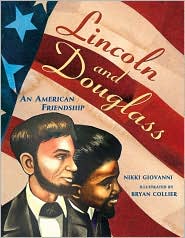
Nikki Giovanni and Laura Godwin on nonfiction
One of the first questions I asked is where the idea of writing about the relationship between the two men came from, as opposed to doing a biography of either individual. Nikki answered that Laura initiated the idea for this project. Showing the importance of timeliness with books, Laura noted the impetus for this project. "I knew there would be a lot of books out for the bicentennial of Lincoln's birth [in February 2009], and I thought it would be interesting to have a book out that wasn't a straight-up biography. I knew Nikki would come up with something great."
The book includes biographical information about Douglass and Lincoln, as well as their relationships with the abolitionist movement, and includes profiles of John Brown and Mary Ellen "Mammy" Pleasant, both of whom were involved directly or indirectly with the raid on the armory at Harper's Ferry. Nikki noted that "the abolitionist movement was really big and it did have breadth, and that's why Mammy Pleasant and John Brown," adding that "Mammy is a forgotten figure of history." As Nikki related, both in person and in the book, Mammy Pleasant is an interesting character who escaped slavery in Maryland and went west to San Francisco, earning a living by doing laundry and running a boarding house. That said, Nikki indicated that she never considered a separate book for either Mammy Pleasant or John Brown.
Her decision to talk about the relationship between Lincoln and Douglass was based on stories she'd learned about the relationship between the two men. Quoting Professor Anna Arnold Hedgeman, an African-American civil rights leader, politician, educator and writer from memory, Nikki said, "The problem with the Lincoln memorial is that they need to have a statue of Frederick Douglass standing there looking over his shoulder."
When I asked whether Nikki and Laura have another biographical project in the works, they indicated that they don't – yet. However, Laura said most enthusiastically that she would love to do another biography with Nikki. In particular, Laura thinks "the way she's able to make connections and focus on an event makes the whole time period make sense."
Nikki talked about her interest in historically-based projects. Although she is currently a professor of English at Virginia Tech and has won several awards for poetry, Nikki said, "I'm a history major. . . . I learned poetry very independently." When I asked Nikki and Laura whether they felt that poetry was a useful form in which to discuss nonfiction subjects (with specific reference to biographies such as The Poet Slave of Cuba by Margarita Engle, Twelve Rounds to Glory: The Story of Muhammad Ali by Charles R. Smith, Jr., A Wreath for Emmitt Till by Marilyn Nelson and the works of Carole Boston Weatherford, I found that neither of them felt that nonfiction poetry texts were new, and that both of them felt that they can work well. Laura said, "From my point of view, these sorts of things come and go. Sometimes a particular book catches the popular imagination, but I feel that it's always been around." Nikki implicitly agreed with that assessment. "I think it's wonderful. I'm a practitioner. I'm aware of what you're talking about, and I've read some. I've been writing prose poetry for years and I see it as the field catching up," she said.
"It's an easier first choice."
One question I had was whether nonfiction and poetry are both considered "other" in children's publishing. Laura answered, " I would have a hard time disagreeing [that it's other] – there's more fiction. It's an easier first choice." That said, Laura was of the opinion that nonfiction is still growing. "So many kids are naturally interested in the world around them. It's a natural part of the literature for kids. If you turn kids loose naturally, they're going to read some of each of these [, fiction and nonfiction]."
During our conversation about nonfiction, I asked about the importance of sources and fact-checking. Nikki agreed that it should be important: "When writing for children, you have to give them the information and it has to be correct." Nikki made clear that she shared the stories she herself had been told. In response to my question as to whether the facts were re-checked in-house, Laura said, "Nikki is coming from a vast store of knowledge. We don't hire her for her fact-checking skills. The book goes through copy-editing." For certain, the publisher documented that Douglass was at the second inaugural after the speech, and they checked to be certain that the venue was correct because the illustrator needed that information as well.
To which we can all say, "Amen."
Thursday, May 29, 2008
Independent Dames writing nonfiction
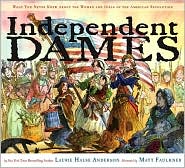
One thing that Laurie does (which works well, I think) is to use approachable language. In fact, the narrator of Independent Dames and Thank You, Sarah has a decidedly irreverent tone. And where other information is presented (as in the bio bubbles in Independent Dames, she provides only the interesting bits, in concise, approachable language.
Another thing Laurie does well is to create a sense of the times by describing not just the actions of a person in isolation, but some of the setting (time, place, and other events) that were taking place, so that a reader understands not just the contribution of a particular woman, but something about the times in which she was living (and whether her actions flouted convention).
The Research Bit
Research is a key component of writing nonfiction (or historical fiction). Getting the details right is an important part of establishing credibility. As Laurie said:
Historical accuracy is vital to my work. My manuscripts have all been reviewed by historians whose special expertise is the time periods or events covered by my story. Most of the characters in my novels are fictional, but they are as true to what people were like back then as possible. When “real” people wander across the pages of my books, like George Washington, they only do or say things that I can prove they did or said. Laurie Halse Anderson, interview with Kelly Fineman
When researching the life of Jane Austen, I read biographies by other people, Austen's novels, Juvenilia and letters, books of literary criticism, historical accounts of life in Georgian and Regency England, books about locations in England, and more. I have spreadsheets to keep track of what books and articles I've read, and notebooks full of copies of articles from periodicals and web pages. I have written notes, often typed and backed up, but always kept together so I can find what I need. Organization is crucial when it comes to research. And so is knowing when enough is enough.
What I do for my Austen project is not unlike what Laurie Halse Anderson does when researching for a historical novel or nonfiction project:
It helps that I read quickly and I am rather compulsive about organization. I read constantly, both popular books about the time periods I care about and specialized historical journals. I belong to a number of history-based listservs and take advantage of the expertise of others. Once I have the broad outline of what I want to accomplish in a book, I delve into academic libraries, looking for the writings of historians who have made my topics their life’s work, and using their bibliographies as my guide to primary source materials. I keep copious notes and often have nightmares in which I am drowning in a sea of citations. Laurie Halse Anderson, interview.