Wednesday, April 2, 2008

Turning Kids on to Science

One of the high points of my school visit assembly programs is when I challenge kids to a bet they can’t do. I hold up a ten dollar bill and say, “I’m going to put my money where my mouth is. Who’s my first victim?” A forest of hands shoots up with a pressing forward of small eager bodies. Everyone, it seems, wants the opportunity to fail! Apparently, a dare is irresistible. I have also noticed, it my travels, that if you tell kids something is easy, they tune out. If you tell them it’s difficult or impossible, they pay attention.
After one kid fails to pick up the ten dollar bill from the floor and another, who’s squatting around a broomstick can’t pick up a handkerchief with his teeth, I say, “I don’t give the fun away for nothing. You have to learn the scientific reason why these things can’t be done. I’m not going to kid you, science is very hard. You have to get ideas in a sequence. If you can’t answer my first question, then my second, and then the third, you’re going to be lost at the payoff. You really have to pay attention” Then I disingenuously say, “ Do you think you can do this?” A chorus of yeses is the response. The challenge to learn something difficult is also apparently irresistible. I then proceed to a quick, interactive lesson on gravity and the stability of objects.
Kathy Darling and I stumbled on this format of presenting challenges and dares to kids in our first book together, Bet You Can’t! Science Impossibilities to Fool You. We assembled a collection of “bar” bets, and quick scientific tricks and presented them as stunts that sounded easy to do but were truly impossible for scientific reasons. A lot of the activities were nothing new, they had been published in many collections of science activities for kids. What was new was our presentation. Much to our surprise, the book was named Best Science Book of the Year by the New York Academy of Sciences. It went on to become a best-seller and a classic. We wrote four more collections and they are all being published in spring of 2008, revised and updated and augmented in a huge single volume We Dare You! Hundreds of Fun Science Bets, Challenges, and Experiments You Can Do at Home (Skyhorse Publishing).
I have long thought that it would be fun to make a video tape of kids doing these tricks. Over the years I have tried to get various producers interested. Science is a hard sell! But, at long last, technology has made it possible. Why not invite my readers to use the book as a script and have their parents or their schools videotape them having fun with science? I could post them on my website. To get the ball rolling, I began videotaping my own grandchildren. The results are up there for all to see. Take a look:
http://www.vickicobb.com/vickisvideos.html

The published results can be used by teachers to motivate students, to introduce topics, to reach the reluctant readers. This is a unique educational opportunity—combining a book with an invitation to participate in a mammoth video project—a "You Tube" with a mission. Everyone wants to be in show business and now, here’s a natural forum to combine being on stage with learning science. I’m betting that if this project takes off, it will turn a lot of kids on to the marvelous intellectual challenge that is behind what makes scientists love science.

Tuesday, April 1, 2008

Live Chat Starts NOW!

Many of us INK writers have a passion for biography. We thought it might be fun to have an open dialogue about cool biographies for kids--the how and why of who we choose to write about, how we discover the voice we need for any given topic, and what angle, perspective, or format we decide upon when embarking on a new biography. I've been asked to start, but we'll be open for discussion for a full hour, live, until 1 pm EST, so please jump in with any questions or comments you like to either expand on something we say, or take the conversation in a new, related direction.

This past November, I wrote an article for SLJ about picture book biographies and looked at several fantastic books by authors I inferred were extremely passionate about their subjects. For me, passion is a necessary ingredient. But what other factors inform a writer’s decision-making process? A small gem of information or an interesting angle often piques my interest, or a person who I know to be extraordinary but who seems to have escaped getting his or her fair share of attention for whatever reason. For example, and I admit the evidence for this is purely anecdotal--if you ask a random person who Elizabeth Cady Stanton is, chances are you will get a slightly embarrassed, incomplete response. But they will most certainly know who Susan B. Anthony is from her famous portrait on her coin. This has always irked me. No disrespect intended to Ms. Anthony who was extremely important, but without Stanton, Anthony would likely not have blossomed into the full mover and shaker she became. Stanton was the force behind the first Seneca Falls convention; Stanton was the first one to act on the idea that women should have the right to vote. My disappointment with her seeming lack of notoriety sparked the inspiration that became Elizabeth Leads the Way. This same sense of exasperation fueled my desire to write about the so-called Mercury 13 women who took all the same astronaut testing as our original Mercury 7 astronauts, but NASA would not admit women into the space program. Yet even self-proclaimed space buffs are often amazed that they have never heard of these pioneering women. With any luck, my forthcoming Almost Astronauts book will help change that.

And now, let the conversation begin! As a reader, what do you think of these approaches? As a writer? What other burning questions do you have? What do YOU want to talk about?

Monday, March 31, 2008

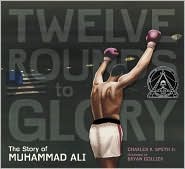
Twelve Rounds to Glory — a biography in poems

When I was a kid, boxing was in one of its golden ages. Reigning champs were Joe Frazier, George Foreman and Muhammad Ali. I watched Ali fight on TV, and talk smack on TV, and make political points on TV. During his smack-talking days, Ali was quite the slam poet. "Float like a butterfly, sting like a bee, your hands can't hit what your eyes can't see" is just one example. Many more can be found in his press conference appearances pre- and post-fights.

Today's post is about a recent biography of Muhammad Ali. It's one of those new biographies that proves that there is more than one way to tell someone's life story. Similar to The Poet Slave of Cuba: A Biography of Juan Francisco Manzano (by Margarita Engle), Twelve Rounds to Glory: The Story of Muhammad Ali is a biography told in poetry.

At the very end of last year, Candlewick Press put out a wonderful biography by Charles R. Smith Jr. called Twelve Rounds to Glory: The Story of Muhammad Ali, illustrated by Bryan Collier. Like the Engle book, this book won awards for its story-telling. Twelve Rounds to Glory won a Coretta Scott King honor as well as a Norman Sugarman Best Biography honor.

The story of Ali's life is told in Ali-like verse that is separated into twelve chapters. Each chapter is a poem that describes an episode in Ali's life - his birth in the segregated south; his childhood and development as a boxer; his early boxing career and his Olympic achievement in Rome; the development of his brash public persona; his boxing bout with Sonny Liston that earned him his first heavyweight championship; his decision to embrace Islam, ditch his birth name (rooted in slavery) in favor of Muhammad Ali, and his position as a conscientious objector during the Vietnam war; the career ramifications of his decision to refuse to fight in the war; his loss in the fight with Frazier in Georgia (where he could fight because there was no boxing commission, including Ali's derision of Frazier as an "Uncle Tom") and subsequent fights setting up his challenge to reclaim the heavyweight championship; the "Rumble in the Jungle" - a title fight against reigning champ George Foreman in Zaire ("Ali! Boo-ma-YAY!" - "Ali, kill him!"); his rematch against Smokin' Joe Frazier and the ferocity of that particular match; a loss by decision to Leon Spinks, making Spinks the new heavyweight champion, followed by a decision to retire; the post-retirement bouts in order to earn a few paychecks, and the reasons for the need for money explained; and his out-of-the ring life as a father and, in later years, man with Parkinson's syndrome. The text of the book ends in 1998, with Ali lighting the Olympic torch in Atlanta. The timeline following the text runs through 2005, and his receipt of a Presidential Medal of Freedom, the opening of the Muhammad Ali Center in his hometown of Louisville, Kentucky, and his being awarded the Otto Hahn Peace Medal in Germany.

All of this could be the stuff of legend, but Charles Smith avoids the book becoming a panegyric. He keeps it real by including some of the bad along with the inspiring and the good. Ali was an inspired fighter and an inspirational speaker, but along with his uplifting words on race and the horrors of war, Ali generated some truly ugly taunts when it came to dealing with other fighters. Along with his dedication to the Muslim faith and his search for peace and integrity, Ali's personal relationships were not always terrific, whether it was with women or some of his staff. Because this biography is geared toward children ages 10 and up (middle school and, I would argue, high school), Smith doesn't go into graphic detail, but enough information is given to present at least the basic facts faithfully, without whitewashing any of it.

Here's a taste of the book. And if you'd like to hear it as well as (or instead of) reading it, Charles is only too happy to oblige, and you can access this (and three other poems) as audio files at his website.

ROUND ONE: The Golden Child
"I always felt like God made Muhammad special,
but I don't know why God chose me to carry this child."
—Odessa Clay, Cassius Clay's mother

Bathed in beautiful light
from parental love,
brown skin shimmers
with a glow from above.
In 1942, the seventeenth of January,
you entered the world
in Louisville, Kentucky.
Whites Only stores
and Whites Only parks
sifted you out
because you were dark.
No Negroes Allowed
and No Colored signs
created separate worlds
and drew color lines,
but your middle-class parents
managed to survive
through hard work and faith
and were able to provide
you, their first child,
and your little brother later,
with food, shelter, clothing,
and something much greater:
love
that was passed
to you from day one,
love
that was passed
to you, the new son
of mother Odessa
and father Cassius Clay,
who also passed the torch
of your name
that birth day,
passed down to you
from a white farmer who
inherited a plantation
and your great-grandfather too.
But Clay freed his forthy slaves
during America's dark days,
then fought to end slavery
and fought to change ways
and laws
and thinking
deep in the South,
using newspapers,
knives,
fists,
and his mouth.
He fought with a spirit
that lives in you today,
reflected in your name,
Cassius Marcellus Clay,
reflecting love from your parents,
who had faith and belief
that God would watch over you
and provide inner strength.


Now, in the actual book, this poem appears on one page, split into three columns, with a piece of art by Collier on the facing page showing the infant Ali lying atop a quilt. It is one of the shortest poems in the book, some of which go on for pages with multiple columns per page, which gives you an idea of the commitment that Smith had to getting the information right. The illustrations throughout the book are a combination of watercolor and collage, and they add a tremendous amount of impact to the text.

This book comes in at 80 pages, and those skinny columns and punchy rhymes (pun intended) push you along at a pretty good clip. And the word choices are wonderful, particularly in the fight scenes which actually get a bit too graphic for really young readers or squeamish girls in places, but I imagine that boys would read those same passages and call their friends over and read them again, looking at each other with awe and in glee and exclaiming "COOL!"

A sample of what I'm talking about, from "Round Seven: "Who You Callin' Tom?":

Out of nowhere like lightning
came a leaping left hook
filled with Uncle Tom anger
as Frazier's fist shook
your brain in your skull,
snapping your neck back,
when his fist met your jaw
with one mighty CRACK!
sending millions of ants
into your body as the mat
rose up to smack
your beaten brown back.


From later in the same chapter, and a fight with Ken Norton:

Ten fights,
ten wins,
all led up to Ken
Norton, a boxer
and former marine who
posed a big problem
for you in round two
when his rock-solid fist,
released from way back,
slingshot your cheek
and broke your jaw with a CRACK,
pooling your mouth with blood,
marinating your mouthpiece;
you continued to fight
using your ring expertise.


In all those 80 pages there are only a handful of what might be considered forced rhymes or manipulated line breaks, and to be honest, they're still in keeping with the nature of Ali's delivery style, which Smith channels extraordinarily well. Here's a quote from Smith's website that gives you an idea how Smith went about writing the poems in this remarkable book:

I wanted the book to represent every part of this remarkable man and do it in such a way that hasn’t been done before. Once I had all the facts, double and triple checked, I then had to put it into verse. Each word was chosen with care, which made each line strong, which made each verse strong, which made each chapter strong, which made the book strong. Since it’s about boxing, I wanted it to feel like a boxing match, so to do the fight scenes, I watched old movies of the actual fights and wrote down what I saw, starting with the introductions of each fighter and where it took place.


Most of the images inside the book include people, usually composed in collage format. The only inside spread I could find available on the 'net, however, is the image at the start of the final chapter, which appears not to involve collage, but to be a straight-up watercolor. Feast your eyes on the image that leads off the last chapter, "Round Twelve: Muhammad on the Mountain":


Charles R. Smith Jr. Boo-ma-YAY!

Friday, March 28, 2008

I.N.K. is going LIVE!

That's right. Next Tuesday, April 1st (no foolin'), I.N.K. will be going live. From 12:00-1:00 PM EST, several I.N.K. writers will be on the blog to talk about biography and chat with you.

What are the hot titles for 2008, what makes a good picture book biography, and how does an author decided how to approach his/her subject? And that's just to get the ball rolling.

We welcome all of you to ask questions and add your own point of view. So, quickly, go create your free blogger account so that by Tuesday you'll be all set to participate.

Thursday, March 27, 2008

Heroes in Children's Books: Cesar: ¡Si, Se Puede! Yes, We Can!

Nutritious nonfiction. Sometimes I have to be tricked into reading what’s good for me. I accidentally read this book and I am so glad. I just read Cesar, ¡Si, Se Puede! Yes We Can! by Carmen T. Bernier-Grand, illustrated by David Diaz (Marshall Cavendish, 2004). Wow. It is a luminous, inspiring book. Bernier-Grand gently lays out the life of migrant worker advocate Cesar Chavez through easy-to-read poems. Her work is so loving and understated that you don’t feel you are reading poetry; you are just being pulled piece-by-piece into the daily, yearly events that shape a person strong enough to do heroic things. Teachers would surely love reading one spread at a time and then having brief discussions about what the pieces brought forth. This book is not in-your-face nonfiction. It’s nonfiction and heroism made personal. All the material could be used for kids at young ages…1st grade through 6th. But older kids, and sort-of adults like me love this, too! David Diaz’s art is sunny, joyful, delicious. It seems to grow and glow on the pages. Every school needs several copies of this book. I think it could change lives.

Now I am going to go look up Bernier-Grand's recent Pura Bel Pre author honor book, “Frida: ¡Viva la vida! Long Live Life!”

Once you get the taste for nutritious nonfiction, you want more and more. Because nonfiction is shelved by topic, not author, it takes a little extra work to hunt down the work of a particular nonfiction author. Yet there are some great nonfiction voices, like Bernier-Grand's, that are worth searching for.

Wednesday, March 26, 2008

Penny-Pinching Picture Research

Before I began writing for children, I worked as a picture researcher for an educational interactive multimedia company. When I began writing nonfiction children’s books, my old job experience proved financially and literarily (?!) valuable. In my next life I want to be an author-illustrator, but in this one, having no talent in drawing or painting, I settle for doing my own picture research. Through my choice of pictures and captions I can strengthen my narrative. Picture research begins during content research, when I photocopy all images I might use, along with source information.

Paean to the Internet
Twenty years ago I began by making a long wish list of illustrations for a project. I faxed this to the Library of Congress (and other venues,) waited a few weeks for photocopies to arrive in the mail, then sorted through them.
Today I enter http://www.loc.gov/rr/print/catalog.html and instantly access tens of thousands of images, and not just American history. Just now, searching “ostrich” I found 70 entries including art prints, political cartoons, landscapes, and much more from around the world. I especially enjoyed “Mud mosque in Mali with three minarets topped by ostrich eggs.” Be careful. It’s easy to while away countless hours browsing this amazing site.

Bargain hunting
Picture researchers for glossy magazines and high-profile books will turn to stock houses first. As a children’s author, that’s the last place I look. Some publishers will give authors a photo budget; some will require you to pay for photos; some will pay upfront, then take the costs from royalties. (By photos I mean all illustrative material.) Three types of fees may apply: research fees to find the photos; print (or scan) fees for the image itself; and permission fees to the copyright holder.
Tasks to avoid: the enormous job of acquiring prints and scans, sending letters and invoices, paying invoices, and getting permission releases for every single image. Get your publisher to do that, if you possibly can.
Whatever your agreement, you’ll want to get the most for your money. Here is how to do that:
• Library of Congress – Much, though not all, of their collection is in the public domain. This means you will pay print fees, but not permission fees. LC doesn’t do research for you. If you don’t find what you want online and can’t travel to Washington, you’ll have to hire a private researcher to go through the files of prints. (If you do visit the Library, you can spend blissful days browsing…..)
• Government agencies – NASA, NOAA, USGS, and many other public agencies have old and new photos, as well as charts, graphs, maps and the like – all in the public domain. National tourism agencies, here and abroad, also offer free or cheap photos.
• Private companies – They are often happy to give you illustrations for free.
• Historical societies – These are great sources for local subjects and landscapes, and for material like maps, documents, letters, etc. You may have to pay the staff for extensive research, but they often reduce or even waive permission fees if you say the magic words: “children’s book.”
• University and large public libraries – Libraries offer many of the advantages of historical societies. In addition they may have the “papers of” your subject or subjects relating to your subject. “Papers of” are often microfilmed and if you can’t visit the source library, they will send the microfilm to your local public library through interlibrary loan. Ask about “ephemera” which may be found outside the prints and photos collection. For my book on Jeannette Rankin I located the menu for a 1913 Montana suffragist luncheon: “roast young Montana turkey with chestnut dressing.” I also found suffragist lyrics to “My Country ‘Tis of Thee.”
• Museums – Art, history, and natural history museums are great sources for illustrations, but prices are higher. The magic words “children’s book” probably won’t lower your permission fees, though you might negotiate if you buy several images.
• Stock houses – These act as agents for freelance photographers, news photos, and some historical collections. Permissions fees are high – in the hundreds of dollars (or more) – and are usually non-negotiable.

Visit libraries and archives whenever possible and browse. I found several wonderful windmill-related images for The Wind at Work in an old postcard collection at a museum. These weren’t cataloged and I doubt a librarian-researcher would have thumbed through the boxes.

When I’ve gathered more than enough possible illustrations, I send copies to my editor and we cull them together. At this point we discuss how many high-priced images we really need. Be sensible, but not miserly. That gorgeous image that costs $500 may be like the designer shoes or crystal vase that brings you joy for years to come. And unlike the shoes, your perfect illustration is tax-deductible.

Please add your tips on penny-pinching picture resesarch to the comment file below.

Tuesday, March 25, 2008

Poetry in Non-Fiction?

I never asked "Why poetry in non-fiction?" until I had written (with my wife, Yael Schy) a science book containing a series of poems about camouflaged animals -- Where in the Wild? Camouflaged Creatures Concealed. . . and Revealed. Yes, the book was already finished before it occurred to me to wonder why I had wanted to do most of it in verse instead of strictly in prose, like all of my other books. If someone had asked, my answer would have been similar to that of the proverbial mountain climber: because it was there. Poetry was a new peak for me and I wanted to see if I could climb it to enter a new literary realm. I didn't think much about how entering that realm could improve the book or affect its readers.

I did know that I was not breaking new ground, though the poetic path through the non-fiction landscape was only lightly worn. The late (and certainly great) Ruth Heller, peerless author and illustrator of non-fiction on subjects that some might consider dry, wrote all of her books in verse. Nary a line could be called dry; "juicy" would be a better description, no matter how "interest-challenged" the topic. Here is how Ruth opens Up, Up and Away: A Book About Adverbs

ADVERBS work terrifically
when answering specifically. . .
"How?"
"How often?"
"When?"
and "Where?"

Penguins all dress
DECENTLY.
Toe
dancers
practice
FREQUENTLY.
This house was painted RECENTLY. . . and
small green frogs live THERE.

(You really must see Ruth's illustrations to appreciate the fullness of her genius.)

In preparing to write this post, I pulled Up, Up and Away and some of Ruth's other books from the shelf. Here she is, speaking about the hows and whys of pollination in The Reason for a Flower:
From an ANTHER
on a STAMEN

to a STIGMA
on a STYLE

POLLEN
grains
must
travel
and
stay
a
little
while.

And
then
you'll
see
the
reason
for
each
FLOWER--
even WEEDS.
The reason for a FLOWER is to manufacture. . .
SEEDS

Now we know the reason for the flower, and I am beginning to know the reason for the poem. I can't stop reading it! It's fun! It has captured me, latched onto some nerve center in my brain and it doesn't want to let go. The delicious rhymes and rhythms of verse do that. Neuroscientist Daniel J. Levitin explains how music triggers pleasure sensors in the brain in his 2007 book, This is Your Brain on Music. My hunch is that poetry works in a similar way. Reading can be for information or pleasure or both. If poetry helps put the checkmark in both columns, how can we -- why should we -- resist?

It worked that way for Lucy, the 8-year old daughter of the creators of over 200 podcasts about children's books published on the website http://www.justonemorebook.com/. In their podcast on Where in the Wild?, Mark Blevis and Andrea Ross mention that on a recent ski outing, Lucy could be heard scooting down the slopes reciting the opening lines of our poem "Grayish, Greenish," about the tree frog that can virtually disappear on the similarly-colored bark of a tree:

Grayish, greenish, blackish tree
The colors you see are the colors of me.

Grayish, greenish, blackish bark,
I'm bumpy and blotchy, part light and part dark.

Joy Hulme is another author (and another friend) whose non-fiction verse impressed me long before I considered trying my own hand at it. Looking for insight, I reread
Sea Squares, Joy's poetic introduction to the mathematical concept of square numbers. Using a marine motif, Joy "counts" in squares. Here is how she greets the reader:

Come with me to the side of the sea,
Where the ocean meets the shore.
We'll count some creatures that crawl and creep
Or grow on the ocean floor.
Some flop, some dive, some swim and swish,

Some fly where the breakers roar.

Joy not only paints a picture but she evokes a mood. I'm smelling the salt spray and feeling the sand between my toes. A couple of gulls hove into view. They're in the book, too:

Two two-eyed gulls, with two wide wings,
Shrieking and swooping and pecking up things.
2 white gulls with 2 eyes each,
Have 4 bright eyes to watch the beach.

And then the mood turns slightly comical:

Three three-striped clown fish, black and white and red,
Nesting in anemones' spiny ocean bed.
3 clowns with frowny faces
Have 9 stripes in fishy places.

So poetry can evoke a mood. There's a "Duh!" moment for you -- any English teacher can tell you that and I'm sure many did. Chances are that your English teachers were not thinking of non-fiction. But why shouldn't the wary eyes of the coyote lurking within the pages of a science book be just as mood-invoking as those of an entirely fictitious coyote? And why does the non-fiction reader deserve any less of a mood, conveyed in as few words as possible? Perhaps the ultimate example is in haiku, enjoyed by the Japanese for its paucity of verbiage. In Where in the Wild?, we use the 5:7:5 form to describe the speckled treasures that are a shorebird's eggs, deftly hidden amid the similarly patterned stones of a riverbank:

speckled treasures lie
bare upon the pebbled bank
precious life within

Poetry can also bring a smile on the face of anyone who appreciates worldplay. Our poem about the red-spotted newt, a salamander that roams the forest during one stage of its life cycle, offers surprising rhymes for some important scientific terms, including one found at the poem's end:

... If you should see me on a hike
You may think I'm lizard-like.
But I'm no reptile -- think again!
I'm really an amphibian.

In thinking again, I begin to wonder why more non-fiction is not written in verse. I invite readers of this post to contribute selections from their favorite works of non-fiction poetry (or just to recommend book titles)... and to add to the list of reasons for a poem.

Monday, March 24, 2008

Fact:Fantasy::Words:Pictures

One of the comments on my last post came from an illustrator. She pointed out how nice she felt that her work had been appreciated.

No wonder, then, that after my last post, I’ve been thinking a lot about the role that illustrations play in nonfiction. Of course, pictures can be purely functional. I’m not sure that a picture always can or should “replace a thousand words” but in some instances, pictures are very helpful in making a point or clarifying something – especially in nonfiction books. Imagine, for instance, if we writers had to rely on written instructions alone when we wanted to tell kids how to do an experiment or make an object! That, in itself, should make us value illustrators – and I certainly hope we do.

However, pictures can be so much more than purely functional or even just attractive. They can transform a work of nonfiction in an intangible way. The example I’m thinking of is JUMP! - a biography written and illustrated by Floyd Cooper. This lovely book about Michael Jordan focuses on an incident in Jordan’s childhood. I did make it to the basketball team in my high school, long, long ago, but I can’t say I’ve really kept up with the sport- I rarely watch it (or any other sport for that matter) – and I hardly ever read stories about sports personalities – so it’s unusual for me to rave about a book like JUMP!

It’s not that words aren’t important in JUMP! They certainly are. Cooper’s spare yet beautiful prose kept me smiling throughout the book – it touched just the right chord, it had just the right lilt. The words bounced along ever so smoothly – and if that sounds like a contradiction to you, then think about your favorite basketball player dribbling, passing and shooting, and you’ll know what I mean.

But it was the illustrations that made the book so incredibly special to me. Cooper uses a palette of browns and grays that seem to melt onto the page and transport the reader into another world – a world that seems to be more fantasy than reality. His illustrations confer a dream-like quality onto the pages – they seem not to be made of paper, but rather woven out of some gossamer fairy-tale fabric.

And that special combination – of words rooted in fact and pictures that seem to swirl with magic – makes this one of those very special works of creative nonfiction that brings alive the dream-like quality of life of the sports celebrity whose life it celebrates.

Friday, March 21, 2008

More on "List Books"


Just home for a few minutes (okay, hours, if you must know the truth) between school trips, and read Padma’s almost embarrassingly kind post about my book Beaks! (Thank you Padma!) It got me wondering, though, if I had anything more to share about creating these kinds of books. “List” books—those which basically include collections of items—are very popular, and appear in almost all subject matters from history to biography to science. My first list book, Animal Dads (illustrated by Steve Jenkins), did so well that I immediately bent my mind to other subjects that might fit into the list format. The question here, though, is how does one create these books?

As always, the first step is research. Go learn everything you can about a subject. For a book like Teeth (illustrated by Phyllis V. Saroff), for instance, I’ll start with some animal encyclopedias, then grab some comprehensive books on different animals groups, then dive into scientific journals, which often have the most interesting facts about animals. I don’t try to write anything immediately, just let all this information percolate through my brain.

My second step is to make a list. What’s important is that I’m not listing specific animals at this point. Instead, I am asking myself “How many different ways do (fill in subject) function? For teeth, do they grind? Do they munch? How many can an animal have? What do teeth do for an animal besides eating? I write all of these things down in one column. Then, in the column next to it, I begin filling in species or examples that fit the bill. Usually, I end up with several examples that satisfy any one requirement. This is nice since it allows a greater overall variety of subjects.

Once I’ve got my list, then I work on my main text. I try to group common elements in my list together. For Teeth, these groups include teeth types, numbers, display uses, unusual teeth (such as tusks), and so forth. This is probably the most critical stage of the project, because I have to make the writing come alive, using both halves of my brain. The text not only has to flow, it has to have surprises in sentence structure and word choice. For instance…

Teeth slice.
Teeth stab.
Teeth crack.
And they grind, mash, and munch.
Teeth can be very different.
Or all the same.
Teeth can be small.
Or very large.
Tusks are teeth.
So are fangs.
Antlers and horns are not teeth—but you probably knew that already.

And so forth. Really, what I’m creating here is a poem, hopefully with a voice that draws in the reader. Now doing this can take some work. I’ll bet I went through twenty versions of Animal Dads before I hit just the right style and voice I was looking for. When you’ve got it, though, you’ll know.

So far, I’ve published about eight list-type books, but the list approach isn’t just for professional writers. Once Animal Dads came out, schools I visited began presenting me with all kinds of their own list books that students had created. Taking a topic—almost any topic—and writing a list book proves a great way to get kids interested in a subject and in writing. A typical list book has about twenty entries—just about the size of a typical classroom. By giving one aspect of a subject to each student, teachers offer them a bite he or she can handle without being overwhelmed. Then, when the kids put their book together (often creating art at the same time), they can all learn together in a way that is fun and fascinating.

Thursday, March 20, 2008

A Nonfiction Story

So, here we are, rethinking nonfiction. The rethinking piece means something different to each of us, I suspect. My professional roots are that of an editor of children’s library market nonfiction—a hat I wore proudly for more than a dozen years. Just this week, as I taught a group of undergraduates, I heard myself saying that “I loved, loved, loved my job as an editor.” Really? One guy asked. I mean, when people say that, they’re usually being sarcastic, he continued. No, I assured them, I adored being an editor. In fact, I often miss it. My entire job revolved around thinking about nonfiction for kids. So now, a decade into a full-time writing life, I find myself indeed rethinking nonfiction. Mulling over interesting ways to tell true stories. Stories that will grab young readers and inspire them to—dare I say it?—learn.

A lot of the rethinking that goes on for me has to do with building on my library market roots. And in some ways, overcoming them. Library market nonfiction, at least in the traditional sense from a decade and longer ago, simply takes a different approach than the trade. The difference, as I see it (and feel free to expand or disagree in the comments area) is that the nonfiction library market takes a fairly straightforward approach to topics, and maintains a close correlation to curriculum needs. This makes good pedagogical and business sense, as the educational market caters mainly to schools and libraries, with the trade crossover occurring in the minority.

The trade approach is the flip-side to this—and yes, I’m aware that I’m simplifying things for blog-brevity’s sake. The trade is interested in capturing much more of the bookstore market and counts on a built-in crossover to the schools and libraries for those titles that do have curriculum tie-ins. But the key to success in the trade nonfiction market is anything but straightforward. Something for which I am simultaneously grateful for and with which I continually struggle.

Let me explain. Having the freedom to approach a topic from my desired angle was not something I could do often in the library market, so when I branched out and began to think along trade lines it was liberating. However, having been so firmly rooted in the “straightforward,” I tend to have to break out of that mindset in my second (and third and fourth…) drafts of nonfiction manuscripts. I always start with the basics. Not that there’s anything wrong with that. In fact, it has stood me in good stead. The creative challenge then becomes seeing things from different perspectives and thinking in story.

In part, I credit Marc Aronson for helping me with this. He is my editor on a forthcoming book called Almost Astronauts. One day we met to talk about the book in its early stages. I happened to be coming from a morning of fiction writing. I made a comment something along the lines of “I have to switch gears now. I’ve been working on a novel.” He immediately said, “Oh no, stay right where you are. That’s the mindset you need to approach this story.” This story. A simple thing, semantics. And of course, not simple in the least. I had not yet allowed the word “story” to blend with the term “nonfiction.” And once I did, my pen began to fly. What’s your nonfiction story?

Wednesday, March 19, 2008

1 Idea…Many Versions…1 Book

My book for Spring of 2008 has a simple premise—how life would change if math and numbers were suddenly gone. What if you couldn't count, or add, or measure, or tell time…? Here’s a preview of Missing Math: A Number Mystery.


We usually see books only when they're in their pristine final form, printed in living color on coated paper (in the case of picture books, anyway.) This post will give a sense of the behind-the scenes gyrations, which took longer than usual in this case.

Version #1:
The Number Cruncher was a picture book written in verse. I still like the play on words of the title. The main character ran around eating any num
ber he saw. Some sort of monster or alien, here’s what he looked like:


The dummy is undated and my memory inexact, but it’s before I went digital for illustration around 1997 so it’s over ten years old. There are some handwritten notes, such as maybe he should be more of a robot-like character. I didn't realize it until now, but the 25 m.p.h. speed limit sign somehow endured through all the versions to appear in Missing Math. Although the specific reason this version was rejected has faded, in retrospect, consuming a few numbers here and there doesn't have enough impact.

Version #2:
No More Math? Still a picture book, it had become an updated three wishes story in prose about a boy who encounters a robot alien who has crash-landed. It starts out:

A robot alien! And a spaceship! The whole scene was a shocker, but I had my sneakers on in case I had to make a quick getaway. There was nothing to worry about, because this guy could barely find the tool box, not to mention a ray gun.

In return for his help, the robot offers to grant the boy three wishes, and the plot lumbers on. In rereading this, it’s so long-winded I can see why my editor suggested I try…


Version #3:
The Day Math Disappeared, a chapter book version. The manuscript is dated 2001:

…Don’t ask me where he came from, I didn’t find out. It is a good question, though. Some secret government project? Anyway, once he decided I wasn’t going to dismantle him or anything, he went back to working on the ship or plane, or whatever. He called it his “ziptek,” so we can just stick with that.


My nephew Caleb read it and liked it, even if my editor ended up giving the thumbs down on it. The concept
was probably too young for a chapter book.

Version #4:
When Math Took a Vacation is a picture book again, with a main character named “Math.” He supervises the numbers who cheerfully perform their jobs on rulers, mailboxes, license plates, and so on. That is, until Math takes a well-deserved vacation—while the boss is away, the numbers play and havoc ensues. Another rejection, which wasn’t too surprising at this point. Here are some of the number characters at work before they run off to sip sodas at the seashore, or whatever they were doing:


Version #5:
The Number Cruncher, is dated 2005 and told in first person from the viewpoint of a little boy:

Somebody ATE my money last night!
And Something bit my shirt,
my notebook got nibbled,
my homework has holes,
and my books are dripping with drool… YUCK!
Something totally WEIRD is going on.


It’s in sort of a non-rhyming poetic format, which may be why my editor suggested I try it in rhyming verse. Verse? I hadn’t written anything in rhyme since 1
990. Sure, why not? That ended up being the manuscript for Missing Math. It has an all-animal cast, some nonsensical angles such as not even being able to THINK of a number, and a weird machine that is being used to steal the numbers for some unknown purpose. Fortunately, there is a persistent cat detective who is determined to solve the mystery of the missing math. You can see him on my site.

So why did I persevere in the effort to get this notion into book form? Despite the setbacks, I stayed in love with the the idea of making math vanish as a way to help kids perceive how integral it is to everyday life. But credit must also go to my editor Margery Cuyler who never forgot about it for all those years, and kept asking to see the “no math” idea in some new form. Her interest motivated me to rethink it. Missing Math: A Number Mystery gets right to the point and shows how completely things fall apart. But, it would’ve been nice if it had come together just a tad more quickly!


If anyone would like more info about how I made the video preview for Missing Math, please check out The Dust of Everyday Life blog, which gives an overview of the software used.
The post is titled Making a Book Preview (Trailer). Other people there have also written about making book trailers.

Tuesday, March 18, 2008

Art Books to Inspire

In my childhood, I spent many summers at Oma's house in Germany. To my brother and I, this meant a month of no television, visiting relatives that we couldn't converse with, and finding things to do instead of fighting. One summer after reading all the books we packed, I wandered into my uncle's office and looked through his library. I grabbed the ONLY book in English on the shelf and sat down to read. The book was The Agony and the Ecstasy by Irving Stone. Instantly, I was mesmerized by the story and passion of the life of Michelangelo. On our next trip to town, I made my mother stop by an art store and, when we got back, I set to work with sketchbook and pencils. My brother and I walked the winding path to the castle and I sketched the church towers. I sketched the vineyards gracing the hillsides. My sketchbook went everywhere with me. I sat in the kitchen table with Oma and sketched the castle view. Oma asked if I she could have the castle view drawing. She had it framed and the drawing hung on the entryway wall until the day she passed away.
In Irving Stone's telling of Michelangelo's life in The Agony and the Ecstasy, I found a passion that lead me to a career in art and design. With the lifestyles of
today, so many children are missing the opportunity to find their artistic passion. How many Monets, Picassos, and Cassats are, at this moment, playing a video game, watching TV, or texting their friends? My biggest wish is that someday my writing will inspire one child to grab a piece of paper and pencil and draw... and find his of her artistic passion. The following are just a few of the wonderful nonfiction books I love, that hopefully will inspire children to paint, draw, sculpt, build, and create!

Inspiring Art Nonfiction, Picture Books:

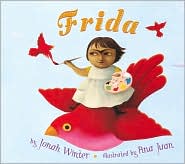
Frida by Jonah Winter (author) and Ana Juan (illustrator)
Arthur A. Levine Books 2002

This book is my very favorite book on art. I have taught Art Appreciation classes in the elementary schools for 9 years and I am always finding that the book holds a captive audience for all children from Kindergarten to 5th grade. In Winter's telling of Frida Kahlo's life, her passion, creativity, and persistence shine through in a poetic narrative. The Mexican folk art of monkeys, devils, skeletons and jaguars, which represent the demons that Kahlo faced and incorporated into her paintings, add another interesting dimension to the art lesson.

Action Jackson by Jan Greenberg & Sandra Jordan (authors) & Robert Andrew Parker (illustrator)
Square Fish 2007

In this beautiful picture book, the reader follows Jackson Pollock's passion for painting, stroke by stroke.
"An athlete with a paintbrush, he uses his whole body to make the painting. Layers build with each gesture, new colors emerging, blending, and disappearing into the wet surface. He swoops and leaps like a dancer, paint trailing from a brush that doesn't touch the canvas..."
Wonderful telling of this artist's story.

Inspiring Art Nonfiction, Middle Grade:

The Spirit Catcher: An Encounter with
Georgia O'Keeffe
by Kathleen Kudlinski
Watson-Guptill 2004

Okay, I know this is not officially nonfiction but I love this book and all the books in the Art Encounters series. In Kudlinski's telling of O'Keeffe's life, through the eyes of a fifteen-year-old boy, the reader experiences all the riches of the passion and inspiration through the beauty and mystery of the desert.


Inspiring Art Nonfiction, Young Adult:

Andy Warhol, Prince of Pop
by Jan Greenberg & Sandra Jordan
Delacorte Press 2004

I wish that I could have read this book in high school. Greenberg and Jordan paint a perfect picture of this unique artist... whose passion and popularity I did not understand until way past high school. This biography mixes just the right elements of passion, angst, and artistic lifestyle to interest teens.


The Vanishing Point
by Louise Hawes
Houghton Mifflin 2004

Well, once again, this book is more historical fiction than nonfiction but this true story of the real 16th century painter, Lavinia Fontana, will absolutely inspire, educate, and empower teens through the eyes of the young artist.
And isn't that a great cover?