Wednesday, March 19, 2014

The Illustrator's Side of the Story

Today I’m giving my slot to Sarah S. Brannen, the uber-talented illustrator of Feathers: Not Just for Flying.

Birds and feathers go together, like trees and leaves, like stars and the sky.”

It had me at hello. I read the first sentence of the manuscript that would become Feathers: Not Just for Flying, and I wanted to illustrate it more than any book that had come my way before. I love drawing natural things like rocks, moss, bones, or feathers, but I hadn’t yet had the opportunity to illustrate the things I do best in a children’s book.

Several years went by before I was able to start; Melissa had to finish the book and get a contract for it, and the publisher, Charlesbridge, had to find me—I was eagerly waiting to be found—and spend some more time finalizing details. At last, in the fall of 2011, it was time to start sketching.

Although I had been wanting to illustrate this book for years, once I read the manuscript over a few times, I realized that it was going to be an unusual challenge. Each bird discussed had two separate pieces of text, which had to be presented separately. I was convinced that I couldn’t illustrate a book about feathers without drawing actual feathers, but because of the text, it was clear that each illustration would also need to show the bird doing the action described.


And I wanted to add another set of illustrations. The similes in the book compare feathers to blankets, cushions, matador capes, fishing sinkers, etc.; I felt that it would be necessary to illustrate some of the things a young child might not be familiar with, like a matador.

So each spread had five different elements; ten, in the cases of spreads that showed a different bird on each page. I couldn’t think of how to pull it all together in a coherent design. I went for a walk, as I always do when I have a tough problem to solve. I wish I could explain how I came to the idea of a trompe l’oeil scrapbook, but the idea just burst into my head full-formed, as I walked along North Road near my house.

Actually, my first idea was that each page would be the drawer in a curio cabinet, laid out like a collection, with the words written on a background, cut out of “magazines,” scribbled on sketchbook “pages,” etc. Then the main illustration could also look like it was a photo, or a piece of art, and the feather could lie on top.
Everyone liked the idea, although it eventually changed from a cabinet into a scrapbook.

I did a lot of research to find images of birds doing the things discussed in the text. I had been picking up feathers for over three years, hoping against hope that I would someday illustrate this book. I had to spend a lot of time identifying them, and figure out how to get feathers from some of the more unusual birds. A rosy-faced lovebird owner in Iceland sent me some feathers from her pet. A scientist in New York and a nature photographer in Australia sent me high-resolution photos of the club-winged manakin and the sandgrouse, respectively. The red-tailed hawk was easy… I was mowing the lawn one day and found a wing feather in the grass next to my house.

After all the research, the art went quickly and it was a delight. I loved drawing the feathers.


Along the way, someone mentioned to me that it was illegal to possess wild bird feathers. I didn’t believe them. But I told Melissa, and we looked into it, and discovered that under the terms of the 1918 Migratory Bird Treaty, it is illegal to possess feathers from a long list of native American birds. (It is legal to possess feathers of non-native species like peacocks, lovebirds, and mute swans; domestic fowl like turkeys are also okay).

I learned to draw feathers where I found them, and I’ve actually done a series of drawings of feathers on rocks, or sand, which turned out to add an interesting layer to the art.

However, the whole idea of the book was to encourage children to make a scrapbook of natural things, to study and learn. Obviously we couldn’t recommend that children engage in an illegal activity! The publisher talked to the Department of Fish and Wildlife and was told that although enforcing this aspect of the act was not a high priority, that it is illegal to possess the feathers of any bird on the list.

It may sound absurd, but when the law was enacted, many species were threatened by the fashion of wearing bird wings and feathers in hats, and egg collecting was very popular. Although picking up a feather a bird has dropped doesn’t harm the bird, there is no way to prove where you got a feather once it’s in your possession. So it does make sense, once you think about it.

Ultimately, it was decided to remove the tape which showed the feathers being mounted in the book. The scrapbook look remains, and the illustrations of the feathers accompany the illustrations rather than being intrinsically part of them. We had a slight story idea that was cut—there had been an illustration of a child holding the scrapbook on the original title page, and it was dropped.


It was a long, labor-intensive, complicated process, and the book was published over five years after I first saw the manuscript and fell in love with it. I’m very proud of how it turned out, and I can’t wait to share it with the world.
 

Tuesday, March 18, 2014

Everything I've Learned About Interesting Nonfiction, Kids, Writing, and Life from I.N.K.

My sons went to a Quaker school, and every time they left meeting for worship they sang, As we leave this friendly place, and that's the song that's going through my head right now. I spent about half an hour trying to find a recording for you, but I can't.* I need a (Quaker) librarian to help me. (See below re librarians.)

I.N.K. has been a great place to hang around these past few years. I've learned so much from all of the other writers, from the teachers and librarians who've commented, and from writing my own posts.

So I thought I'd share with you some--no, not everything, of course--of what I've learned and give you some places to visit in the absence of I.N.K. Though I hope Linda will keep the blog up so people can dip into the archives.

1.Nobody knows kids like teachers. Stating the obvious, but I'm amazed by how much teachers know about children, about human nature, about different kinds of learning,  about what works and what doesn't. One of my favorite blogs is There's A Book For That, written by a woman who must be one of the best teachers ever. Carrie Gelson teaches a class made up of 2nd, 3rd and 4th graders in Vancouver. She's a great fan of nonfiction, of books, and, clearly, of children. I kind of want to pretend I'm 9 and go sit in her class.

2.Nobody knows books and research like librarians. Soapbox time. Every time I visit a school I am bowled over by how much librarians know. Which book to put in which kids' hands. Better than any Amazon formula, "If you liked Those Rebels John and Tom, you will probably like A Home for Mr. Emerson and  Handel, Who Knew What He Liked."  Ditto independent booksellers!

And whenever I need research help, no amount of futzing around on the internet will be better than asking a librarian. One hour of futzing around on the internet is worth 270 seconds with a librarian. There's nobody like a librarian and there's nobody like Betsy Bird. Visit her blog Fuse8 whenever you can. You won't be sorry! And there are so many more. In fact, HERE is a compendium of the best librarian blogs!

3. Nobody knows writing like authors.  Except when we're stalled or stuck or terrified. Then we go read what other authors have to say. I'm sort of addicted to the Paris Review interviews. If you go here you'll see Geoff Dyer saying all kinds of interesting things about nonfiction and how one can bend it and still have it be nonfiction! I've talked about John McPhee's interview before on I.N.K. in a piece I wrote about letting content dictate form. I intend to be addicted to the DRAFT column in the New York Times as soon as I'm done with my W.I.P. Check it out. It's a wealth of information--writers writing about writing.

4. There's nothing like having friends who do what you do. There are so many great authors on I.N.K. Great people. Having this blog has been like having a nation-wide support group. Teachers have the faculty room. Librarians have the water cooler. Writers can get lonely. Thanks to all you I.N.K. folks for hanging around the virtual coffee machine with me. Someone please pass the cookies. And while you're at it, please add to my list of what you've learned, and where we should hang out next.

*Ok, I found a recording. It's a real school singing it, and it's rough, but it brought a tear to my eye.

Here you go: As We Leave This Friendly Place.

Love,
Deb


Monday, March 10, 2014

Picture Books and Middle Grade Readers: A Perfect but Uneasy Mix?


You can’t judge a book by its cover?  Rightly or wrongly, we all do.  In the children’s book market, trim size matters too.  And, when you’re a nonfiction picture book author, these two criteria create a complicated mix.

Here’s why I’ve been thinking about this subject.  Last year, Penguin’s paperback imprint, Puffin Books, approached me and illustrator Elwood H. Smith about combining our books, The Truth About Poop and Gee Whiz, into one digest format edition for the middle grade market.   Why not?  Where Elwood’s original illustrations were vivid and lovely, they were just as funny in black-and-white and worked well in this 5 x 7 ½ trim size.  

 
                          PLUS


EQUALS


Furthermore, this new edition was in a format that says to kids, “You’re older now, grown up enough for a big person’s paperback.  Welcome to middle grade and the road to adulthood.”

The Truth About Poop is remaining in print; in fact, it’s soon celebrating its tenth anniversary.  I’m happy to say it’s still selling, being reviewed on Amazon and hopefully offered in brick-and-mortar bookstores around the country.  But I realize that these two versions, that share the same text and drawings, are for different audiences.

There comes a day in every child’s life when it’s no longer okay to carry a teddy bear outside or hug Mom in public.  For most kids, there’s also a time when reading landscape-format or square-shaped picture books with bright illustrations becomes taboo—at least in public or outside the classroom.  The same material that can amuse, amaze and be shared in black-and-white and portrait-shaped rectangles doesn’t cut the middle grade mustard when it’s in color.

But, here’s the rub.  So many nonfiction picture books in these sizes and shapes are written for this age group and even older.  This short length is just the right sized introduction to an idea or subject that can become an abiding interest.  Beautiful pictures or photographs not only bring these subjects gloriously alive, they are a “working vacation,” providing additional information while they also give respite, letting a young reader stay involved while absorbing what was just read. And our readers may need this rest.  We often write about complex situations or questions with high level language and abstraction.  We talk about the ingenuity of Ben Franklin, the eccentricity of mathematicians and Thelonius Monk, the stuff that stardust is made of. 

The Truth About Poop and Pee just came out on March 6th and I couldn’t be happier.  It translates well into its new format, and snuggles comfortably into its new home on bookstore shelves where every book is the same dimension.  If it reaches new readers this way, I’m very delighted.  I’m glad I can nurture an interest in biology, chemistry, sociology, history while kids just think they are reading about poop and pee.

But I also hope these same readers won’t be so ready to “put away childish things” and will still be willing to explore the wonderful world of nonfiction picture books in living color.

Friday, March 7, 2014

INK Authors Making News

NEW BOOKS


Welcome to the World: A Keepsake Baby Book  by Marfé Ferguson Delano (National Geographic)


The Truth about Poop and Pee, by Susan E. Goodman (Penguin), a new edition that brings together two of her best-selling books.


A Home for Mr. Emerson, by Barbara Kerley (Scholastic)


APPEARANCES

Deborah Heiligman will be speaking at the Virginia Festival of the Book March 21-23

Anna Lewis, author of Women of Steel and Stone: 22 Inspiring Architects, Engineers, and Landscape Designers, will be speaking at the Bellefonte, PA Art Museum on March 22, which has installed a large Anna Keichline exhibit. 


AWARDS

The Animal Book: A Collection of the Fastest, Fiercest, Toughest, Cleverest, Shyest--and Most Surprising--Animals on Earth, written and illustrated by Steve Jenkins (HMH)
            • The Horn Book 2013 Fanfare List of the Best Books for Young People
            • NPR 2013 Great Reads
            • Book Links Top 30 Titles from 2013
            • Junior Library Guild Top 10 Books for Youth 2013
            • ALA Notable Book 2014

Who Says Women Can’t Be Doctors by Tanya Lee Stone (Henry Holt)
            • NPR Great Reads

The Boy Who Loved Math: The Improbable Life of Paul Erdos, by Deborah Heiligman. (Roaring Brook)
            • Orbis Pictus Honor Book
            • Book Links Top 30 Titles from 2013

Eruption! Volcanoes and the Science of Saving Lives, by Elizabeth Rusch. (HMH)
            • Book Links Top 30 Titles from 2013

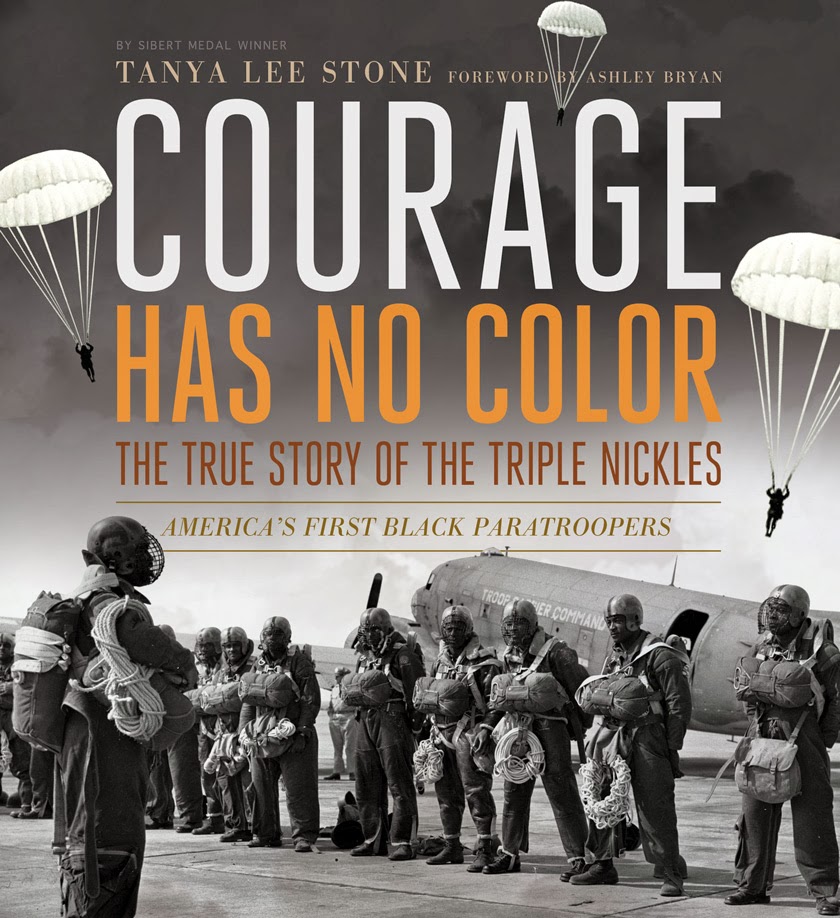
Courage Has No Color: The True Story of the Triple Nickles, America’s First Black Paratroopers, by Tanya Lee Stone. (Candlewick)
            • Book Links Top 30 Titles from 2013


The Nature Generation has announced the shortlist for its 2014 Green Earth Book Awards. The award honors authors whose books best convey the environmental stewardship message to youth.

Eat Like a Bear, by April Pulley Sayre, illustrated by Steve Jenkins (Henry Holt)

Here Come the Humpbacks, by April Pulley Sayre (Charlesbridge)

No Monkeys, No Chocolate, by Melissa Stewart and Allen Young (Charlesbridge)

A Place for Turtles, by Melissa Stewart (Peachtree Publishers)


Wednesday, March 5, 2014

Join the Resistance


My “inner blogger,” which I discovered six years ago when Linda Salzman started this blog, is now in full flower at the Huffington Post.  Since September I’ve tried to post twice a week.  My initial mission was to add my two cents to the national discussion on education.  But a second mission has emerged—to shed light for the general public on our genre, children’s nonfiction literature.  To that end I’ve requested that my colleagues send me their most recent books.  I read them and write posts that show a book’s timeliness to current events or where it fits into the curriculum.  I am not a book reviewer as all of my posts are unabashed cheers for the brilliance of these authors.  As an author, myself, there is a conflict of interest for me to act as a critic.  But I have no problem endorsing the creativity and insights of my fellow authors. 


The adoption of the Common Core State Standards has created an opening for public awareness of our genre.  It has helped to create a readership for this blog.  When I first read the CCS standards, I saw them as an opportunity for teachers and educators to bring their own passions and creativity to classrooms through, among other things, the use of our books.  Children need to know there are many voices out there so they can develop voices of their own.  But this opening for diversity has been hi-jacked by standardized testing and the demand that teachers constantly document how they are meeting the CCSS—yet another chore that competes with instructional time.  One of the more absurd examples of the implementation of the CCSS is the lesson on close reading of the Gettysburg Address by focusing on text only, with no background knowledge of the Civil War.  

Diane Ravitch is leading a movement against the CCSS.  I’ve been a faithful subscriber to her amazing blog (she posts 5,6,7 times a day!) and she and her followers are gaining traction.  Meanwhile, NY State, for example has a huge contract with Pearson for their textbooks and their texts.   Granted, they and McGraw Hill and other textbook publishers are buying rights to our books to excerpt in their publications (and/or in the tests themselves) along with lesson plans making nice, convenient packages for harried teachers and furthering the notion that their books are the only books kids need to read to pass the tests, although their ethics in this are currently being questioned (in the example I've linked above).

My intent through my Huff Post blog is to join Diane's fight against the huge corporations that have dominated classroom reading for many years, the standardized teaching and testing and their ties to teacher evaluation.  Instead of emphasizing the horrors of turning teachers in to robots, all teaching the same page at the same time, I want to show the exciting alternatives that our genre offers. So I invite the readership of this blog to join me.  This means you need to use social media to spread the word. So "follow," "tweet," "share," and "like." It's the way business is being done these days.  So many people out there are still unaware of our existence.  This is one positive way we can all  help save public education.

I’m showing you the covers of the books I've given a shout-out to, so far.  The titles below the images are links to my posts.  Please join the "resistance" and spread the word. 


Arousing a Sense of Wonder
In the post that went live last Thursday (Here Come the HUMPBACKS!), I featured April’s three recent picture books.  I gave a shout-out to all of us who write for this blog and on the iNK website.  Keep those (virtual) cards and letters coming!!!