Blog Posts and Lists
Monday, October 18, 2010
A Dear John Letter
Friday, October 15, 2010
Avoiding Alarmism
“Leaving the lights on won’t actually kill a polar bear.” This headline for a column in the July 4, 2010 issue of the “Washington Examiner,” a free daily paper found at most DC Metro stations, caught the eye of a friend of mine. She tore out the column, scribbled “here’s another view” at the top of the page, and left it on my front porch. It’s got me a little worked up. It’s not every day you see the word “iniquitous” used to describe the motives of children’s book authors.
Meghan Cox Gurdon began her piece with the story of two young girls in her kitchen, one of whom asked Gurdon to “please tell [the other child] that global warming isn’t real.” When Gurdon asked why, the girl responded, “Someone told her that if she leaves a light on, a polar bear would die.”
“Nonsense,” Gurdon told the child. “Grown-ups are investigating global warming and arguing about it. The one thing I can tell you is that you shouldn’t be afraid to turn the lights on. It’s not going to affect a polar bear either way.” With that, “the worried child’s face cleared, and the two girls went off to play.”
I think we can all agree that children shouldn’t worry that a polar bear will die every time they flip on a switch. And while it’s obvious that Gurdon is a global warming skeptic, I’m not writing today’s blog to help de-mystify climate science. What concerns me is the way she went on to indict “adults in the grip of environmental alarmism” who have “made a point of filling young lives with the threat of looming eco-catastrophe.” In particular, she pointed her finger at the “innumerable children’s books [that] sell a terrifying future to children as young as 4.”
One of the nonfiction books Gurdon singled out was Sarah L. Thomson’s “Where Do Polar Bears Live?” Part of the Let’s Read and Find Out Science series (suggested ages 5-9), this book had the effrontery to state that “If the Earth keeps getting warmer, the summer ice in the Arctic could melt completely by the time you grow up.” Seymour Simon’s latest collaboration with the Smithsonian, “Global Warming” (ages 5-9), earned Gurdon’s contempt for its cover, a breathtaking photograph of polar bears walking through melting ice.
Granted, polar bears are overused cover creatures these days. (And I say that as the author of a book with a polar bear on its cover, “Earth in the Hot Seat: Bulletins from a Warming World.”) It’s valid to criticize illustrations for anthropomorphism or to conclude that a book may have an outlook too bleak for its intended audience. But Gurdon stepped over the line with the following:
“Put aside the debate over climate science for a moment. These are adult matters, or at least they should be. It’s iniquitous for grown-ups—who themselves are roiled over the subject—to transfer their anxieties to children who are too young to wrap their minds around the issues.”
Iniquitous? Thomson is a respected children’s book author. So, of course, is Simon, who according to Kirkus “may have done more than any other living author to help us understand and appreciate the beauty of our planet and our universe.” Based on my own experiences writing about global warming, I expect that Thomson and Simon went out of their way to AVOID “transferring their anxieties” to their young readers. The more research I did, the more experts I consulted, the more knowledgeable I became about climate science, the more concerned I became about the rapid changes happening to our world right now, but I was still determined not to let my book be depressing and alarmist. The last thing I wanted to do was make global warming seem so scary that kids would feel hopeless about it. So I labored to explain the subject clearly and calmly, and to acknowledge that while climate change poses a serious challenge to people and other creatures around the planet, it’s also an opportunity for human innovation. I wanted to help kids feel empowered, not threatened, and I'm sure Thomson and Simon do, too.
I’m a mother, too. I understand the powerful instinct to protect one’s children. But I think Gurdon is underestimating kids, their optimism, and their ability to understand the basics of science, including climate science. Furthermore, after perusing some of her other columns, I suspect that Gurdon’s skepticism of global warming—and her criticism of these books and authors--is based less on an understanding of climate science than on her politics. But let’s put that debate aside for the moment. Accusing people of evil because they write about a topic that you find too controversial? Well, that’s just…sad. And turning the lights off when you leave a room? That's just smart.
Speaking of climate science, check out these terrific resources:
“How We Know What We Know about Our Changing Climate: Scientists and Kids Explore Global Warming” by Lynn Cherry (paperback, March 2010)
Climate Kids: NASA’s Eyes on Earth
http://climate.nasa.gov/kids
A great new web site.
Arctic Sea Ice News and Analysis
National Snow and Ice Data Center
http://nsidc.org/arcticseaicenews/
"The Magic School Bus and the Climate Challenge" (2010)
Ms. Frizzle tackles global warming!
Thursday, October 14, 2010
Back To School
The class I’m taking, “Editing for Writers,” taught by Stephen Roxburgh, doesn’t even start until this weekend, and yet I already have homework. I’ve been mulling all day: how to describe, in one paragraph, what the “core story” of my novel is—not a plot summary, mind you, but something much more challenging.
What is my story about?
It’s the same question I ask myself every time I embark on a new picture book biography—not what happened, but what is the story about?
(It’s not surprising that this question would come up whether considering a novel or a work of narrative nonfiction. After all, both genres are forms of storytelling.)
When working on a biography, what happened is unwieldy and amorphous. Its legions of characters and mountains of detail threaten to swallow the poor researcher whole and spit out the husk—dry and utterly spent. (OK, OK, a little melodramatic. But when buried up to one’s eyeballs in books and articles, when said eyeballs are spinning from a day peering into the screen of the microfilm machine, it’s hard not to feel a little put upon.)
One of the greatest challenges of writing narrative nonfiction, I’ve found, is that it’s not always clear at the beginning what shape the story will take, and I think it’s crucial to approach the material with an open mind. It takes a certain amount of mucking about and slogging through research material before the hint of a storyline emerges (since, after all, you can’t simply make stuff up). Certain themes seem to resonate with what you’ve been reading. It becomes easier to take step back and see how a character’s actions illustrate those themes, and then the beginnings of a story come into focus—a story about something.
I’m heading to class with the first draft of a novel, but I fully expect to apply what I learn to future narrative nonfiction projects, as well. I’ll report back next month what I learned.
Happy Back to School!
Wednesday, October 13, 2010
Imagination in All Things
Sounds good, doesn't it? Let's give the kids something to read that's different from what's required of them. Facts aren't all that matters in a good education; exercising the imagination is also important, and novels are what do that. But wait a minute--what's wrong with this picture? For one thing, where do the ideas for fiction writers come from? They come from the real world, from real events, things that really happened. And think about science fiction--it's a wonderfully imaginative genre that takes its inspiration from real scientific discoveries and inventions.
Some people prefer to call nonfiction books "informational books." I agree that the word "nonfiction" can have a negative sound to it--it says what our books are not instead of what they are. But "informational" sounds plodding and boring, and our books are far from that.
Reading exciting history, such as the recounting of the adventures of great explorers, for example, can really get children imagining. Take this tidbit from my book, The Lewis and Clark Trail Then and Now, describing the journey ahead:
"For more than two years, your diet will be limited to a few items.......You will work so hard that you can easily gobble down a meal of nine pounds of meat. Many times you will go hungry. You will be completely out of touch with family and friends except for one chance to send, but not receive, letters after the first winter."
A mathematically inclined reader might think for a moment, then realize--wow! Nine pounds of meat--that's 36 Quarter Pounders! The child who is constantly visiting his Facebook page and texting on his cell phone may wonder--how could I survive not being able to contact my friends? These kinds of reactions stimulate the readers imaginations to take them places mentally and emotionally that they have never been before.

Good nonfiction writing can also take something that seems mundane, like dust, and transform it into something magical. Here's a sample from April Pulley Sayre's book, Stars Beneath Your Bed The Surprising Story of Dust:
"Dust can be bits of unexpected things--a crumbling leaf, the eyelash of a seal, the scales of a snake, the smoke of burning toast, ash from an erupting volcano.......Old dust stays around. Dirt that made King Tut sneeze is still on Earth. It might be on your floor. That dusty film on your computer screen might have muddied a dinosaur." Now that's writing that will stimulate any reader's imagination!
One final point that has been brought up before in our blogs--there are children out there whose imaginations are more stimulated by nonfiction than fiction. They may even put down fiction as "just made up stories" and only be interested in reading about "real" things. If one goal of education is to help children develop a love of reading, then not allowing these children to read the kind of books that they find interesting can only work against this goal we all share.
Tuesday, October 12, 2010
When falling In Love Is A Bad Thing
*
This would never do, of course. Not only was the text wildly long for the majority of my intended readers, it was 200 pages over the contracted page limit. Yes, I had known the text would come in long for many, many months, but I'd continued pushing the text forward to work out the book's themes and overall structure. Besides the writing was going smoothly and I wanted to see where it would lead, especially with regards to the dramatic action sequences. So it was all my own fault -- and don't think my inner voice didn't let me know. Every so often, it would suddenly blurt out, "Just be ready to delete a lot of this stuff, Murphy."
*
When I finished I wasn't in a panic. Well, not a big one anyway. I knew I had a great deal of work to do and knew it would take time to accomplish. So I took a deep breathe and launched into the revision.
*
At this point my # 1 priority was to cut as much of the text as possible without completely destroying the narrative story line and flow. I did what every writer does: I read each sentence carefully and analyzed it to see what needed to stay and what could go, cutting a word or phrase here, a paragraph there. Some of this was quite easy. There is always excess fat that needs to be trimmed. Some deletions were more problematic. I might slash a paragraph and feel fine about the decision, only to realize later that the paragraph set up a crucial scene and needed to be restored. After going through the entire text once, I went back for another try at it, ax in hand and ready to chop. When the dust finally cleared, I sat back to look at the text and was shocked by what I found. After weeks of work I had managed to cut the text by a measily 7 1/2 pages!
*
Now the panic set in for real. I had focused on cutting the text and had pushed the delete key hundreds and hundreds of times. I thought I'd been brutal on my writing, had attacked it with single-minded purpose. But the manuscript was still over 300 pages long. What had gone wrong? It took several days, but the answer finally came to me. I had fallen into a common writer's trap. During the initial writing phase, I had lived with the text for months on end, had read over and massaged every word, every line, and every paragraph numerous times to get the text just right -- and I'd fallen in love with what I'd written. I couldn't see the flaws, so I couldn't devise a solution. Didn't want to really because I thought I'd already worked out all the problems. In effect, my inner voice -- that ever present critic I counted on to help me make the text as perfect as possible -- had followed me down this path as well and couldn't really point out the problems or a solution either.
*
What to do now, aside from panicking completely. Here a more rational and calm voice finally chimmed in. Clearly, I had lost the ability to view my text with perspective; logic suggested that the best way to get my perspective back was to put as much distance between me and the text as possible. I needed a vacation from my words, and not just one that lasted a few hours or even days. I needed to get as far away from the manuascript for as long as possible.
*
At this point I decided to enlist my editor's help. I sent her the manuscript, told her it was too long (as if she wouldn't see this immediately), and that I could use some guidance on what to cut. Then I went on to work on other projects and whenever I thought about opening the George Washington file I used every ounce of will power I had (with help from that inner voice) to resist the temptation. Several months went by like this until my editor sent me an e-mail. She had no specific suggestions on what to delete; her only guidance was to "keep the focus on George. He's the star of the show."
*
This wasn't the kind of advice I'd expected. I guess I'd felt so clueless about what to do that I'd hoped for a more speciific blueprint. Which was when it dawned on me that she had actually done just that.
*
I opened the George Washington file and began to read what now felt like someone else's manuscript. Which was a good thing. My inner voice was chattering away, saying over and over, "Keep the focus on George." And whenever the focus drifted away from him even for a second, I highlighted the section and pushed delete. Over and over and over again. At one point I deleted an entire chapter (where British officers discussed military tactics and their views on Washington). Push, delete; push, delete. It wasn't easy sending away great chunks of what felt like a beloved child, but it had to be done no matter how painful. And this time when I viewed the results, I was almost as shocked as after that first failed revision. This time I had whittled the text down to 74 pages!
*
It wasn't finished by a long shot. The text would require months of intense revision work. But eventually a much more compact and focused narrative emerged that would become THE CROSSING: HOW GEORGE WASHINGTON WON THE AMERICAN REVOLUTION. Despite this near disaster, I haven't given up on listening to my inner voice; it's been a faithful and accurate guide for too many years. But I do sit back in my chair from time to time and think about where its advice might take me. And sometimes if it seems like it might be a long, intricate journey, I close the file and take a little vacation before making a decision.
Monday, October 11, 2010
There's a New Blog in Town

First things first—a shout out to Linda Salzman. Just as we must become parents to appreciate our mothers and fathers, I now understand the effort our blogmaster has made to keep I.N.K. running smoothly—from pinpointing the visitor counter as the culprit that gummed up the other software to making sure posts were scheduled and published. This is no easy task. Thank you, Linda.
I have come to this new realization because I’m now a blogmaster myself. This year I’m the author-in-residence of the Michael J. Perkins Elementary School, which is right in the middle of Old Colony Housing Project, which is right in the middle of South Boston. For those of you who don’t live in Boston, perhaps you remember the huge fights in our city about desegregating the schools in the early 70s. Southie, primarily an Irish-American neighborhood at the time, was right in the thick of it. Others of you might have seen Clint Eastwood’s Mystic River; its story took place in South Boston. Ben Affleck’s movie, Gone Baby Gone, was filmed in Old Colony.
Times have changed in many ways. Some of South Boston has been gentrified. The kids who attend the Perkins School look like an assembly of the United Nations. But Old Colony still has the red brick institutional design that labels its residents. Soon that’s going to change too. Stimulus money is bankrolling Phase 1, taking the first part of Old Colony down and constructing zero energy buildings in its place.
The day before school started, I went to a meeting of all the teachers. Most of it was about bus schedules, etc. But principal Barney Brawer also talked about how this massive renovation could double as a living museum, offering lessons in science, math, and writing to children in every grade. Then I talked about ways I hoped the blog could fit into curriculum and classrooms, and the thrill of having one’s work published for all to see.
Later a teacher came up to me and said, “You know what excited me most about your suggestions? You mentioned brainstorming with the kids about who they can ask to get answers for their questions, then actually talking to these experts. That’s a whole new idea for them. It’s something they need.” Her comment made me very happy.
So come visit the PerkinsBlog, subscribe even. Some day I’ll figure out how to install a visitor counter without gumming up the works.
www.michaeljperkinsschool.blogspot.com
Friday, October 8, 2010
Making It Better
Last weekend I spent several hours experiencing a nonfiction project that absolutely blew me away. The project is called “It Gets Better” and it was started by columnist Dan Savage in reaction to the heartbreaking rash of recent suicides by gay teens. In a column on September 23, Savage wrote about his reaction to the death of 15-year-old Billy Lucas, who hanged himself after enduring intense bullying at school. “I wish I could have talked to this kid for five minutes,” wrote Savage. “I wish I could have told Billy that it gets better. I wish I could have told him that, however bad things were, however isolated and alone he was, it gets better.”
Instead, Savage and his husband posted a video titled “It Gets Better” on YouTube and invited others to do the same. The response has been overwhelming. Within 10 days there were hundreds of videos from adults of all ages and ethnicities in the U.S. and abroad. Posters included recognizable gay and gay-friendly bloggers, actors, and musicians. But most contributors were “ordinary” men and women who wanted to bear witness to the experience of growing up gay or lesbian in a world where adolescence is an emotional whirlwind and any perceived weakness can leave a person vulnerable to attack.
One poster said he was beaten so violently in high school that he’s been confined to a wheelchair since. But even those who escaped long-term physical harm bear emotional scars from verbal abuse and fears that they were letting down their parents or committing sins against their god. Taken together, the videos paint a vivid picture of what life was like for many gay and lesbian teens in recent decades, a picture that it would be difficult for one filmmaker or one author to put together alone. The fact that so many people seized the opportunity to tell their stories and reassure young people that “it gets better” is a poignant example of a community finding its voice.
Before the Internet redefined community in this way, it was every man and women for him/herself.” When I was questioning my own sexuality in the 1970s, there were just a handful of books available and hardly any depictions of healthy lesbian relationships on film or TV. The first positive portrayal I remember seeing was “The War Widow,” a 1976 PBS teleplay set during World War I, in which the lonely wife of a soldier falls for a bohemian photographer. Though the most risqué physical contact between the two women took place when one put her hand gingerly on the other’s shoulder, their candid talk of romantic feelings was a revelation.
It was around that time that People magazine ran an article on British tennis champion Virginia Wade, referring to her “constant companion,” a woman. I’d always loved watching Wade on the court; she had the first really powerful serve in women’s tennis. Now her success—she won Wimbledon in 1977, as well as two other Grand Slam singles titles—reassured me that even though I was different, I could aspire to anything I wanted. It also fueled my interest in women’s sports as a focus for my research and writing. Female athletes inspired me in general, but I sensed that this was an area where I might learn about others like me.
Things are so different in 2010. LGBT issues now are front-page news and many gays and lesbians are out and proud. But that doesn’t necessarily mean growing up gay is easier than it was in the ‘70s. When I was a kid, the hate speech was whispered because people just didn't speak about homosexuality. Today it's shouted in glaring headlines and viral videos that demonize gays and lesbians who want to get married or serve in the military. Kids are impressionable. When they hear their parents rail against gay soldiers, it's not that hard to guess which scapegoats they'll target for their own frustrations.
Hopefully, the compassionate reaction to the recent tragedies will give hope to kids who are being bullied. The very presence of the "It Gets Better" videos is a sign that there is a community waiting to welcome them when they get through school. In the meantime, some folks who were inspired by Dan Savage’s project started the Make It Better Project with the aim of giving students the tools they need to make their schools better now. One of their first actions is to rally people across the country to contact their Congresspeople this Tuesday, October 12, and urge them to vote for the Safe Schools Improvement Act and the Student Non-Discrimination Act to end bullying.
Thursday, October 7, 2010
Every Word Counts: Lyrical Language
Since I’m as much a scientist as I am a writer, I’ll start out with a scientific finding: The anatomical structure of our ears and the physical laws of sound wave transmission make certain combinations of sounds and syllables particularly pleasing to us. That’s why devices like alliteration, rhythm, and repetition can give writing a magical quality. We call it lyricism.
Here are some examples of lovely lyrical books that focus on natural history topics.
Vulture View by April Pulley SayreThe sun is rising.Up, up.
It heats the air.
Up, up.Wings stretch wide
to catch a ride
on warming air.
Going where?
Up, up.
Arctic Lights, Arctic Nights by Debbie S. MillerThe sun’s arc drops lower as the top of the world angles away from its source of heat.
White sky and earth create flat light, and it is hard to see where land ends and sky begins.
Under the Snow by Melissa StewartIn the heart of winter, a deep layer of snow blankets fields and forests, ponds and wetlands.
You spend your days sledding and skating and having snowball fights.
But under the snow lies a hidden world.
All of these books have a calming, comforting tone that make them perfect as bedtime stories but they can also enrich science lessons. The lyrical language helps readers fall in love with the books--and their topics.
Can you think of other books with beautiful lyrical language? If so, please share them in the comments section.
Wednesday, October 6, 2010
The Voice from the Page

There is a consensus about what makes a great teacher—it takes mentoring, experience, constant professional development, passion, commitment, discipline, sacrifice and TIME. Guess what, folks—it takes the same thing to become a great writer. Our editors are our mentors, we write, write, write, we get feedback from our readers and critics. It’s tough but we stay with it despite no union, no safety net, no regular paycheck.(And, let me tell you, there is attrition in the ranks.) The qualities that make a great teacher are evident in their personalities, in their intense interactions with their students, in their deeds. What reaches their students is WHO they are as human beings—their humanity. Guess what folks—the same thing is true of us writers. We all have learned how to put who we are as human beings behind the words on the page. It’s called “voice.” Literature has voice. Can you feel how hard I’m hitting these keys right now? I want you to HEAR me. I want my words to shout not tweet.
The #edchat I participated in was my first. I was a little handicapped by my lack of experience with Twitter. Tweets flew by so fast I was breathless trying to read and type (and think) simultaneously. (So many tweets, so little time…..) I was amazed at the way some tweets got answered directly by others. (How’d they do that?). And that there were so few typos!!! Finally I wrote a tweet that seemed to resonate with the group: “Where is it written that every kid has to read the same book on a subject? Why can’t they read different books and discuss?” I used up all my 140 characters on that one but it got me noticed. That tweet was retweeted by quite a few and afterwards a lot of people tweeted me directly (it’s like an email but very short) to thank me and invite me back next week. (A major Twitterer, Shelly Terrell, with almost 9,000 followers sent me her TweetDeck tutorial to be better prepared next time.)
Maybe we delude ourselves with our awards and blogs and conversations with each other that we are making a difference. The bottom line is that the people who read this blog all get what we are saying; we’re preaching to the choir. It feels good to have that validation. But it’s becoming increasingly clear to me that our task is to reach the people who aren’t listening to us—mainly teachers. I don’t think that they know or have even thought about the difference nonfiction literature can make in their jobs and in their students’ lives. So we have to show (not tell) them. I’ve asked my brilliant colleagues here at I.N.K. to send me two paragraphs on the same subject: one written strictly for information and one written by them. I’ve posted them on our new wiki http://authorsoncall.wikispaces.com/. On the left you’ll see a hyperlinked page listed with the title “What’s the difference between literature and traditional informational writing? See for yourself.” Since it is a wiki, we can keep adding examples. Also, at the top of this page you’ll see a tab for “Discussion.” Click on that and hit “New Post” to register a comment about the page that can become a conversation. It takes many voices to make a difference and a chorus to be heard.
Now learn how to use Twitter and tweet the h… out of this blog!!
Tuesday, October 5, 2010
BACK TO THE SOURCE
Gimme a break, sports fans. You and I could blog all day long about great literature that just so happens to be nonfiction. There’s a reason that the majority of books sold to American adults are nonfiction; the subject matter is fascinating and the quality of the writing can be absolutely superb. And guess what? The exact same standards hold true for the best children's nonfiction books these days too….and they’re related to the kids’ curriculum to boot. Besides, original source material (all those diaries, journals, private letters, songs, articles, speeches, sketches, and artifacts that were created by people who were on the scene at a given time and place) is fabulous stuff.
So let’s meld some very cool original source material with nonfiction stories kids might like to read. Here are a few surprising examples I’ve tied into the stories in my own books—you could never make this stuff up and every good nonfiction author has plenty more.
EXAMPLE 1) Quotes from people who went to the California Gold Rush:
MAN TRAVELING TO THE GOLDFIELDS BY SHIP: “The water is becoming bad. I don’t mind it much. I have a way of killing the bugs before drinking them.”
MAN TRAVELING BY LAND: “Hail exceeded anything I ever saw, being as large as pigeon’s eggs. Found our cookstove full of water. There may be fun in camping, but we haven’t discovered any.”
IN NEWSPAPER ARTICLE ABOUT THE GOLDFIELDS: “Chickens were persistent gatherers of small nuggets of gold, and their gizzards were regularly searched by the cooks who prepared them for the oven. At Diamond Springs one was killed for Sunday dinner whose gizzard panned out at $12.80.”
EXAMPLE 2) Comments from the journals of Lewis and Clark as they crossed the West:
“The mercury this morning stood at 40 degrees below 0. An Indian man came in who had stayed out all night without fire, and very thinly clothed. This man was not the least injured. Those people bear more cold than I thought possible.” “This evening Sacagawea was delivered of a fine boy. This was her first child and Mr. Jessaume informed me that a small portion of the rattle of a rattlesnake had never failed to hasten the birth of a child. Having such a rattle, I gave it to him. He administered two rings broken in small pieces and added to water. Whether this was the cause or not, she had not taken it ten minutes before the baby was born.”
EXAMPLE 3) Two quotes that help uncover both sides’ points of view during the American Revolution.
PATRICK HENRY, furious that England’s naval blockade of Boston Harbor enslaves Americans by denying their right to govern themselves, famously says:
“Our chains are forged! Their clanking may be heard on the plains of Boston…I know not what course others may take, but as for me, give me liberty, or give me death!”
SAMUEL JOHNSON, the greatest English writer of his day, retorts:
“How is it that we hear the loudest yelps for liberty from the drivers of Negroes?”
EXAMPLE 4) From young Charles Darwin’s diary the day he set out on his voyage round the world:
“With every sail filled by a light breeze we scudded away. Soon became seasick. Raisins the only food the stomach would bear.”
Folks, I got a million of ‘em. A great nonfiction book for kids can work magic with the very Original Source Material that the radio panel hated so much. Were they kidding about how boring it is? Original Source Material is the juiciest stuff out there and it can make the people who wrote it or said it spring vividly to life. Sometimes I write entire books that fill every page with this stuff and relate an exciting and cohesive story at the same time. Bah, humbug, panel people. Let's put great nonfiction Literature and great original source material in school classrooms today! So there.
Monday, October 4, 2010
I.N.K. News for October
financial literacy program.
http://bit.ly/bHwSTs
Artwork from several of Loreen Leedy's picture books will be included
in The Storymaker's Art, and exhibit of illustrations by eight artists
at the Art Institute of Fort Lauderdale.
http://www.thestorymakersart.com/
Gretchen Woelfle will be on hand to sign books at Breakfast With the Authors, sponsored by the Santa Barbara County Education Office on October 9, in Santa Barbara, CA.
From Susan E. Goodman: My new Step into Reading book, Monster Trucks!, was just published September 28th by Random House. For my other writing news, check my blog post this month, on October 11th. Other news that doesn't really belong here...I'm going to Paris this month for two weeks!
Deborah Heiligman will be speaking at the Rutgers One on One Plus Conference, October 16. http://www.ruccl.org/One-on-One_Plus_Conference.html
and at the New York State English Teachers Conference October 21-22.
From Jan Greenberg: Thanks to Steve at WindingOak, my new website is launched. Please check it out. Jangreenbergsandrajordan.com October 1 and 3, the St. Louis Symphony Orchestra is performing Appalachian Spring with images from my new book Ballet for Martha: Making Appalachian Spring. My co-author Sandra Jordan, the illustrator Brian Floca, and editor Neal Porter are coming in and we are doing a panel discussion for the St. Louis Public Library on Saturday, October 2. A narration of the book with images and music will be performed by the St. Louis Symphony on November 10 and 16 for the Young People's Concerts.
Now Available
href="https://blogger.googleusercontent.com/img/b/R29vZ2xl/AVvXsEghhH60Vxz15BhAN-vPb0WX2ZfYvvdv_ePbarzKb0AdkgOHip-cAGvGV9uQbQKxGUt3gAFDnHgY9w5p9AnN3oUo3NrwCiTTaQMt3kDsHZg9KvMsudQnsZe3-VI4UMrcv7_iqbfndj6IZZ4/s1600/martha.jpg">
Tanya Lee Stone's newest nonfiction book, The Good, the Bad, and the Barbie will launch soon and its first two reviews are both Stars! School Library Journal wrote, "The author maintains her signature research style and accessible informational voice." Kirkus: "Sibert Medalist Stone tantalizes." The Good, the Bad, and the Barbie is part biography--both of the doll and of her inventor, Ruth Handler--and part exploration of the cultural phenomenon that is Barbie.
Friday, October 1, 2010
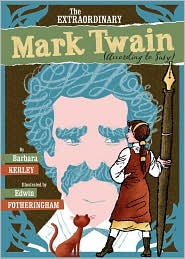
The Extraordinary Mark Twain (According to Susy)
This book earned starred reviews at School Library Journal, Kirkus and Publishers Weekly, and I can tell you why: it rocks, plain and simple. Hmm, where to start.
I think I'll begin with the subtitle, and tell you that this book is based in large part on the observations of Susy Clemens, the daughter of Samuel (a.k.a. Mark Twain), who wrote her own biography of her father when she was 13 years old. Barbara Kerley found that information and followed it to its natural conclusion: a book about Susy writing the biography of her father. It's the perfect sort of biography, really, because it is a biography of a biographer and her subject all at the same time: a child's-eye view of Twain from a person who knew him best. And when Susy's father cottoned on to what she was up to, he made comments just to help her along with her biography. About Susy as a biographer, Clemens said: "This is a frank biographer and and honest one; she uses no sandpaper on me."
I'm going to skip next to one of the things reviewers don't often talk about explicitly (unless it's a pop-up book), and that's book design. Moreover, I'm going to start with dimensions, so that you'll understand what the weird little device is in this book that works so very well. The pages measure 8-1/2 x 12, which means that the book cover is slightly larger in each dimension. But every few pages, there's a two-page insert that measures only 4-1/2 x 5-1/2, which is an excerpt from Susy's Journal. The "cover" says "Journal", the inside two-page spread is an excerpt from Susy's actual journal using LinotypeZapfino One, a sort of semi-script printing that preserves Susy's exact words and spellings (even when they're a bit "off"). There are eleven journal inserts in all, which add so much information and character and charm to this book. Here's the text from the last one in the book:
The other day mamma went into the library and found papa sitting there reading a book, and roaring with laughter over it; she asked him what he was reading, he answered that he hadn't stopped to look at the title of the book . . . she glanced over his shoulder at the cover, and found it was one of his own books.Susy told it like she saw it, and it adds so much dimension to the real Samuel Clemens - as does the way Kerley weaves additional quotes into the main text, relating details in a cogent, coherent way - that the book is a delight.
Further contributing to the delight are the marvelous illustrations by Edwin Fotheringham, whose work on last year's Mermaid Queen, by Shana Corey, I raved about. Here's the first two-page spread from the text, which establishes the set-up of the book and what inspired Susy to write her father's biography in the first place.
Kersey notes that Susy documented both Twain's public life and Clemens's private life. She talked about his early years ("Papa was born in Misouri . . . And we know papa played "Hookey" all the time and how readily would papa have pretended to be dying so as not to have to go to school!"), his speaking engagements, his books - and her opinions on them ("She loved The Prince and the Pauper for its 'lovely, charming ideas' and beautiful language.") - and she wrote of their home life, and what Clemens was like in private. That included, of course, his writing habits:
I adore almost everything about this book: The text, the design, and the illustrations I've already discussed. But the book includes a phenomenal Author's Note at the end, which provides information on Twain and on Susy Clemens, who died of spinal meningitis at the age of 24. As the Author's Note says (grab a tissue - you've been warned):
For the rest of Twain's life, he treasured the biography, misspellings and all . . . The loss of Susy [] may have been the hardest for Twain to bear. After her death, he wrote to a friend, "I did not know that she could go away and take our lives with her, yet leave our dull bodies behind. . . . My fortune is gone, I am a pauper."Kerley also provides a guide to "Writing an Extraordinary Biography", which offers tips to children who wish to write a biography. It's not only available in the book, but also on Kerley's website. The final page in the book (which would ordinarily have been an endpaper, but they used every inch of this book, so there's actual content printed inside the back cover!) contains "A Selected Time Line of Mark Twain's Life" and a family photograph (along with dedications, copyright info, etc.), and the inside of the back cover provides a bibliography of sorts - a list of "Sources" for every single quote contained in the book, including the author's note.
My one quibble with this book (and longtime readers won't be shocked to hear it) is that the book lacks page numbers - something that's particularly troubling when the "Source" list at the back of the book references the pages by number. It wouldn't have been hard to add them to the book, and it would help to sort that out more quickly. *shakes fist at editors and book designers over this picayune point*
You can see a few more spreads from inside this book at Edwin Fotheringham's website (select "Children's Books" from the left-side menu, then scroll through. You can embiggen any of the images by clicking on them after you select them.) And here's a link to the New York Times review of this book, if'n you're interested.