As you've probably noticed, we have news of our own-- a new logo! We're all so happy with it that we've made it a full page, at least for now. All of the credit for spearheading the logo campaign goes to Loreen Leedy. She did a terrific job of getting everyone involved and pushing us to forge ahead. Many thanks to Steve Jenkins for giving of his time and talents to design a logo that we all love. Don't be surprised to see our distinctive ink splot on bookmarks and T-shirts in the near future.
Two of Vicki Cobb's books from her new Millbrook series, Your Body Battles a Cold and Your Body Battles a Broken Bone, were named as Junior Literary Guild Selections for Spring 2009.
Dorothy Patent reports that her book, When the Wolves Return: Restoring Nature's Balance in Yellowstone, is an IRA Teachers’ Choice winner for 2009. Dorothy will be traveling to Cody, Wyoming this month, to complete her residency at the Cody Institute for Western American Studies. On April 23, she will give a presentation there about her current project, a book on the relationships between Indians and horses through time.
Kathleen Krull will be speaking and signing at the Los Angeles Times Book Festival on Sunday, May 26, and at the San Diego Children's Book Festival on Saturday, May 9.
April Pulley Sayre's new book, Honk, Honk, Goose: Canada Geese Start a Family (Holt) is being released April 14th and has already received starred reviews in Booklist and School Library Journal.
In the last two months, she has traveled to 8 states, presented programs for 16,000 students, and snorkeled with 6 manatees.
Susanna Reich has been elected to the Board of Trustees of PEN American Center, an association of writers working to advance literature, defend free expression, and foster international literary fellowship. Among PEN's many activities are the World Voices Festival of International Literature, which this year welcomes 160 writers from around the world to New York City, April 27-May 3. Panels, readings, performances and public conversations will center on the theme of Evolution/Revolution, including three panels of children's and young adult writers, featuring Neil Gaiman, Mariken Jongman, Shaun Tan, Andrea Davis Pinkney, Mary Ann Hoberman, Francine Prose, Vera B. Williams, Tijs Goldschmidt, and I.N.K.'s own Vicki Cobb and Deborah Heiligman. For details visit <http://www.pen.org/>
From Susan Goodman: PEN New England's Children's Book Committee is holding it's 11th Annual Children's Book Discovery Evening (The Susan P. Bloom Award presentation). This year, one of its winners is a nonfiction entry, Maria Gianferrera for her picture book, Terrific Tongues. Come hear Gianferrera and the other winners read on Sunday May 3 at 6:30 p.m., at Lesley University's Amphitheater in University Hall, 1815 Massachusetts Avenue, Cambridge, MA. The winning manuscripts will be read by editors from Candlewick, Houghton Mifflin and Knopf Books for Young Readers.
From Deborah Heiligman: A few nice things recently for CHARLES AND EMMA: THE DARWINS' LEAP OF FAITH. AARP featured it in their March issue on line as books that Grandparents should know about. http://www.aarpmagazine.org/books/books_for_grandparents_march09.htmlAudiocommentary.com named the audio version Editor's Pick of the Month. Both of these things were especially nice because the book is non-fiction and it's lovely to see non-fiction next to the more usual fiction choices. The audio version has a nice review coming in Horn Book, too, which makes me very happy for the fanstastic reader, Rosalyn Landor, who gives voices to all the characters, in her lively British accent. It is so much fun to listen to my words by someone who is an actor and also knows how to pronounce the words in the correct British way. We got to know each other, though, becasue she called me a number of times while recording to ask how various scientific words are pronounced. (Which sent me scurrying to dictionaries and experts. One doesn't think of the pronunciation while writing YA non-fiction.)
From Barbara Kerley: My book, WHAT TO DO ABOUT ALICE? just made the Capitol Choices 2009 list.
http://capitolchoices.com/displaybooks.asp?parent=2622&sort=102&list=2624&curpage=2
If you missed Tanya Lee Stone's CSPAN/BOOK TV presentation to 5th graders at Politics & Prose on her new book Almost Astronauts, it can now be viewed anytime on the BookTV website

Monday, April 6, 2009


Friday, April 3, 2009
Actually, I Like Sports
A few weeks ago, I was enjoying my Monday morning ritual of reading the New York Times while peddling hard on an exercise bike at my local gym, when the fortysomething man on the bicycle next to me looked over. I was holding Sports Monday, staring admiringly at the clever layout presenting the men’s NCAA Final Four brackets on four big basketballs. But apparently I had offended his view of the social order. “Are you actually going to read the sports section?” he asked, incredulous. “Yes,” I answered. “I write books about sports.”
Wednesday, April 1, 2009
Labels and Legends
Some of the most poorly written and boring informational writing gets millions of readers. I’m talking about the legends and labels that explain exhibits in museums, zoos and aquariums. Even as a child, as I read the facts on the small square above the lion’s cage in the Central Park Zoo—the Latin name, where it came from, and what it ate--I felt unsatisfied. I wondered about its behavior, which was usually sleeping in a cell of a cage that contained only a piece of a log as its minimal furnishing. I wondered how the lion really lived in the wild. Museums and zoos have improved over the years but the writing (usually done by museum staff) still leaves a lot to be desired.
So it’s no surprise that I have long harbored a secret wish to write a museum.I’m getting my wish! Well, I’m not exactly writing a museum, I’m writing a single exhibit. But, hey! It’s a start! A fabulous curved mirror, originally designed to produce a 3-D optical display for a flight simulator, has been donated to my new local library in Greenburgh, NY. It will go on display in about two weeks. In my enthusiasm for this project, I’m sharing with you the writing hoping it will generate some interest so you’ll want to see such a mirror in the future (there aren’t many of them around.)

The Story of this “Boomer” Mirror
It’s not easy to refuel an aircraft while it’s traveling at 500 mph six miles above the earth’s surface. Boeing developed the “Flying Boom,” a flexible, semi-rigid tube, to deliver fuel from a tanker plane to another aircraft while both are traveling at high speeds, six miles plus above the earth’s surface. The boom operator must be able to make many tiny adjustments in positioning the boom nozzle to dock with the very small receptacle on the receiving plane. Needless to say, this skill requires great hand-eye coordination, acute depth perception, and a considerable amount of practice.

A fighter being refueled by a tanker jet.
This is not a skill to be acquired on the job. Boomer operators are trained in a flight simulator, an on-the-ground exact replica of the inside of a jet tanker. They look at a three-dimensional display of a plane they might be refueling and that’s where this mirror comes in. This mirror was designed to create the optics for a “virtual reality” of the inside of the tanker aircraft above the receiving aircraft so that the boomer-operator-in-training can make mistakes without any fatal accidents.
View of the boomer and the receiving aircraft as it would look in a flight simulator
A duplicate for this mirror is currently in a flight simulator. This one was a spare. The mirror was designed by Eastman Kodak and built by Displays and Optical Technologies in Round Rock, Texas.
Some Cool Things To Do With This Mirror
See Your Own HUGE Eyeball Floating in Space
Put your eye 18 inches from the back surface of the center of this mirror (This spot is outside the case in the air.) This is the focal point of the mirror, the meeting point for all the light rays starting from your eye that are reflected back from the mirror’s surface. When you position your eye in at the focal point, you will see a humungous monstrous image of your eye looking back at you. If you move your eyes around this spot you can see your face with three eyes.
Shake Hands with Yourself
Position your hand 36 inches from the surface of the center of the mirror. (Again, this is in the middle of the air outside the case.) This is the center of the curve of the mirror. (The mirror is actually part of the inside of a sphere.) At this spot, an image of your hand is created that is upside down and reversed. When the image is directly on top of your hand, you can’t see it. However, when you move your hand right or left, a floating image moves in the opposite direction. If you move your hand up and down, you can shake hands with yourself. If you move a pointed finger towards this point, you will see an image of your finger moving towards you.As you move an object around in the vicinity of the center of curvature, the magnification and speed of the image changes. Verrrrrry strange……
I spoke to Beverly Serrell, a noted expert and consultant on museum exhibit designs. I wanted to get her take on the writing of signs and labels for exhibits, (which is not a particularly lucrative profession.) “It is very important to watch people as they look at an exhibit,” she told me. When I told her I had written my first exhibit she said, “I promise you that it will change before you find its final form.” I can't seem to escape a learning curve.......
So it’s no surprise that I have long harbored a secret wish to write a museum.I’m getting my wish! Well, I’m not exactly writing a museum, I’m writing a single exhibit. But, hey! It’s a start! A fabulous curved mirror, originally designed to produce a 3-D optical display for a flight simulator, has been donated to my new local library in Greenburgh, NY. It will go on display in about two weeks. In my enthusiasm for this project, I’m sharing with you the writing hoping it will generate some interest so you’ll want to see such a mirror in the future (there aren’t many of them around.)


The Story of this “Boomer” Mirror
It’s not easy to refuel an aircraft while it’s traveling at 500 mph six miles above the earth’s surface. Boeing developed the “Flying Boom,” a flexible, semi-rigid tube, to deliver fuel from a tanker plane to another aircraft while both are traveling at high speeds, six miles plus above the earth’s surface. The boom operator must be able to make many tiny adjustments in positioning the boom nozzle to dock with the very small receptacle on the receiving plane. Needless to say, this skill requires great hand-eye coordination, acute depth perception, and a considerable amount of practice.

A fighter being refueled by a tanker jet.
This is not a skill to be acquired on the job. Boomer operators are trained in a flight simulator, an on-the-ground exact replica of the inside of a jet tanker. They look at a three-dimensional display of a plane they might be refueling and that’s where this mirror comes in. This mirror was designed to create the optics for a “virtual reality” of the inside of the tanker aircraft above the receiving aircraft so that the boomer-operator-in-training can make mistakes without any fatal accidents.

View of the boomer and the receiving aircraft as it would look in a flight simulator
A duplicate for this mirror is currently in a flight simulator. This one was a spare. The mirror was designed by Eastman Kodak and built by Displays and Optical Technologies in Round Rock, Texas.
Some Cool Things To Do With This Mirror
See Your Own HUGE Eyeball Floating in Space
Put your eye 18 inches from the back surface of the center of this mirror (This spot is outside the case in the air.) This is the focal point of the mirror, the meeting point for all the light rays starting from your eye that are reflected back from the mirror’s surface. When you position your eye in at the focal point, you will see a humungous monstrous image of your eye looking back at you. If you move your eyes around this spot you can see your face with three eyes.
Shake Hands with Yourself
Position your hand 36 inches from the surface of the center of the mirror. (Again, this is in the middle of the air outside the case.) This is the center of the curve of the mirror. (The mirror is actually part of the inside of a sphere.) At this spot, an image of your hand is created that is upside down and reversed. When the image is directly on top of your hand, you can’t see it. However, when you move your hand right or left, a floating image moves in the opposite direction. If you move your hand up and down, you can shake hands with yourself. If you move a pointed finger towards this point, you will see an image of your finger moving towards you.As you move an object around in the vicinity of the center of curvature, the magnification and speed of the image changes. Verrrrrry strange……
I spoke to Beverly Serrell, a noted expert and consultant on museum exhibit designs. I wanted to get her take on the writing of signs and labels for exhibits, (which is not a particularly lucrative profession.) “It is very important to watch people as they look at an exhibit,” she told me. When I told her I had written my first exhibit she said, “I promise you that it will change before you find its final form.” I can't seem to escape a learning curve.......
Friday, March 27, 2009
I.N.K. is on Facebook!
Please join us. I.N.K. on Facebookor just search for I.N.K.: Interesting Nonfiction for Kids.
We haven't figured it all out yet but we hope to expand the discussion and bring new people into the mix.
We're going dark for a few days to work on our site and other things. When we come back we just might have a new look, some new bloggers, and some other interesting things to introduce to you.
See you on Wednesday, April 1st with brand new posts. No foolin'.
Edited to add--tune in to C-Span 2 this weekend to see Tanya Stone!
See times and summary below:
Tanya Lee Stone, Almost Astronauts: Thirteen Women Who Dared to Dream
Tanya Lee Stone recounts the stories of the thirteen women who trained to become astronauts in 1960, many years before the first woman would be accepted into the NASA program. Known as the "Mercury 13," all the women passed their required tests but ultimately had their career advancement blocked due to what the author posits was gender prejudice. Ms. Stone's book is written for a young adult audience and she presents it to a class of students at Politics and Prose Bookstore in Washington, DC.
(Saturday 8:45 AM and 9 PM, Sunday 4 PM, Monday 4 AM ET)
We haven't figured it all out yet but we hope to expand the discussion and bring new people into the mix.
We're going dark for a few days to work on our site and other things. When we come back we just might have a new look, some new bloggers, and some other interesting things to introduce to you.
See you on Wednesday, April 1st with brand new posts. No foolin'.
Edited to add--tune in to C-Span 2 this weekend to see Tanya Stone!
See times and summary below:
Tanya Lee Stone, Almost Astronauts: Thirteen Women Who Dared to Dream
Tanya Lee Stone recounts the stories of the thirteen women who trained to become astronauts in 1960, many years before the first woman would be accepted into the NASA program. Known as the "Mercury 13," all the women passed their required tests but ultimately had their career advancement blocked due to what the author posits was gender prejudice. Ms. Stone's book is written for a young adult audience and she presents it to a class of students at Politics and Prose Bookstore in Washington, DC.
(Saturday 8:45 AM and 9 PM, Sunday 4 PM, Monday 4 AM ET)
Thursday, March 26, 2009
Beat Boring Nonfiction: Create a Scene!
This time of year, when I am visiting schools, I am less focused on what I write for kids than what they are writing. This week, during a wonderful visit to my home state of S.C., I visited with young authors who were making great strides in crafting interesting nonfiction. I'd like to pass along what I shared with them in a Writer's Group Session for grades 3 and 4.
One common assignment is for students to write about someone they admire. They often choose someone they know well: a parent, a friend, or a teacher, for instance. The first drafts of these pieces typically sound like lists. I like my friend because she is sweet. She is nice to me. She is good at sports. She shares with me. She cheers me up when I am sad.
Certainly, a list is a good way to start. But what really fires up these kinds of essays is scenes. For the second draft, I encourage the students to be specific. Choose a characteristic of the admired person and find an instance when this characteristic was expressed. The reader needs to experience what it is like to have this person in his/her life. We need to hear the details. Several short incidents can make a strong piece. These telling details and incidents show us both the character of the admired and the admirer. They loosen up the writing and add character to the piece.
When my mother showed me the letter, she . . .
When I was sad about my cat dying, my friend sat with me and . . .
Of course, an admired person may be a public figure, not a friend or family member. Scenes still apply. Digging for incidents just takes a bit more work.
When he was 14, he . . .
When she was turned down for school, she . . .
When she lost the election, she . . .
That's it. Make a scene. These moments of narrative within expository pieces make nonfiction interesting. I've seen the change they can make in a student's writing.
P.S. My new book is out. I feel like being a bit loud about it. If you read the book, you will see why. (Hint: honk, honk, hisssssssss!) This is not a shy, retiring book. It is:
Honk, Honk, Goose: Canada Geese Start a Family. Illustrated by Huy Vuon Lee and released by Henry Holt.
My thanks to the students of Lexington, S.C. and Gilbert, S.C. This week they gave me the pleasure of hearing it read and performed for the first time. I divided the audience into groups. Some had "honk." Some had "hee-honk." In unison, we hissed. I conducted the group and it was laugh out loud hilarious. Okay, so we were making a scene!
One common assignment is for students to write about someone they admire. They often choose someone they know well: a parent, a friend, or a teacher, for instance. The first drafts of these pieces typically sound like lists. I like my friend because she is sweet. She is nice to me. She is good at sports. She shares with me. She cheers me up when I am sad.
Certainly, a list is a good way to start. But what really fires up these kinds of essays is scenes. For the second draft, I encourage the students to be specific. Choose a characteristic of the admired person and find an instance when this characteristic was expressed. The reader needs to experience what it is like to have this person in his/her life. We need to hear the details. Several short incidents can make a strong piece. These telling details and incidents show us both the character of the admired and the admirer. They loosen up the writing and add character to the piece.
When my mother showed me the letter, she . . .
When I was sad about my cat dying, my friend sat with me and . . .
Of course, an admired person may be a public figure, not a friend or family member. Scenes still apply. Digging for incidents just takes a bit more work.
When he was 14, he . . .
When she was turned down for school, she . . .
When she lost the election, she . . .
That's it. Make a scene. These moments of narrative within expository pieces make nonfiction interesting. I've seen the change they can make in a student's writing.
P.S. My new book is out. I feel like being a bit loud about it. If you read the book, you will see why. (Hint: honk, honk, hisssssssss!) This is not a shy, retiring book. It is:
Honk, Honk, Goose: Canada Geese Start a Family. Illustrated by Huy Vuon Lee and released by Henry Holt.
My thanks to the students of Lexington, S.C. and Gilbert, S.C. This week they gave me the pleasure of hearing it read and performed for the first time. I divided the audience into groups. Some had "honk." Some had "hee-honk." In unison, we hissed. I conducted the group and it was laugh out loud hilarious. Okay, so we were making a scene!
Wednesday, March 25, 2009
This and That: Fiction and Nonfiction
As I browsed through a few picture books just out this spring, I noticed that writers, illustrators, and book designers continue to defy that most obnoxious of platitudes we children’s authors hear too often – “Anyone can write picture books – they’re so short and simple.” The picture books below present multi-layered stories in words and pictures and the interplay between the two. Some of these books are clearly written as nonfiction. Some are fictional, but present as much information as a nonfiction account of the subject. And one I am hard-pressed to classify at all.

B is for Baseball: Running the Bases from A to Z doesn’t list an author on the cover. Small print on the copyright page lists “Book design by Sara Gillingham. Text by Lisa McGuinness.” This book promotes alphabet books from beginning readers to older kids. It is a history book and a sports book. All the photographs are from the last century and show us the game of baseball (pitcher, umpire, knuckleball) as well as the spectator sport (hot dogs, national anthem, and fans.) Drawings show us the parts of a baseball field. We read about Little League, the Hall of Fame, and the women’s league. Colorful design elements highlight old black and white photos. A “simple” book? I don’t think so.

Sandra Markle’s Animals Charles Darwin Saw (illustrated by Zina Saunders) was reviewed in this blog in the round-up of Darwin bicentennial books. I’d just like to point out the lively mix of biography, geography, and zoology the author and illustrator give to us.

A Tree for Emmy by Mary Ann Rodman (illustrated by Tatjana Mai-Wyss) taught me all about mimosa trees and Emmy who, like her favorite tree, is “stubborn and strong and a little bit wild.” We see a mimosa’s strong branches, fuzzy pink blossoms, and percussive seedpods. We learn why mimosas aren’t sold in nurseries like fruit trees. But Emmy manages to get a mimosa tree for her birthday and we learn how she cares for it. Fiction masquerading as nonfiction? Nonfiction masquerading as fiction? Who cares – it’s a terrific story.

When Louis Armstrong Taught me Scat by Muriel Harris Weinstein (illustrated by R. Gregory Christie,) informs us about the subject, but with fewer facts and more experience. Momma and Sugar start to dance to “swingy music” that “jumps inside my body, rolls riffs on my tongue, and tootles to my toes.” Momma begins to sing scat and Sugar tries it too. That night Louis Armstrong visits her for a scat lesson that turns into a fourteen-page riff on bubble gum. Two author’s notes on Armstrong and scat give us useful history, but reading the scat aloud with wacky typeface and illustrations shows us what Louis was about.

Duck! Rabbit! by Amy Krouse Rosenthal and Tom Lichtenheld is the book I find hard to classify. Its 206 words are spoken by two unseen friends who argue about a creature shown on the pages – is it a duck or a rabbit? This is a book about perception – about expanding our perception as we see first a duck, then a rabbit (or visa versa,) as we look as its bill/ears. Then imagination kicks in as we “hear” a quack or a sniff, “see” it flying or hopping, getting a drink or cooling its ears. Finally the two friends wonder if maybe the other was right. I expect a librarian will put this with the fiction picture books, but there’s a lot here that we nonfiction authors can claim as our own.
Reading and writing for this blog has given me a broader understanding of fiction and nonfiction – what it contains and how it communicates. Have you gone looking for books that blur the lines between fiction and nonfiction? What have you found?

B is for Baseball: Running the Bases from A to Z doesn’t list an author on the cover. Small print on the copyright page lists “Book design by Sara Gillingham. Text by Lisa McGuinness.” This book promotes alphabet books from beginning readers to older kids. It is a history book and a sports book. All the photographs are from the last century and show us the game of baseball (pitcher, umpire, knuckleball) as well as the spectator sport (hot dogs, national anthem, and fans.) Drawings show us the parts of a baseball field. We read about Little League, the Hall of Fame, and the women’s league. Colorful design elements highlight old black and white photos. A “simple” book? I don’t think so.

Sandra Markle’s Animals Charles Darwin Saw (illustrated by Zina Saunders) was reviewed in this blog in the round-up of Darwin bicentennial books. I’d just like to point out the lively mix of biography, geography, and zoology the author and illustrator give to us.

A Tree for Emmy by Mary Ann Rodman (illustrated by Tatjana Mai-Wyss) taught me all about mimosa trees and Emmy who, like her favorite tree, is “stubborn and strong and a little bit wild.” We see a mimosa’s strong branches, fuzzy pink blossoms, and percussive seedpods. We learn why mimosas aren’t sold in nurseries like fruit trees. But Emmy manages to get a mimosa tree for her birthday and we learn how she cares for it. Fiction masquerading as nonfiction? Nonfiction masquerading as fiction? Who cares – it’s a terrific story.

When Louis Armstrong Taught me Scat by Muriel Harris Weinstein (illustrated by R. Gregory Christie,) informs us about the subject, but with fewer facts and more experience. Momma and Sugar start to dance to “swingy music” that “jumps inside my body, rolls riffs on my tongue, and tootles to my toes.” Momma begins to sing scat and Sugar tries it too. That night Louis Armstrong visits her for a scat lesson that turns into a fourteen-page riff on bubble gum. Two author’s notes on Armstrong and scat give us useful history, but reading the scat aloud with wacky typeface and illustrations shows us what Louis was about.

Duck! Rabbit! by Amy Krouse Rosenthal and Tom Lichtenheld is the book I find hard to classify. Its 206 words are spoken by two unseen friends who argue about a creature shown on the pages – is it a duck or a rabbit? This is a book about perception – about expanding our perception as we see first a duck, then a rabbit (or visa versa,) as we look as its bill/ears. Then imagination kicks in as we “hear” a quack or a sniff, “see” it flying or hopping, getting a drink or cooling its ears. Finally the two friends wonder if maybe the other was right. I expect a librarian will put this with the fiction picture books, but there’s a lot here that we nonfiction authors can claim as our own.
Reading and writing for this blog has given me a broader understanding of fiction and nonfiction – what it contains and how it communicates. Have you gone looking for books that blur the lines between fiction and nonfiction? What have you found?
Tuesday, March 24, 2009
Silver Lining
I can no longer easily find a parking spot. My favorite chair is now usually occupied. “This item is not renewable because there is a waiting list” is the startling reply as I try to hold onto that book I haven’t yet read for a few more weeks. My territory has been invaded.
Thus I nodded my headed knowingly as I read Joseph Berger’s article in the New York Times that there has been a “surprising upside to the economic downturn.” What’s the good word? Yes, indeed, I already knew. “Libraries are booming.”
People are rediscovering the library in droves. They are borrowing books, CDs and DVDs. They are using the free internet service and attending the free weeknight programs. According to one librarian Berger quoted, the library is being used “as a gathering place for people who are intelligent and have similar values so they’re not as isolated.”
Can it be that there is actually a silver lining to this dismal economic situation? Of course the library budgets are being cut along with everything else. But will people actually start to appreciate the tremendous resource that is their local public library? Will new users now become aware of how important the library is to their community and possibly contribute to fundraising efforts when they can? If movies are too expensive will more parents take their kids to the library to find a good book or two?
Perhaps our libraries will finally be acknowledged in the public’s mind. Imagine everyone valuing them as much as those of us who love to read. I’d be thrilled to see it happen. As long as I get my chair back.
Thus I nodded my headed knowingly as I read Joseph Berger’s article in the New York Times that there has been a “surprising upside to the economic downturn.” What’s the good word? Yes, indeed, I already knew. “Libraries are booming.”
People are rediscovering the library in droves. They are borrowing books, CDs and DVDs. They are using the free internet service and attending the free weeknight programs. According to one librarian Berger quoted, the library is being used “as a gathering place for people who are intelligent and have similar values so they’re not as isolated.”
Can it be that there is actually a silver lining to this dismal economic situation? Of course the library budgets are being cut along with everything else. But will people actually start to appreciate the tremendous resource that is their local public library? Will new users now become aware of how important the library is to their community and possibly contribute to fundraising efforts when they can? If movies are too expensive will more parents take their kids to the library to find a good book or two?
Perhaps our libraries will finally be acknowledged in the public’s mind. Imagine everyone valuing them as much as those of us who love to read. I’d be thrilled to see it happen. As long as I get my chair back.
Monday, March 23, 2009
Nature, Toddlers, Books--Connecting the Dots
This month I am still traveling in Southeast Asia visiting international schools and speaking at an education conference in exotically named Kota Kinabalu (in the Malaysian part of the island of Borneo), and I have asked my friend Nancy Raines Day — an environmental educator, bookseller and author of both fiction and non-fiction for children — to write a guest post for me. I will be back in April.
David Schwartz
Thanks, David. I feel lucky to be in touch with this community! After spending the last couple of years working on California's new environmental curriculum
Many of you know the book, The Last Child in the Woods: Saving Our Children from Nature-Deficit Disorder. In it, Richard Louv makes the point that children and nature are and must be connected for the health of our children and our planet.
It worries me that American children probably spend less time in touch with nature today than ever before. Especially city kids may have trouble relating to living things in environments they have no personal connection to. Of course, the more outdoor experiences—walks in the park, camping trips, or days at the beach—they can get, the better.
In between such opportunities, putting the right books in their hands can be a great way to connect kids with nature. As Louv wrote, “People who care about nature often mention nature books as important childhood influences.”
Many fine nature books are out there for school-age children. Nature books at the earliest (0 to 4-year-old) level can help build a base for later understanding. Rachel Carson has said, “It is not half so important to know as to feel when introducing a young child to the natural world.” Below, I’ve rounded up some books that help the youngest audience feel their connection to the natural world.

My favorite “young” books new for spring are In My Nest and In My Pond, written by Sara Gillingham and illustrated by Lorena Siminovitch (Chronicle Books, 2009). These tiny books are a tactile delight, allowing little fingers to delve through layers of thick pages while wiggling a baby bird--or fish--in the midst of its family. In My Nest shows the twigs, leaves, and feathers that go into building the nest. When a child later sees a real bird carrying a twig in its mouth, he or she will feel such satisfaction knowing why!
 Also perfect for spring is Kevin Henkes’ Birds, a large book with appealing illustrations by Laura Dronzek (Greenwillow, 2009). Kids everywhere see birds in their daily life, so feathered friends are the perfect wildlife ambassador. The imaginative text engages all the senses. You have to see the illustrations to get a sense of the utter joy conveyed in this passage: If there are lots of birds in one tree and they all fly away at the same time, it looks like the tree yelled. . .
S U R P R I S E !
Another great intro to birds and other animals for toddlers is the whimsical, geometrical art in Charley Harper ABC’s and Charley Harper 123’s (Ammo Books, 2008). He captures each creature's essence with warmth and humor. Harper said of his bird art, “I have never counted the feathers....I just count the wings.”
 To introduce very young readers to environments they may not know firsthand, try Over in the Ocean in a Coral Reef by Marianne Berkes, illustrated by
I’d love to hear about your experiences with these or other books that strengthen young children’s nature connection!
Friday, March 20, 2009
My Daughter, Myself

Twenty-five years ago, my husband, Ronnie, and I received the call that every parent dreads. Our daughter, Lynne, had been in a car accident. A careless boy driving too fast on a country road. He walked away, but she was rushed to the nearest emergency room. Thus began our summer from hell, but, at the end of it, after suffering multiple fractures, she healed and returned to college. My friends told me to write a book about it. But it was too raw, painful, and, besides, it was Lynne’s story to tell, not mine. She went on with her life, a law degree, marriage, two children, later a doctorate in English literature, a teaching job. A life of her own in New York. A great life!
Three summers ago, that long ago accident came back to haunt her. And eventually, she did write a book about it. It’s not a book for children. But it is non-fiction –The Body Broken A Memoir. The pub date from Random House is next Tuesday, March 24. She will be on Good Morning America that day and then come home to St. Louis to celebrate her book with family and friends. I wanted to tell you about it. Perhaps you or your family or a friend are dealing with chronic pain and you might want to share her story. I wish she’d been able to write a different book, a different story. But I am so proud of her.
“We are all looking for lessons in courage. And family. And faith that some of our sweetest hours will come on the darkest days. All are here in Lynne Greenberg’s razor-sharp memoir of life and pain and the miracle of a family bound together by love.”
—Diane Sawyer, ABC News
“Greenberg’s memoir is unsparing, accurate and moving.”_ Maxime Kumin, Pulitzer Prize-winning poet
Thursday, March 19, 2009
Tanya Goes to Washington
After a whirlwind mini-tour to our nation’s capital for my new book, Almost Astronauts, I decided it made sense to share the experience with you here. A sort of virtual show-and-tell, if you will. The old elementary school days of show-and-tell are really what helped sow the seeds of my writing life, after all. Discovering something new, finding out more about it, and then presenting it to my classmates was the ultimate rush when I was six and seven. And it’s the same rush I feel now when I get to stand up in front of a crowd of people and say, “Hey listen to this, you’re not going to believe what I found out!”
I got to do just that last weekend, to several different groups of kids. First stop was the Sheridan School, where I showed them a slide presentation, highlighting some of the tests the "Mercury 13" women went through when they were tested to be astronaut candidates. I told them how even with stunning testing results, the women were still kept out of the program, and some of the reasons why--including a few American heroes behaving badly who really put the kibosh on the whole program. The kids amazed me with the depth and breadth of their questions, and their grasp of the entire story. The next morning at Politics & Prose, as the CSPAN cameraman was setting up an audience mike that the 5th grade girls coming in were supposed to use for questions, I worried that they might be shy. It’s not easy to get up in front of people, walk to a mike, and ask questions in public. Boy was I wrong! Those kids popped up off the floor as soon as the Q&A started, and get this—there wasn’t a single repeat question and every question was directly related to the book and my presentation. Hey DC—your kids are AMAZING!
On Saturday it was on to the Smithsonian’s National Air & Space Museum in Washington, D.C., for their annual Women in Aviation & Space Day at the location in Chantilly. If you haven’t been, check it out—it is an incredible museum set in a hangar with air and space craft in it such as the Lockheed SR-71 Blackbird (the fastest jet in the world), the space shuttle “Enterprise,” and even Betty Skelton’s Lil Stinker, which is shown in Almost Astronauts.
When I arrived, two things had me squealing like a little kid right off the bat. The first was realizing that I had just walked under Betty’s aforementioned plane and was looking up at the craft she had explained with such love and affection when I interviewed her. The second was that Nicole Malachowski, the first woman to become a Thunderbird and whom I featured in the book, was speaking on the flyway just a few feet away. Moving closer to hear her speak, I was thrilled when she caught my eye and waved. When she was done we had a chance to catch up and she told me how excited she was about the book and that she had it on her coffee table at home.
 Giving a talk in this location was surreal, especially when I turned to see that the person who had popped in to help advance my slides was none other than Margaret Weitekamp, curator at the NASM and author/expert of the first book written for adults on the “Mercury 13” women. It was her doctoral work that uncovered the smoking gun in our story—and she wrote the foreword for my book.
Oh, and did I mention the Girl Scouts? Thousands of Girl Scouts went through the museum that day, earning their aviation badges by listening to the talks and experiencing the exhibits. It was a great day for women in aviation and space and I felt just like that six-year-old version of me again—spouting show-and-tell to a live audience. Nonfiction—oh the places you will go!
I got to do just that last weekend, to several different groups of kids. First stop was the Sheridan School, where I showed them a slide presentation, highlighting some of the tests the "Mercury 13" women went through when they were tested to be astronaut candidates. I told them how even with stunning testing results, the women were still kept out of the program, and some of the reasons why--including a few American heroes behaving badly who really put the kibosh on the whole program. The kids amazed me with the depth and breadth of their questions, and their grasp of the entire story. The next morning at Politics & Prose, as the CSPAN cameraman was setting up an audience mike that the 5th grade girls coming in were supposed to use for questions, I worried that they might be shy. It’s not easy to get up in front of people, walk to a mike, and ask questions in public. Boy was I wrong! Those kids popped up off the floor as soon as the Q&A started, and get this—there wasn’t a single repeat question and every question was directly related to the book and my presentation. Hey DC—your kids are AMAZING!
On Saturday it was on to the Smithsonian’s National Air & Space Museum in Washington, D.C., for their annual Women in Aviation & Space Day at the location in Chantilly. If you haven’t been, check it out—it is an incredible museum set in a hangar with air and space craft in it such as the Lockheed SR-71 Blackbird (the fastest jet in the world), the space shuttle “Enterprise,” and even Betty Skelton’s Lil Stinker, which is shown in Almost Astronauts.
When I arrived, two things had me squealing like a little kid right off the bat. The first was realizing that I had just walked under Betty’s aforementioned plane and was looking up at the craft she had explained with such love and affection when I interviewed her. The second was that Nicole Malachowski, the first woman to become a Thunderbird and whom I featured in the book, was speaking on the flyway just a few feet away. Moving closer to hear her speak, I was thrilled when she caught my eye and waved. When she was done we had a chance to catch up and she told me how excited she was about the book and that she had it on her coffee table at home.
 Giving a talk in this location was surreal, especially when I turned to see that the person who had popped in to help advance my slides was none other than Margaret Weitekamp, curator at the NASM and author/expert of the first book written for adults on the “Mercury 13” women. It was her doctoral work that uncovered the smoking gun in our story—and she wrote the foreword for my book.
Oh, and did I mention the Girl Scouts? Thousands of Girl Scouts went through the museum that day, earning their aviation badges by listening to the talks and experiencing the exhibits. It was a great day for women in aviation and space and I felt just like that six-year-old version of me again—spouting show-and-tell to a live audience. Nonfiction—oh the places you will go!
Wednesday, March 18, 2009
Help us create a logo for I.N.K.
Since the I.N.K. blog is now over a year old with several hundred subscribers, it probably is time to come up with a logo and/or banner. We thought our readers could give us a hand with opinions and ideas. What says “Interesting Nonfiction for Kids” to you? Here are some of the concepts we’ve played around with:
#1 A galaxy with various nonfiction topics flying around
#2 An antique quill pen writing the I.N.K. letters on parchment
#3 Skywriting by a jet or an airplane pulling a banner
#4 An octopus holding up various books
#5 A fountain pen writing
#6 A takeoff on Roy Lichtenstein artwork, with thick black lines and colorful dots.
I didn’t get a chance to sketch out anything for the above ideas, but did try some (non-finalized) art for the next few concepts:
#7 Block letters with nonfiction topics inside

Still #7, but with color

#8 Book with various topics flying out.

#8 with color

#9 Ink bottle and splat with topics

So, do you like any one in particular, or have another idea? Please leave a comment and tell us what you think... and any and all I.N.K. bloggers, by all means chime in!
Update: Thanks for all the good comments... here is another variation, I’ll call this #10 to avoid confusion.

#1 A galaxy with various nonfiction topics flying around
#2 An antique quill pen writing the I.N.K. letters on parchment
#3 Skywriting by a jet or an airplane pulling a banner
#4 An octopus holding up various books
#5 A fountain pen writing
#6 A takeoff on Roy Lichtenstein artwork, with thick black lines and colorful dots.
I didn’t get a chance to sketch out anything for the above ideas, but did try some (non-finalized) art for the next few concepts:
#7 Block letters with nonfiction topics inside

Still #7, but with color

#8 Book with various topics flying out.

#8 with color

#9 Ink bottle and splat with topics

So, do you like any one in particular, or have another idea? Please leave a comment and tell us what you think... and any and all I.N.K. bloggers, by all means chime in!
Update: Thanks for all the good comments... here is another variation, I’ll call this #10 to avoid confusion.


Tuesday, March 17, 2009
Green Craft Books for St. Patrick's Day

Happy St. Patrick's Day!
Hope everyone has their "green on" today!
Happy National Craft Month!

Hope everyone's crafty this month!
When Linda told me my post day was St. Patty's Day, I thought, "Great... what the heck am I going to do with that topic?" I've let the topic stew and stew in my head this month. Then, last week, I discovered that it's National Craft Month. Woohoo! Again, I thought, "Craft books is a fantastic topic for this month." Then, again, that nagging St. Patty's Day date popped in my head. Stew, stew, stew... Eureka!
GREEN CRAFT BOOKS!!!!
For the last few winters, I've taught the class, SUMMER Arts and Crafts, at the local elementary school as part of afterschool enrichment. Doesn't that sound great? Summer crafts in the Winter! I turn on beachy/woodsy/nature-y music; which is kind of cool because it sets the mood and calms down the group. Then, I ask the kids to listen to the sounds and pretend we just came back from a long hike in the woods.
Almost all the crafts we've made incorporate recycled materials. At first, when I started thinking about crafts that would work for the group, using recycled materials wasn't a requirement, but it just made sense. Why buy something where materials you have running around the house would work just as well? With each craft, I leave the project open-ended. Dreamcatchers can be made from any size or material of plastic ring like sour cream container tops or take-out containers. The roping can be made of yarn, lanyard plastic, embroidery thread or any material that can be casually woven creating a center "eye". The sky's the limit on the decorating: beads, feathers, stickers, etc.
With all the projects, I stress to the students almost any material can create a great craft, so their imagination can soar.
Last summer, I recommended some great green craft books as part of my Summer Arts & Crafts book list. Now, there are some more wonderful green craft books that were recently published or are about to be released. What I love most about these particular books is the projects are open-ended. The crafts shown are just the tools for millions of creations!
And, it probably goes without saying, all these books are filled with projects perfect for National Craft Month or Earth Day at the library or in the classroom!
EARTH-FRIENDLY CRAFTS:

Clever Ways to Use Everyday Items
Kathy Ross (author)
Celine Malepart (illustrator)
Millbrook Press March 2009
Earth-Friendly and Kid-Friendly. Fun pages, cute illustrations, and great ideas.
GREEN CRAFTS FOR CHILDREN

Emma Hardy
Cico August 2008
Interesting separation of projects into 4 chapters: Salt Dough, Paper, Natural Materials, and Fabric and Wool. The book cover caught my eye with the gorgeous rainbow sherbet colors!
WHAT CAN YOU DO WITH AN OLD RED SHOE?:

A Green Activity Book About Reuse
Anna Alter
Henry Holt March 31, 2009
I love this book - from the adorable illustrations, to the fun open-ended projects, to the creative design of each page. Creating the craft from each character's eye will instantly draw kids into the project!
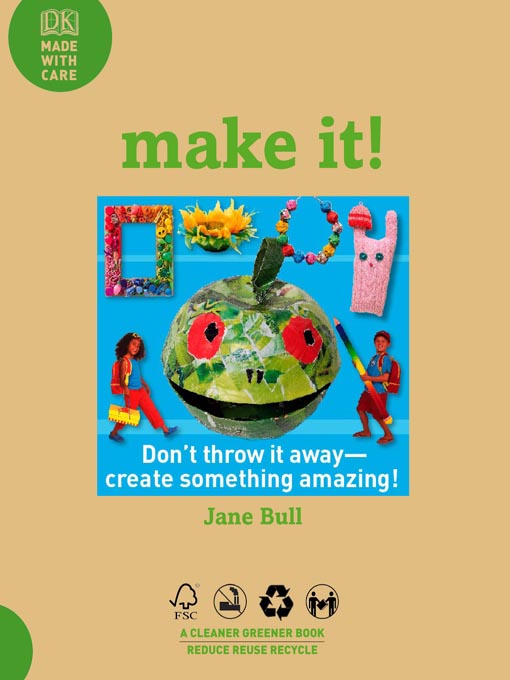
MAKE IT!
Jane Bull
DK Children May 2008
Cool graphics and bright colors make each page fun. Some of the most unique ideas I have seen plus the foundation for thousands of other fun projects.
After teaching the Summer Arts & Crafts class last month, something suddenly dawned on me. In many of the little projects I created growing up, the craft involved a recycled piece. This was the '60s to '70s. Was recycling even "in" back then?
I sewed a black and green snake for my brother for a Christmas present - the materials were old scraps, the inside was an old coat hanger and my next door neighbor's old panty hose! I made a super cool Bar's Open/Bar's Closed with an old piece of wood and my woodburning kit. (I thought it was cool, anyway.) Old towels: stuffed animals. Old pieces of soap: bath crystals.
I thought every kid did this.
Even now, my basement has quite an assortment of used stuff: all sorts of paint palettes for myself and classrooms, glass jars, oatmeal containers, old seashells, leftover pieces from my children's craft projects, and all sorts of really cool things that my husband calls junk and wants to throw out in the trash. Was my "resourcefulness"inevitable because my mom grew up in Germany during WWII and my dad grew up in Indiana during the depression?
Anyone else have this need to reuse things?
Wishing everyone a creative National Craft Month and a lucky St. Patrick's Day!
Subscribe to:
Posts (Atom)