Thursday, April 23, 2009

A Nonfiction Author's Dream

When I arrived, the royal court was assembled in full fancy dress. I was instructed to hide behind the castle wall. The crowds rustled and waited. Someone handed me a tiara and a wand. "You'll need to wear this," she said. Ha, ha! I'd always secretly pined for a tiara. I donned my finery and walked out beneath the crossed swords of the counselor and the voice therapist. Music blared. Crowds roared. I was seated on a throne.

Trumpets sounded. "We declare the next three days to be April Pulley Sayre days in the kingdom of Libraria!" The crowd went wild. Performances began. First the staff (all in royal dress) conducted a play celebrating alliteration and other writing techniques that create compelling nonfiction, specifically mine.

Could a nonfiction author ever hope for such a reception? Yes. This really happened to me last week at Battle Ground Elementary in Indiana. And, no, that's not me in the queen outfit. That's a teacher! This staff is extraordinary. They love words. They not only read my books; they analyzed the books and studied the writing techniques. Their classrooms are full of active writing. Even the smallest child there knows onomatopoeia and alliteration. The staff had training in many areas of writing. And they were actually using it.

After the faculty put on the play, classrooms and grades stood for their contributions. Songs of bumblebees and feeding larvae. Songs to celebrate Trout Are Made of Trees. Chants about libraries. Songs about reading, accompanied by percussion and conducted by the music teacher. A multi-part rendition of Ant, Ant, Ant: An Insect Chant, complete with homemade paper insects on sticks. Trout, Trout, Trout: a Fish Chant was performed by pairs of students who sported fish headbands. They had created hand motions appropriate to each fish name. Thirty or so students with recorders stood up and played to accompany one piece. Students with beautiful bird masks spoke the words to Bird, Bird, Bird: a Chirping Chant.

Surely this was fiction or at least a dream. Hadn't I just been to a school where none of my books were in the library, no one knew my work, and the classroom teachers were in a meeting during my talk? Well, yes. Two weeks before I had been to one of the worst schools of my career. This amazing school, in the very same state, had to be a hallucination.

Yet it was real. Making reading and writing joyful is not a one day effort to show off for a visiting author. The royal play I had witnessed was part of a year long theme. Original mini-plays celebrating writing and reading are written by teacher Jolene Freeman and conducted three or four times a year as part of a huge reading celebration that culminates with a community event involving parent volunteers.

This is a public school. It is not a rich school in a fancy area. They save up to bring in an author every other year. They are in the countryside. They have a relatively high proportion of Title I students who face varying challenges. This is a staff that works very hard to create this learning environment. They are daily, creatively bringing out the best in their students. They do this even though this year they are split between two buildings down the street from one another. One librarian with two libraries. One principal with two school buildings. I saw the principal pitch in and help with anything and everything that needed doing—all the way to clearing plates and setting up books for a signing.

Thanks to an extraordinary art teacher, the walls were blooming with gorgeous art related to my books. Art animals migrated everywhere in honor of my book, Home At Last. Sponge-print whales swam the hallways. Chalk and glue-relief turtles flippered past. Block print lobsters walked along the floors. Butterflies with see-through tissue wings fluttered in the air.

Educators created poetry, nonfiction books, science diagrams and other projects to go with Trout Are Made of Trees, The Bumblebee Queen, and other books. Connie Hayman, the well loved, practically legendary librarian who had invited me, had retired. Yet the new librarian, Mrs. Sturgeon, embraced this author day with gusto. When some faculty were less than excited about a nonfiction author coming, she wrote promos to get them interested in the books. Soon, all faculty members were on board. They love lyricism and narrative techniques. A few were surprised to find it in nonfiction. Of course, as INK readers, we know better. Great nonfiction techniques are on display in the books discussed here every day.

I have been fortunate to visit many schools that go the extra mile to celebrate nonfiction and incorporate writing into students' lives. I share their photos and ideas on my website. But this school? Well, I'm kind of still glowing about it. This experience should get me through hard work ahead.
Yes, I still have the plastic tiara. I think I'll put it on and go write a book.

Wednesday, April 22, 2009

Honk, Honk, Goose!: The Movie


Once an English major, always an English major. Now that Garrison Keillor has made our geeky selves rather cool (at least to each other,) I can publicly admit how much I love to dive into books and pick them apart. And when I read Rosalyn Schanzer’s delightful recent post, Coming to the Theater Near You! and April Pulley Sayre’s stunning Honk, Honk, Goose! Canada Geese Start a Family (illustrated by Huy Voun Lee,) I couldn’t resist taking a dive.

[Full disclosure: April is a good friend of mine, which did not influence this review in any way! I’ve never met Huy Voun Lee – so that proves my objectivity. Besides, I’m just tagging behind the critics who are giving this book stars and more stars.]

So, back to Rosalyn’s movie talk…. As a Screenwriter Sayre has written a tale of romance, danger, and heroic vigilance. Our hero, Father Goose is handsome, assertive, brave, romantic, and good with children – every female’s dream. But his is not an easy job. Predators lay in wait to harm his family. He sometimes fails to avert trouble, but he never gives up. Sigh. What a guy.

Co-directors Sayre and Lee work together to give this story passion and drama. Lee’s stunning cut-paper illustrations give us a stylized but realistic rendering of the world of Canada geese – habitat and predators, as well as details of domesticity. Danger abounds, which Lee shows us in many spot illustrations, but Father Goose is ever-alert. Sayre, as always, uses nature sounds and rhythms to dramatize her story.

Casting Director April chose to make Father Goose the protagonist. Many animal books focus on Mama, but Papa gets the spotlight here. Huy Vuon emphasizes his protector role by showing him with wings spread, neck stretched forward, tongue extended as he speaks his lines boldly: “Honk, hee-honk! Hisssssssssssss!”

Costume Designer Lee exquisitely uses her cut-paper medium to give us finely-cut feathers on the wings which, when spread, dominate the page. She uses downy-textured papers for the geese and goslings’ bodies. Thus we “feel” the power of their bodies and the fineness of their down feathers.

Lee serves as Set Designer with help from Sayre. Lee shows the geese’s habitat of open grassland, (plain green paper with cut-out dark green ridges to show contours and elevation,) and a pond (two-tone mottled blue paper.) This dreamy blue covers the entire double-page spread of the couple’s courtship. We are immersed in the setting as they do what needs to be done to start a family. Sayre’s sounds enhance the setting: “Dabble dip” as they paddle, “Pluck, pull” when they feed, “Stretch, curve, their necks danced.”

Father Goose’s stunts are set up by both author and illustrator. As Stunt Co-coordinators, Sayre describes a raccoon invading the nest and breaking an egg. Father honks, hisses, and lunges. Lee shows us a scary goose in profile, wings reaching beyond the page, neck crossing from one page to another. I’d run away too, like the raccoon.

Cinematographer Lee alters her angles throughout the book: wide establishing shots in the beginning, close-ups for intimate moments, then wide shots showing the new goose family, leading up to the final extreme close-up of Father Goose staring at us and giving us his loudest ever “Honk, hee-honk, honk! Hisssssssss!”

These are Sayre’s Special Effects that bring her hero and the story to life – a sound design that begins with lots of honks, followed by splishes and splashes, flap flaps, more honks, crack crick peeps, still more honks, plop plops, peeps and yawns, and ending with Father’s triumphant Honk. Well done, Father Goose. Well done, April Pulley Sayre and Huy Voun Lee.

Hollywood, are you watching?

Tuesday, April 21, 2009

Falling In Love With Dead People

My friend Pamela Curtis Swallow is writing a biography of her relative Ellen Swallow Richards. This is how our conversations go lately:

Me: Pam, could you please pass the salt?
Pam: Salt comes from mines, Deb, and did you know that Ellen Swallow Richards was the first woman member of the American Institute of Mining and Metallurgical Engineers?”
Me: Really?
Pam: Also Ellen was the first woman admitted to M.I.T. and did you know that she founded the first health food take-out restaurant and was the founder of Home Economics?
Me: Pam?
Pam: Deb, it all comes down to Ellen.

Pam is besotted. She talks about Ellen all the time. Did I mention she also giggles when she talks about Ellen sometimes? She is completely obsessed. And this is how it should be.

I have written four biographies and each time I fell in love. It wasn’t always love at first sight, and sometimes I had to fight to stay in love. But love it was. And being in love with your subject serves an author very well. Because when the road gets bumpy, love keeps you going.

My first love affair was with Barbara McClintock. I had heard of Barbara back when I was an editor at Scholastic News (See Karen Romano Young’s post of March 5, 2009). McClintock won the Nobel Prize for her discovery of jumping genes and we ran a photo of her holding up an ear of maize, the plant she worked with. A few years later, I was thinking about how much I loved biographies as a kid and I decided I wanted to write one about Barbara McClintock. She had won the Nobel Prize for work she had done three decades earlier and when she finally won, interviewers asked her, "Wasn’t it hard that nobody believed you for all these years?" She answered she knew she was right, and “it would all come out in the wash.” What kind of person believes in herself so much that she keeps on working despite the fact that nobody believes her? I had to write about her so I could find out what made her tick.

I read the first chapter of an adult biography of her, called A Feeling For the Organism by Evelyn Fox Keller, which gave some insight into McClintock as a person, and I was hooked. I wrote a proposal, got a contract, and then read the next chapters of Keller’s book and realized I couldn’t understand the science AT ALL. The short arm of chromosome number 9? What is a chromosome? Jumping genes? What is a gene? How do they work? I had barely taken any science since 9th grade biology. I wanted to give my advance money back. But of course I had already spent it on diapers and cheerios and printer ink. I had to write the book.

Besides, I was already in love, which was a very good thing because I stayed up late many nights giving myself a crash a crash course in genetics so I could write the book.

Love makes you do crazy things. Love made a telemarketer give me her rendition of Marilyn Monroe singing “Happy Birthday, Mr. President” when I told her I was on a deadline writing a biography of John F. Kennedy. Love made me write a first draft of said book, High Hopes, in six weeks, as my editor begged me to. Love made me, the only girl who didn’t get into the sixth grade chorus, sing the lyrics to J.F.K.'s campaign song “High Hopes” with Tita Cahn (“Sing it with me, Deborah!”), widow of Sammy Cahn, so I could get permission to use the lyrics in the book. And love made me agree to write the book in the first place even though I knew I would find out things about John F. Kennedy I did not like. (O.K., love and a decent advance.)

So what do you do when you find out things about your person you don’t like? You take a deep breath and say, I am a biographer. I am not, actually, marrying the person. (Not that the people we marry are perfect, either.) You tell yourself that you are obliged to give a full portrait of your subject. And you want to. Within limits, when you are writing for kids.

Writing is all about choices. Did I write about J.F.K.'s extramarital affairs? No. Not only was it not relevant for kids, it was not an integral part of the story I was telling. Did I write about the fact that he and his family covered up his poor health so he could win the election? Yes, absolutely. It was an integral part of the story: his illness and the decision to cover it up shows who John F. Kennedy was. When kids read the book I hope they come away with a sense of the real person – a boy who grew up in a large family in the shadow of his older brother, and overcame illness to become President of the United States. I must admit I was glad I couldn’t write about the affairs.

Love can be hard. Love is hard when your subject dies. I spent many years thinking about, researching, and writing about Charles and Emma Darwin for Charles and Emma: The Darwins’ Leap of Faith. And every time I read or wrote about Charles or Emma dying, I cried. As time went on my tears did not lessen. Because as time went on I was more deeply in love.
By the time I was writing what would be my almost final draft, I started sobbing uncontrollably when Charles died. This moment coincided with our younger son packing to go to college. Everyone in my family knows I do not deal well with separation. Benjamin was only moving 13 blocks uptown, but he was moving out and we all knew things would change. So Benjamin assumed I was crying about him. He came into my office, patted me on the back, and said, “There, there, Mom, I’ll see you soon,” and I said, between sobs, “It’s not you. Charles Darwin died.” Benjamin has not yet forgiven me, and he’s a sophomore. My husband likes to tell the story that months later, when I got to Charles’s death again, this time in galleys (of my OWN book), I whispered to myself, “Maybe this time Charles won’t die.”

I wasn’t always in love with Charles Darwin, and I barely knew he had a wife. My husband sort of owned Darwin in our family. But one day he (husband, not Charles) said to me, “Did you know that Charles Darwin’s wife was religious? And they loved each other very much. She was upset that he would go to hell and they would be separated for eternity.” I fell in love with the subject immediately: marriage, science and religion, God, devotion, death… I knew I had a book to write. Now I just had to fall in love with Charles and Emma themselves. Primary sources were the way in. I read (and as the research went on, read and read again) a two-volume book called Emma Darwin: A Century of Family Letters. There is no surer way to love than through someone’s personal correspondence—assuming, of course, that person is wonderful and articulate and funny and kind and spunky and true and (oh, dear, stop me). I was in love with Emma.

Next I read Charles Darwin’s autobiography and then his journals, and letters, and the same thing happened. I fell in love with him, too. Irrevocably. How can you not love a man who writes in a private notebook, “But why does joy, & OTHER EMOTION make grown up people cry.—What is emotion?” while he’s thinking about the theory of evolution? And writes to Emma around the same time, “I long for the day when we shall enter the house together. How glorious it will be to see you seated by the fire of our own house.”

Darwin was “one of the true Good Guys of history,” as the woman who helped put together the Darwin show at the American Museum of Natural History said to me after my book was published. He was a terrific husband (and Emma deserved that!) and an attentive and loving father. Charles and Emma had a wonderful marriage, which was a profound influence on his work. When he finally wrote The Origin of Species, it was a different book than it would have been had he not been married to Emma. Although Charles Darwin saw wars in nature he also saw the beauty and--

“Deb?”

Sorry.

But I can't help it. I'm in love.

Monday, April 20, 2009

Writing in the Rearview Mirror

So. It's travel season and here I am back home from Kirksville, a nice courthouse town over on the eastern side of Missouri, where a swell children’s lit fest was convened at Truman State University. Then off I go to talk to school kids in Topeka, KS. I'll draw and answer their questions. We'll laugh and I'll tell them how I study for, write, draw, & paint my books. I'll talk about history too, seeing as I tend to write about dead people and what all they did in the world. Some people think that history's kind of boring. Just a pursuit of factoids: battles & birthdays. (just for you to know: Adolf Hitler's is April 20, 1889) According to history, many a well-known person delighted in dissing history, calling it “a great dust heap.” (Thomas Carlyle) “A fable agreed upon.” (Napoleon Bonaparte) “A catalogue of the forgotten.” (Henry Adams)

Well yeah, sure. I suppose. On the other hand, “to not know what happened before we were born,” said the great Richard Peck, “is to be always a child.”

And too, history is positively juicy with adventure and it's loaded with role models. Me being sort of a sissypants, I admire my sturdy, stubborn subjects: pilgrims, reformers, and a particularly persistent fellow who used to live a couple of blocks from my house. President Truman would have had his 125th birthday next month if he hadn't gotten his ticket punched back in 1972. He's the subject of The Harry Book, my first comic book biography. According to Mr. Truman, "the only thing new in the world is the history you don't know."

A historical vantage point helps us to understand how we got here so we're not wandering around on the world's stage with no idea of what the play's about. After all, any nation is more than its borders and banner; it's a combination of all the stories of all who’ve lived in the land, all down the years of the living past. Knowing what people did and survived helps to explain why peoples and governments behave as they do. A nation is like a person whose experiences and ancestral blood make for a lot of explanation, identity-wise. I’m me because of Ray & Elaine Harness & the rest of my ancestors, their blood, their inclinations, plus all that I've done, been, and read - especially the works of Laura Ingalls Wilder. Ten times a piece. I'm an accumulation of it all. Who we are is who we have been.

Anyway, I figure that knowing what folks have survived gives us courage to face what trials we have and a sense of history gives the present a boatload of drama and serious fun. After all, just about all of us live where others, generations of others, once lived, none of them knowing what the future held. A sense of history livens up the calendar with anniversaries and just about any set of numbers with – uhm – associations. When I see 1836 on the odometer, I think ‘Alamo!’ If the person behind the counter rings up $10.66 on the cash register, don’t you think ‘Battle of Hastings’? I’m afraid I do.

Ah well, on tangents I’ve been known to digress and all I meant to do was tell you how I came to write about the past besides the fact that I'm way better at drawing horses than cars. More about that in the future, Fates willing.

Friday, April 17, 2009

Writing Tips from Jan Greenberg

Jan Greenberg wasn't able to post today. Here are some interesting writing tips she first shared with us last May.


The following are some words of advice I give writing students, as I travel around the country teaching workshops. I’d love to hear from some of you if you have other writing tips that I can share with my students.

1. The first tip has to do with revisions. In high school (a few hundred years ago), when I told my English teacher, my first real editor, that my fantasy was to someday be a writer, she said, “You have to write a million lousy words before you can begin to get it right.” I was lucky that my first novel (A Season In-Between 1979) found a publisher right away, but it went through five revisions before it went to press. Writing is rewriting. Collette said you have to murder your darlings. Flaubert said you can’t be married to your words.

2. Strange work we writers do, turning words around all day. But don’t worry about writing the perfect sentence or you’ll never get past the first paragraph. Write it all down the way you’ve been thinking about it, mulling it over in your head, and then go back and rewrite later. Remember to cut any scene that doesn’t serve to move the plot along or reveal character, no matter how brilliantly written you think it is. If you like the scene that much, go back and try to give it a reason for being there. (I guess those are two tips in one.)

3. I never begin a story, either fiction or non-fiction, without having a sense of beginning and end. Writing a story is like making a sandwich. What do you need to make a sandwich? Yes, two slices of bread. What goes in between the slices can be added as you go along, a tomato here, a marshmallow there. But you need bread to hold the parts together so they don’t fall apart. It’s the same principle for writing a story. Reserve the right to change the ending, but at least you can see a light at the end of the tunnel, so you’re not stumbling around in the dark.

Thursday, April 16, 2009

Like Peanut Butter & Chocolate--Nonfiction & Poetry

Nonfiction and poetry are two of my favorite things. Like peanut butter and chocolate, they go together well. In honor of National Poetry Month, I decided to feature a few nonfiction poetry titles to highlight how an author’s voice can breathe new life into nonfiction.

The Surrender Tree: Poems of Cuba’s Struggle for Freedom by Margarita Engle (Holt, 2008). School Library Journal called this Young Adult book “hauntingly beautiful, revealing pieces of Cuba’s troubled past through the poetry of hidden moments.” This incredible book won a Newbery honor.

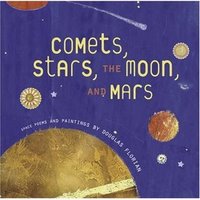
Doug Florian, what can I say? Color me a fan of Comets, Stars, The Moon, and Mars: Space Poems and Paintings (Harcourt, 2007). I love the variety here, including the concrete poem about a galaxy in the shape of a spiral. This reader can feel his passion for the topic on every page. And if you’re looking for fun nonfiction, you need go no further than his Insectlopedia (Harcourt, 1998).

Insectlopedia brings to mind another wonderful book—Paul Fleischman’s Joyful Noise: Poems for Two Voices (HarperCollins, 1988). This title, with illustrations by Eric Beddows, won the Newbery in 1989. The collection is written in the form of verbal duets, which are stunning, creative, informative, whimsical, and a ton of fun to work on with students. I did these with a group of 8th graders a few years ago and the more they recited them, the more excited they became, spinning like water bugs and clicking like cicadas.

For younger readers, also try Judy Sierra’s Antarctic Antics: A Book of Penguin Poems (Sandpiper, 2003), with illustrations by Jose Aruego and Ariane Dewey. Little ones will laugh and learn as they read about the world of emperor penguins.

So celebrate National Poetry Month with a pairing of nonfiction and poetry, and enjoy!

Wednesday, April 15, 2009

10 Reasons Why Kids Need a Garden

• It’s fun to grow your own food whether it’s just one pot of herbs or a multi-rowed mini-farm.
• Homegrown crops taste great!
• Kids are more likely to eat previously rejected goodies they grow themselves.
• Fresh picked fruits and veggies have more nutrients than produce that’s been sitting around.
• A much greater variety of cultivars can be grown that won’t be found in grocery stores.
• Chemicals can be minimized or avoided.
• Gardening saves money. A few dollars worth of seeds can yield a harvest worth much more.
• Gardens save energy. Many food products must be shipped hundreds or thousands of miles to the grocery store.
• Growing your own food is empowering, teaches valuable skills, and encourages self-sufficiency.
• It’s Spring!


For some hands-on inspiration, check out these photos of First Lady Michelle Obama and friends planting the White House Garden. A PDF of the layout can be downloaded from the same page.

Here are some books to get started
:

My First Garden
by Wendy Lewison, illustrated by Miki Sakamoto
Little Simon
16 pages (board book)
ages 2–5
2009

A mother and daughter dig, plant, and water a flower and vegetable garden.


First Garden Activity Book: Fantastic Step-by-Step Ideas
by Angela Wilkes
DK Publishing
ages 4–8
48 pages (spiral bound)
2008

Planting a salad garden, making unique sandwiches, pressing flowers, and windowsill gardening are some of the projects illustrated with photosgraphs. Stickers and seed envelopes are included.


The Vegetables We Eat
by Gail Gibbons
Holiday House
Age 4–8
32 pages
2008

Young gardeners will discover many veggie
options from edible leaves to succulent stems to tasty roots.


A Librarian's Guide to Cultivating an Elementary School Garden
by Bonnie Mackey, Ph.D. and Jennifer Mackey Stewart
Linworth Publishing

160 pages
2008


A comprehensive handbook about school gardens that includes:
Data on improved student performance, environmental literacy, and eating habits.
Funding sources, garden designs, maintenance requirements.
Lesson plans, material lists, book resources, web bibliography.


The Ultimate Step-by-Step Kid’s First Gardening Book
by Jenny Hendy
Lorenz Books
256 pages
2009

This book won’t be released until May... it has 150 projects for ages 5–12 that are illustrated with over 900 photographs.


Wildlife Gardening
by Martyn Cox
DK Publishing
ages 4–8
80 pages
2009

Shows how to plant a habitat with food and shelter for wild creatures such as bees, butterflies, and bats.


Gardening with Children
by Monika Hanneman et al, illustrated by Sam Tomsello
Brooklyn Botanic Garden
120 pages
2007

Making a root-view garden, chlorophyll prints, a hummingbird feeder and more from the the home of the oldest children’s garden in North America.


Happy digging!

Tuesday, April 14, 2009

Unschooling

A couple of months ago I wrote about a year-long road trip Robin Page (my wife), our 10-year-old son and I are planning. In response, I.N.K. readers gave me some good leads on homeschooling resources and provided some philosophical guidance.

Lately, as I continue my homeschooling research, I've been coming across a lot of references to 'unschooling'. This is an informal movement (with a patron saint: John Holt) that has been around for years, but I encountered it only recently. Unschooling appears to range from what we might think of as typical homeschooling (if there is such a thing) to a free-form experience-life-as-it-happens approach, in which children explore whatever they happen to find interesting. In the latter case, it's up to the parents to make sure that a child is exposed to lots of different potentially engaging situations.

To some extent, unschooling is simply a rebranding of homeschooling, which has found itself increasingly identified with a fundamentalist Christian movement that has mostly to do with limiting children's contact with ideas and personalities that didn't fit comfortably into that particular worldview.

Over the past few months I've been reading homeschooling guidebooks, reviews of homeschooling curricula, and looking at a lot of downloadable math and language arts worksheets. I was beginning to think that — even with a fairly unstructured approach — teaching the sixth grade in a VW camper had the potential to make everyone miserable. Robin and I began to shift our concept of homeschooling more and more toward an experiential, Jamie-directed model. Discovering the unschooling movement (which is more about how one doesn't teach a child than it is a specific educational recipe) has reinforced that inclination.

What, the reader may ask (with some justification), does all this have to do with Interesting Nonfiction for Kids? There is a connection, I feel certain. One of the intersections involves a book I've been spending some time with lately. I've referred to it previously in this space: Writing to Learn, by William Zinsser. The premise of this book is that one of the the best ways to learn about any subject is to write about it. Science, history, even math: the act of crafting clear, concise prose teaches both medium and message. Now we just have to figure out how to convince our 6th grader that in composing elegant mathematical word problems he is choosing to pursue his own interests. I have to admit there is a bit of a contradiction here, our focus on self-directed learning while editing Jamie's description of campground flora and fauna. I like to think of it as creative tension.

Thankfully, this post is relevant with the simple change of a preposition: Interesting Nonfiction by Kids.

Monday, April 13, 2009

Hot Off the Press, Mostly

One reason why Jim Arnosky’s books are so engaging is that he’s in them. He uses “I walked watchfully” and “I was crawling on my elbows” in a way most nonfiction authors shy away from. In his newest, Slither and Crawl: Eye to Eye with Reptiles, you are right there with Jim as he shares his fascination with snakes, lizards, turtles, alligators, and crocodiles. He answers the question most on my mind-- how can you get over your fear of these guys-- and lots of other questions budding naturalists will have. He paints many of these creatures as life-sized, and in four lavish fold-out spreads reveals more species and even more details (Sterling, ages 8-12).


I find that most kids are boggled to learn that discrimination against women was common and perfectly legal, and it wasn't that long ago. In Almost Astronauts: 13 Women Who Dared to Dream, I.N.K.’s own Tanya Lee Stone does us all a favor by giving this bias an exhilarating context. In a little-known-to-the-point-of-being-invisible episode in history, thirteen women passed all the tests to become astronauts, only to be turned back when NASA couldn't wrap its mind around the idea of women in space. More than twenty years before Sally Ride took off in 1983, the "Mercury 13" were fighters, dreamers, and serious role models way ahead of their time. Lots of great material here-- especially about women's history (the TV shows, books, and organizations that changed attitudes)--though kids might be most drawn to the drama of the stringent physical tests. Now appearing to starred reviews everywhere (Candlewick, ages 9 and up).

This April 30th, honor the Day of the Child with Book Fiesta!, subtitled "Celebrate Children's Day/Book Day; Celebremos El dia de los ninos/El dia de los libros." Pat Mora's text is straightforward to the point of being nonfiction--an itemization of the coolest places to read books-- and in the back she includes helpful hints for families and teachers to emphasize literacy. The illustrations by Rafael Lopez are boldly stylized in an almost Alice-and-Martin-Provensen way, and the entire production is, of course, totally bilingual (Rayo/HarperCollins,ages 4-8).

Turn off the TV, and read a book... about TV. My publisher might not appreciate this association, but you could celebrate TV Turnoff Week, starting this April 20th, by pre-ordering The Boy Who Invented TV: The Story of Philo Farnsworth. Yes, we could blame our whole TV culture on a 14-year-old farm boy who dreamed up the first television back in 1920-- but wait, Philo thought he was inventing a force for good, and in later life wouldn't let his own sons watch what he decided was drivel. My biography, with startlingly electric paintings by Greg Couch (who also illustrated Sue Stauffacher's Nothing but Trouble: The Story of Althea Gibson), won’t be out till this fall, but it’s been chosen as a Junior Library Guild Selection, which I'm calling momentum. Another TV Turnoff Week starts September 20th, in time for the book’s actual pub date (Knopf, ages 8-12).

Friday, April 10, 2009

A Fiction Writer's View of Things

It seems like several of the I.N.K. bloggers have been hitting the road lately, and I’m one of them. I’m in Mexico so my friend and colleague David Elliott has agreed to take my place today. David considers himself a children’s fiction writer and I suppose that’s true. He’s too gracious to say it, but the novel he mentions below, Jeremy Cabbage and the Living Museum of Human Oddballs and Quadruped Delights, has been optioned by Fox 2000. But some of David’s picture books are poetry about animals and could easily be classified as nonfiction. On The Farm, for example, received many starred reviews because David used facts and great eloquence to distill common farm animals to their very essence. If you want to know more about him, check out http://www.davidelliottbooks.com/index.html.

Here’s David:

I grew up in the 50s in a Midwestern farm town, the kind of place where on Saturdays the farmers sat on the courthouse lawn while their wives did the weekly shopping. It was a town very much like thousands of others scattered throughout the no-nonsense states of Ohio, Indiana and Michigan. But it did have three distinctions. 1) It was the home of the Mills Brothers. 2) It was the site of the first concrete street in the United States. And since my friend Susan Goodman has taught me that any quirky fact can become a compelling story in the hands of the right person, I’ll give you the name: Court Street. 3) It had a Carnegie Free Library.

This library sat on a rise, directly across from the Eicholtz Funeral Home, and kitty-corner to the Lutheran Church. It was the grandest building in town, a neo-gothic affair with a sturdy column on either side of its welcoming entrance. But I didn’t need encouragement, architectural or otherwise. To a working class kid like myself, anything free was good. I spent a lot of time there.

I still remember the way that library smelled when you crossed over its oak threshold, a peculiar mixture of floor-polish, new books, and vomit (a lot of kids used that library) all permeated with the florid scent of the librarian’s eau de toilette. But it’s the library’s floor plan that I’ve been thinking about. As you entered the foyer, wide and high-ceilinged, the kids’ books were tidily shelved in low cases in a room to the right. To the left, directly opposing was the reference room, with its maps, and its histories, and its encyclopedias. Even now, that room gives me a bad feeling. There was only one reason to go in there: Homework.

Recently, I have had the good fortune to visit another Carnegie Free Library, here in New Hampshire, and to my surprise the floor plan was exactly the same. The reference room was on the left, the kids’ books on the right.

This arrangement set me thinking because it seemed to reinforce the odd idea that the world of the fiction was naturally distinct from the world of facts. (No doubt, there were some nonfiction books in that kids’ room, but not many, and I certainly didn’t know where they were shelved.) I understand the comfort of this kind of polarity. It’s clean, and we all know what cleanliness is next to. But I wonder if this kind of thinking sacrifices what is true for what is easy.

I’m now not so sure that this border between fact and fiction exists at all, or at the very least, if it isn’t more liquid than we allow it to be. After all, every scientific advancement, every cultural artifact, every technological gizmo first started in someone’s imagination. And our imaginations would be useless without some hard nouns, some facts to pin them onto.

As a fiction writer, I couldn’t get anywhere without the nonfiction world. This is also true when I’m working on a picture book. Recently, in doing some research for a book of verses about wild animals, I learned that it’s the lion’s ability to roar, along with the tiger’s, the leopard’s and the jaguar’s, that makes them Great Cats. I also discovered that lions rarely roar in the daytime. Who knew? But these two pieces of non-fiction became the basis of the verse that will open the book. And the reverse is true as well. In looking at some of the fabulous nonfiction books currently being published, it’s clear that without the engagement of their authors’ imaginations, the books would not be books at all, but simply glorified lists, the kind of thing that as a gift felt the equivalent of getting a toothbrush in your stocking at Christmas.

In my most recent novel, the protagonist is a street kid who has taken up residence in an abandoned library. In one scene, we see him in the library’s fiction section, reading to find some comfort from the sad truth of his life. I wonder now why I didn’t let him find the nonfiction shelves. Surely, there is just as much comfort to be found in learning about the lives of children, say, from Pago-Pago, the peculiar habits of the naked mole rat, the downfall of history’s biggest bullies.

Or maybe, I should have revolutionized those shelves altogether and put The Truth About Poop next to Octavian Nothing, Rocks in His Head next to From the Mixed Up Files of Mrs. Basil E. Frankweiler, thereby destroying a dichotomy that may not be as clear as we sometimes think.

Thursday, April 9, 2009

All Hail Amazin' Raisin

One thing that being middle-aged has brought me (along with creaky knees and, as my hairdresser once commented, “platinum highlights”) is the beginning of a sense of perspective.

This has proved true in my own life, and in my writing career. I’ve had some amazing highs—the deep satisfaction of nailing an idea after weeks of floundering; starred reviews that sent me flying out the door to walk the streets of my neighborhood until I calmed down enough to get back to work. I’ve also had my share of dismal lows—the five year period when I did not sell a single manuscript; the review in a major newspaper that called my writing style, and I quote, “irritating.” Ouch.

I’ve pursued intriguing book ideas that sometimes work out beautifully (see “high”, above), and sometimes bite the dust after weeks or months of work (and that would be a “low”).

But as the list of highs and lows grows longer, it does make it a little easier to step back, take a deep breath, and then soldier on. Perspective.

About 20 years ago, some of you may recall, there was a national advertising campaign to Name the Raisins—an animated (literally) rock band that sang “I Heard It Through the Grapevine” on TV commercials.

My husband and I were in school, we were broke, and I really wanted to win the $10,000 prize. Besides, how hard could it be to name a piece of dried fruit?

I like raisins. Truly, I do. And the fact that you had to submit raisin box tops with your raisin names meant that we ate a lot of raisins that month. I even made a sour cream raisin pie, a mistake I will not repeat.

Over the course of that month my long-suffering husband and I managed to eat enough raisins for me to submit three names—three glorious raisin names—to the judges.

I tried to think what fun raisins would be like. I didn’t want boring names. I wanted my raisins to have style. To be spunky and just a little bit sassy. MY raisins would have PERSONALITY.

Amazin’ Raisin. Jammin’ Raisin (they were in a rock band, after all). And my own personal favorite, Misbehavin’ Raisin.

I sent in my names, sat back, and watched the grand prize go… to whoever invented the name Tiny Goodbite.

I was outraged. How could Tiny Goodbite compete with that finger-wagging rogue, Misbehavin’ Raisin? Somehow, a Tiny raisin had bested him.

So what did I learn from the raisin days? That it’s good writing practice to be playful, to think about character, to have a little fun. That even if your ideas are not embraced by the powers-that-be, there is a benefit to exploring them anyway.

And, of course, never to make that pie ever again.

Tuesday, April 7, 2009

Coming Soon to a Theater Near You!!!

Whenever I write and illustrate a book, I try to make it feel like a little movie you can hold in your hands. This means I have 8 different jobs to do, and every one of them comes straight out of Hollywood (just minus the big budget). Hoo-hah! To show how this works, I'll roll the credits.


1.
My Screenwriter persona must first conjure up a strong story idea and then write the screenplay. I tend to go for true tales of adventure, and most of my stars stride forth out of history. I command myself to find a brand new twist on these old tales, to be as compelling, substantive, and entertaining as possible, and to be 1,000% accurate at the same time. Remembering that the pictures are King and tell at least half the story, I try to make the script relatively short--but (I hope) as evocative as haiku.
Just one picture tells everything Ben Franklin did in his
entire life.
The words go in the narrow white space to the right.

2. Naturally, I hire myself to be the Director. Will I frame my story as a comedy or a mystery, a drama or a thriller--or all of the above? Should the visuals be realistic or might they work best as a Toon? Once I decide, I'll make a storyboard so that each scene is designed to keep viewers on the edge of their seats and eager to find out what happens next.


3. Next I become the Casting Director. To select the best actors and actresses to play my protagonists, my job is to figure out, for example exactly what Charles Darwin or George Washington looked like at a certain age. Or I have to think about John Smith's personality and then deduce the way he might really have behaved in each scene. And will my Sacajawea characterization captivate the audience and still be historically accurate?


4. Now my illustrator half morphs into a Costume Designer, a job that calls for more research than you can shake a stick at. Every button on King George III's coat, every fancy collar or piece of jewelry around Queen Elizabeth's neck, every weapon fired by the Cossack army, and every robe and headdress of the Mandan Indians has to be correct down to the last detail.

5. I also get to be the Set Designer, so I have to do the same in-depth research as my costume designer self to make sure that the iguanas on the Galapagos Islands, Lewis and Clark's various boats, and the post offices and libraries in Colonial Philadelphia look exactly right. Got to includes the correct saloons and scenery and equipment from the California Gold rush too.
6. As the Stunt Coordinator, it's my job to add plenty of action so that when John Smith gets thrown off of a ship in a storm or when Charles Darwin falls out of his hammock, my stuntmen do their best to whip up some excitement. For humorous effects, I can even have my Ben Franklin stunt man turn cartwheels over the top of his own inventions

7. I'm the Cinematographer for sure. For dramatic effect, the lighting has to be just right. So does the mood and the color in each shot. Every scene must move the story forward in a visually interesting way. I can choose to shoot the scenery from above or below. I can use close-ups of faces or add dramatic wide angle shots from afar.

8. I even get to be the Special Effects expert who wows the audience with exploding volcanoes! Gigantic tsunamis! Or fiery ship battles with showers of stars in the mix!
Hmmmm....I love all eight of my labor-intensive jobs, and like all the rest of the nonfiction author/illustrators out there, I never have time to get bored. But I'm thinking that we're all about due for a raise!

Picture credits in order of appearance come from the following books: How Ben Franklin Stole the Lightning; How We Crossed the West: The Adventures of Lewis and Clark; John Smith Escapes Again! What Darwin Saw; the Journey that Changed the World; John Smith Escapes Again! (again); and George vs. George; the American Revolution as Seen from Both Sides.