Showing posts with label Common Core. Show all posts

Friday, June 27, 2014

Writing Inspiring Nonfiction for Kids and Common Core

Two weeks ago when I read the latest article about the Common Core in the New York Times titled Common Core, in 9-Year-Old Eyes, I knew this would be the topic of my last post. Things have sure changed in the last six years. When Linda Salzman first started this nonfiction blog and invited nonfiction writers from all areas to write a monthly post, I was all about speaking out about art and creativity books for kids. Now, the popular nonfiction buzzwords are Common Core, STEM, digital publishing, marketing, and graphic novels. These were main topics discussed at last weekend’s Second Annual 21st Century Children's Nonfiction Conference --- as pointed out in this Publisher’s Weekly article about the conference.

In the aforementioned New York Times article, 9-year-old Chrispin Alcindor had been a star student but was struggling with math under the new Common Core teaching and was worrying about not passing to the next grade. I was drawn into his story by “his dream of becoming an engineer or an architect, to one day have a house with a pool and a laboratory where he would turn wild ideas about winged cars and jet packs into reality.” Chrispin’s excitement towards learning changed, as he grew frustrated by the new Common Core math. His enthusiasm was crushed. His dream of "walking across the stage at graduation in sunglasses and white sneakers, claiming his award and basking in the applause of the entire school" banished from his mind.

Trish Matthew, Chrispin’s teacher at Public School 397 in Brooklyn, saw the frustration in her classroom. The article continued, “Many struggled with basic math skills. Ms. Matthew, concerned about morale, called each student to her desk at the beginning of the year. “Please don’t think you are a failure,” she told them, one by one.”
I was so touched and moved by Ms. Matthew’s actions, which prompted writing this post and fueled my final comments. 

Last week, Arne Duncan went on CBS This Morning to talk about the Common Core. If you missed it, I’ll post it here.
And, if you're interested in reading a few pros and cons on the Common Core, check out the 505 comments on the New York Times article. Warning: it gets a little heated.

Recently, I've noticed while sitting down with editors to discuss new book projects, the Common Core is often mentioned. They highlight new book projects that have sold because they support the Common Core---fodder for reader discussions on why they thought the author wrote the book, compare and contrast aspects within the story, etc.
As I set off to work on the next chapters in my writing career, while the Common Core and their writing strategies will be in the back of my mind, inspiring young readers will be my main focus. Inspiring them to think. Inspiring them to achieve whatever they want to be. Inspiring them to be creative. Inspiring them to dream.
I will be continuing my blog posts on my website: AnnaMLewis.  Please check there for my next posts and the latest book news.
Here’s to Interesting (and Inspiring) Nonfiction for Kids!

Friday, May 23, 2014

Arts in the Schools and INK (Interesting Nonfiction for Kids)

While writing today’s piece, I anxiously checked news feeds regarding the fire at the Glasgow School of Art’s Mackintosh Building. By the end of the day, the fire service reported they were able to save 90% of the building and about 70% of it’s contents. Just thinking about the possible loss turned my stomach. Started in 1897, the Mackintosh Building was designed by Scotland's most influential architect and designer, Charles Rennie Mackintosh. Opened in 1909, the art nouveau building signaled the birth of a new style in 20th Century European architecture. A 2009 poll by the Royal Institute of British Architects voted it the best British building of the last 175 years. Imagine what we could have lost today.

About six and a half years ago, Linda Salzman contacted me. She asked if I’d be interested in writing for a kids’ nonfiction blog she was creating. Evidentially, someone noticed all the blogging I’d been writing promoting of art books for kids.  Today, in preparing to write this second-to-last post, I reread all my pieces and perused the books I’ve promoted. I was curious if there has been any change in the educational world in regard to the arts. Here's just a few items that I found. There are many more. I wonder where we will stand in another six years. 

In the last six years, we’ve become accustomed to the terms Common Core, and STEM and STEAM.
  • Common Core State Standards now aim towards a 50% nonfiction and 50% fiction classroom reading text; previously the classroom reading text was around 80% fiction.
  • In 2009, President Obama started White House Science Fairs as part of his Educate to Innovate campaign to inspire more girls and boys to excel in STEM subjects. Next week, on May 27, the 2014 White House Science Fair begins. This year’s fair will include a specific focus on girls and women who are excelling in STEM. The Administration’s $4.35 billion Race to the Top competition grants states competitive preference if they demonstrated efforts to close the STEM gap for girls and other groups that are underrepresented.
  • In February 2013, the bipartisan Congressional STEAM Caucus was created, co-chaired by Congresswoman Suzanne Bonamici (D-OR) and Congressman Aaron Schock (R-IL). “We frequently discuss the importance of STEM education, but we can’t ignore the importance of engaging and educating both halves of the brain,” Bonamici maintains. “Creative, critical thinking leads to innovation. The integration of the arts into STEM curriculum will excite creativity in the minds of our future leaders.”
  • Stanford University began requiring all undergraduates to take two units of "Creative Expression" classes, including design, dance, music, fine arts, drama or creative writing.
  • Sesame Street officially expanded its STEM-themed programming to include arts.
  • Last week, Actress Kerry Washington wrote an impassioned plea for arts in the schools in a Huffington Post blog column titled How to Save Our Schools: The Arts and Music are No Fairytale.

Art-themed nonfiction books introduce young people to the passion and inspiration of artists and creators. Years ago, reading Frida by Jonah Winter to an elementary class was an eye opener for me. The text and illustrations presented the art of Frida Kahlo flawlessly, complimenting my presentation. And, the book even caught everyone's attention in a room full of kindergarteners and a class of fifth graders – no small feat.

As the support for arts in the schools continues to grow, I’ll continue to spread the word about nonfiction art books, including STEM/STEAM, activity and creativity books. Tragically, we could physically lose our treasures, but the passion and creative inspiration is what stays in our hearts. That is what art books set out to accomplish.

Monday, May 12, 2014

Nonfiction then and now and...?


I started writing for I.N.K. in March 2008.  With nostalgia and curiosity, I went back to look at some of my initial posts.  I kept on reading and realized that I was also looking at a history of what has happened in the field of kids’ nonfiction from then to now.  At least, some of its zeitgeist, its ups and downs. 

By 2008 we nonfiction writers had had time to road-test our liberation from straitjacket association with encyclopedic information.  We had seen or written books such as Dance, Actual Size, and Action Jackson, celebrating the changes that came with cheaper color printing and more experimental styles and formats.  It was no wonder my second post for I.N.K., A Rose by any Other Name? bridled against the confines of the word used to describe our field.  I wrote: 

As we all know, words matter. So what about the one that describes our genre of writing: nonfiction. I used to feel just fine about it, but now I have a slight twinge. After all, it does have a negative point of reference. The “I’m not fiction” instead of the “I am something” kind of writing…

If you link to the post you can see a discussion of the issue and the difficulty I and other  commenters had trying to find a good solution.

Artistically booming , we were about to take a fall. In June 2008, however, most of us didn’t know that. I’m a glass-half-full-AND-half-empty type, perhaps I had a premonition.  In The Lucky Thing about Friday the 13th(prompted by my assigned post date) I amused myself with cheerful grumbling about the luck factor (or lack thereof) in writing nonfiction for kids.  Here is part of it:

The lucky thing is that schools and libraries can always use a well-written book to update their collection on a particular subject.
The unlucky thing is that they can’t afford to buy them.
The lucky thing is that you can create books on subjects kids will love.
The unlucky thing is that many publishers can’t imagine marketing nonfiction to the trade market, so the kids don’t find them.

If you click on rest of the post, please note I do end with the lucky side; I love what I do and have, luckily, managed to make a living at it.  

Nevertheless a few months later, the fan was hit plunging us into the biggest fiscal crisis since the Great Depression.  It hit the book industry the same way it affected the nation at large.  I know many people whose completed, even paid-for manuscripts were dropped by publishers looking at a shriveling market with no immediate change in sight.  One of my own was pushed to a pub date over a year in the future so it could be “supported more successfully.”

Happily unagented for most of my career, I began to think about the comfort of having an ally.  I started a search for an agent and was shocked by what I found on their web sites.  Another post, Agents-Agents of Change was born. 

A personal nadir perhaps, but hope springs and swings eternal along with changing fortunes for people and professions.  In other words, if you stick around long enough, the pendulum swings.  On a personal level, I had three books come out in 2012.  More globally, picture books, declared a dying form, managed a “rebirth.” YA nonfiction is growing. Nonfiction books are more frequent winners and honor winners of the Newbery, Printz and Caldecott. 

I’m not exactly sure when the phrase Common Core first appeared in I.N.K. posts, but it increased exponentially in 2012.  My book Skyscraper was included in Math Reads, Marilyn Burn’s series using actual books to teach math; and I posted about future models of using our books in the classroom. When Penguin combined The Truth About Poop and Gee Whiz in a new edition, I wrote about what was lost and gained by very intelligently reissuing these books in black-and-white digest form for the burgeoning middle grade market. 
 
I wasn’t the only one commenting on the Brave New World of nonfiction’s role in education.  I.N.K. devoted the whole month of October 2013 to Common Core and nonfiction in the classroom with a spirited discussion about the author’s role in the process.

Is Common Core going to change the role and status of nonfiction in our culture?  Who knows.  I know more imprints are opening their lists to it.  And I wish we’d have more time and posts to report on what happens as a result.  But it’s been great to have an opportunity to think and write about all things nonfiction until now.  Thank you, I.N.K.

This post, in fact, my tenure at I.N.K. is dedicated to Linda Salzman, without whom…

Tuesday, March 25, 2014

VERY SAME TOPICS, VERY DIFFERENT BOOKS Rosalyn Schanzer


It's pretty impressive to see how many different ways nonfiction authors can present the very same subject matter or the very same people in their books. To get the gist, today I thought it might be fun to compare some examples of books on the same topic--mostly (but not entirely) by our own INK authors and illustrators. I'll be brief, I promise.  


So how about starting with our foremost founding father, George Washington himself. Each of these 3 authors has come up with entirely different hooks to pique your interest, so a young audience could get a pretty well-rounded view of our guy by checking out these true tales.


First up is The Crossing: How George Washington Saved the American Revolution by Jim Murphy.  His hook is to focus on Washington's growth as a leader, obviously leading up to the famous crossing of the Delaware on Christmas in 1776. He's used some very interesting artwork from the period to enhance the tale.

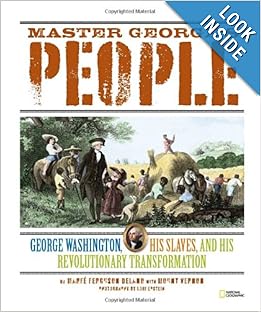
Next comes an entirely different take on George from Marfe Ferguson Delano. Her book, Master George's People, tells the story of George's slaves at Mount Vernon, and she has collaborated with a photographer who shot pictures of reenactors on the scene. 


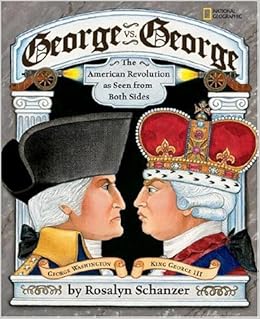
And this one is  (ahem) my version. George vs. George: The American Revolution as Seen from Both Sides shows how there are two sides to every story.  I got to meet George Washington and King George III and paint their pictures myself.
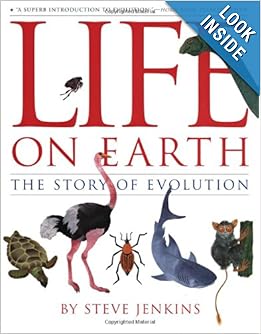
OK, on to the second set.  In one way or another, the next 3 books are all based upon Charles Darwin and his Theory of Evolution. Let's start with Steve Jenkins' handsome book Life on Earth: The Story of Evolution.  With a nod to Darwin, Steve has created a series of stunning collages along with fairly minimal text in order to focus on the history of all the plants and animals on the planet. 
And here's yet another nod to Deb Heiligman for her celebrated true tale of romance between two folks with opposite views of the world. Despite Emma's firm belief in the Bible's version of life on earth, she and Charles enjoy a warm and loving marriage.
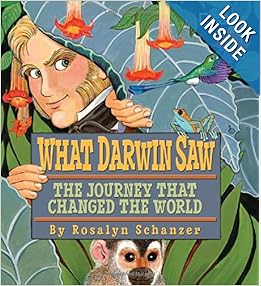
Mine again. What Darwin Saw: The Journey that Changed the World, tells about Darwin's great adventures as a young guy while traveling around the world. We're on board In this colorful graphic novel as he picks up the clues that lead to his Theory of Evolution and then does the experiments that prove it.
And here's series number 3.  Apparently these authors and illustrators were hard at work at the very same time on three very different picture books about the very same person; her name is Wangari Maathai, and she won the Nobel Peace Prize for bringing Kenya's trees back to life after most of them had disappeared. 

The artwork in all three books is outstanding, and each version is truly unique. The writing styles vary enormously too. I strongly recommend that you look at them side by side to prove that there's more than one way to skin a cat.  

Planting the Trees of Kenya was written and illustrated by Claire A. Nivola.


Wangari's Trees of Peace was written and illustrated by Jeanette Winter. 
And Mama Miti was written by Donna Jo Napoli and illustrated by Kadir Nelson.  
I'd bet anything that these folks didn't know they were creating books about the same person until all 3 versions were finally published....writing and illustrating books is a solo occupation if there ever was one. 

OK, that's it--though we could easily go on and on.  Here's hoping that if any kids examine a whole series of books on the same topic written and illustrated in such different ways, they can come up with some unique new versions of their own....and have some fun at the same time. 

Thursday, January 23, 2014

Happy TENTH Anniversary to the Mars rover Opportunity!

On July 7, 2003, tucked into a Delta 2 rocket, the rover Opportunity blasted into space headed to Mars.
On January 24, 2004 PST (Jan. 25 Universal Time), the rover was dropped onto the surface of Mars wrapped in airbags, where it bounced 26 times before coming to rest in a crater.  This little rover, about the size of golf cart, was designed for the three-month mission to find signs of past water on Mars. 

Tomorrow marks the 10-year anniversary of Opportunity’s mission on Mars. TEN YEARS!!! HURRAH! WHOOT WHOOT! I MEAN, CAN YOU BELIEVE IT PEOPLE??? TEN YEARS!!! It was a three-month mission and this little robot, which was not designed to survive even one Martian winter, is STILL EXPLORING MARS TEN YEARS LATER! It is a miracle. This is perhaps the most successful space mission EVER!

I don’t get to write like this, in all caps and with multiple exclamation points, in my books for children, but this is how I feel about this mission and this rover. I am astounded. I am in awe. I cannot believe that a dream and the work of a bunch of scientists and engineers have given us a ten- year tour of another planet.

Opportunity was designed to only travel on flat terrain but has explored crater after crater after crater and is currently climbing the tallest hill of its mission. This is where Opportunity has traveled so far:
 
Opportunity is currently exploring the rim of Endeavour Crater, near an outcrop that may contain clay laid down in a watery past. Signs of past water have been found before, but evidence suggests that unlike the battery-acid-like water present on other parts of the planet, the water here may have been neutral enough to have once sustained life.  LIFE!

I hope you can find a little time to celebrate the incredible success of this mission, especially with your children and students. You can:

Watch a live broadcast from the Jet Propulsion Laboratory today Thursday, Jan. 23, 11 a.m. PST (2 p.m. EST) which will include appearances of two of the heroes from my book The Mighty Mars Rovers, Steve Squyres and John Callas. (Webcast live at http://ustream.tv/NASAJPL and on NASA TV streaming at http://www.nasa.gov/nasatv.)

See Space.com’s slide show of the top ten discoveries from Spirit and Opportunity’s mission.

Enjoy these stunning photos from a decade of exploration.

Check out a slideshow about why the rover lasted so long, at NASA’s 10-year anniversary page. 


Read the story of girl who was in eighth grade when Opportunity landed on Mars and is now an engineer on the mission.

Teachers, there is so much this mission offers to inspire your students. As the mission continues to unfold, Opportunity gives you an incredible opportunity to connect reading, writing, science, history, news, books, videos, and primary source material easily available on the internet. A teachers’ guide to my book The Mighty Mars Rovers offers discussion questions, hands-on activities, and resources. You can also find good ideas in two Common Core guides, one short  and one long.

When I started writing The Mighty Mars Rovers, my husband bought me a little scale model rover to keep on my desk as inspiration. But my model kept falling off my desk and breaking.
Perhaps my desk is a more hazardous place than Mars. 

Or perhaps we humans are capable of much more than we can even imagine.

Long live Opportunity!

Elizabeth Rusch


Images courtesy of NASA/JPL, except for the last one, which I took myself.

Monday, December 16, 2013

Stop, Stop, You're Both Right!!!


I’m sure many of you are like me—making your lists, checking ‘em twice.  Mid-December isn’t the best time to think about writing, reading or Common Core, but here I am. 


Both on this blog and the rest of the web, I’ve read a lot about our job as authors concentrating upon our writing/thinking about Common Core or providing support materials for teaching our books. 


I end up smack in the middle.  I’m reminded of an old ad campaign for Certs when I was a kid (Do they still exist?).  “Certs is a breath mint,” one person states.  “Certs is a candy mint,” insists the other.  Then some bodiless baritone booms, “Stop, stop, you’re both right.  It’s two, two, two mints in one!"  


I believe my job is being a storyteller.  It’s what I love.  I love to dig in to a subject, find my idea of what is important and extraordinary, then do the best I can to convey my sense of wonder and hope it’s contagious.  


I also like the idea that someone will read my book (hopefully, buy my book) and have the opportunity to get caught up in its ideas.  I like the idea that teachers use my book in fun ways that introduce kids to reading or space or politics and make them believers.  In something.


Opening my computer to write this post, I peeked at my email and saw something from World Book Night, a program that organizes one day a year when participants hand out 30 free books to the unsuspecting public.  Years past, I have left them on the #39 bus in Boston and distributed them to a class in an inner city school.  It’s a great program and a great experience you might want to have.


Anyway, this email reprinted a letter the organization received: 


I wanted to tell you that I am at our local library for the first time because I received a book. I read sometimes, but not a lot. After I received and read the book I thought I could start going to our library and checking out books. I now have my first library card ever and I am 78 years old. Thank you for having this great promotion.

P.S. The library helped me do this letter on the computer because I don't have one and I didn't think you would be able to read my writing. I didn't realize that there were even computers at the library. I've learned a lot by coming to our library and seeing what is available. I would never have done this without your World Book Night.  

We never know how, when or where a person will find a book that will guide his career choice or set off her life of reading.  It is in this spirit that I'm providing the link to my new lesson plans for How Do You Burp in Space?

Happy Holidays to all--Susan

Thursday, December 12, 2013

Common Core Care Package: 10 Ways Authors Can Help Educators

Common Core is in the news almost daily. A lot of people don’t like the new standards, or at least the standardized testing that comes along with them. But the fact is that CCSS has been adopted by most of America, so teachers have to address the new standards regardless of the political frenzy swirling all around them.

So the best thing we can do as authors of both fiction and nonfiction is help them. Throughout October, INK bloggers wrote posts about the new standards and many of us suggested ideas for using our books and/or books we admire to support the standards.

Today, I thought I’d share some general strategies for authors who would like to guide educators in using their books to meet the Common Core standards. I'm not sure any author would have time to do them all, but pick one or two and dig in. It will make a difference.

1. Write discussion questions that help students identify a book’s main idea and key details.
Jane Yolen and Heidi Stemple


2. Develop a teacher’s guide with activities that help students build vocabulary; understand connections and relationships between key ideas, events, or individuals in a book; and examine a book’s structure.
David La Rochelle
3. Offer writers’ workshops that focus on such topics as structure, voice, and word choice.

Barbara O'Connor
4. Write blog posts that describe your intentions as you wrote a specific book.

Jeannine Atkins
 
5. Write blog posts, create videos, or develop school visit programs that deconstruct specific aspects of your writing and/or illustrating process.
Lita Judge

6. If you write picture books or photo-illustrated books, write blog posts, create videos, or develop school visits or classroom materials that highlight the connection between pictures and words in your books.
Steve Jenkins


7. Speak at local and national conferences for teachers and librarians about specific aspects of writing craft.
 
8. Develop worksheets and visual aids that educators can use to teach specific aspects of writing craft.
 
9. Create lists of fiction and nonfiction titles that have a connection to your book, so students can compare the texts.
 
10. Provide links to related media on your website, so students can compare them to your book.
Loree Griffin Burns
Do you have other ideas about how authors can help educators address the goals of Common Core? I’d love to hear them. If we all work together, we can give teachers the tools they need to thrive in the age of Common Core.


Wednesday, December 11, 2013

Common Core & Nonfiction Photography Part II

PHOTOS CAN HAVE LAYERS OF CONTENT, JUST AS GOOD DRAWN ILLUSTRATIONS DO. 

You know all those little fun bits that illustrators tuck into their drawings and paintings? The birds that shows up in every illustration, the signs on every door, the meaningful numbers that make sense when you read to the end? Well, those features are a tad harder to plop into a photo. But photographers can seek to add those extra, nourishing elements, too, if they know ahead of time they are working on a book.  

When I photographed Rah, Rah, Radishes, I was just beginning to hone my photography and content in this way. For that book, I tried to photograph at booths that had signs that brought forth good math content, nutrition and farm messages. No, I did not write them. Those signs were there. Nonfiction photography is a matter of choice, as  my thousands of unused photos can attest.  But for the subsequent book, Go, Go, Grapes, I did more still lifes, here and there, to fill in produce that I could not find in the same photo in the markets and small stores. 


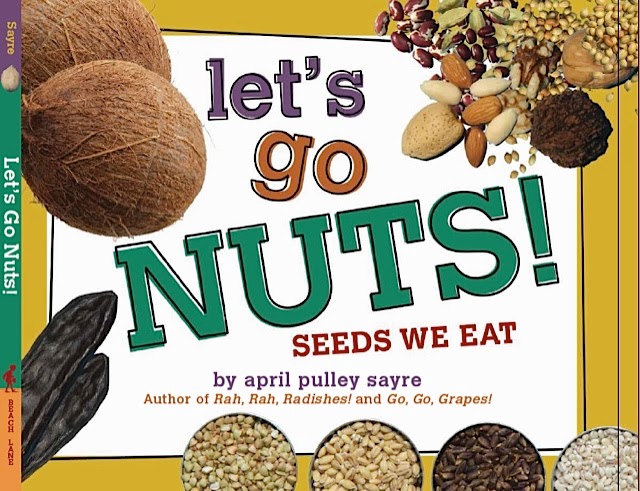
Yet I didn’t really understand the power of what I could do until I was in an IKEA in Chicago selecting some props for Let’s Go Nuts: Seeds We Eat. Perhaps it’s because I have so many math teachers in my life but when I saw the red measuring cups and spoons, I thought: AHHHH! Yes! That’s when I realized I wanted to add cool stuff whenever possible...math fractions, quantities, geographic context, cultural context. Things that would make bounce readers to fun activities.  I have only begun to push in this direction. It’s a matter of trial and error and learning what works for audiences at this young level. It’s not what a really cool graph can do for synergy but it is layering some more deliciousness into the work. 

Measuring cups are in the book!


After the measuring cup moment, I kinda went, um, nuts, organizing photos with extra content not covered in the text: extra information about patterns, foods, and eating local foods. (Note: only some were organized in this way. Many were photographed onsite at the market or store.) But if you look closely you will find mathematical patterns of repetition and grouping. 
Colors and patterns for early childhood teachers may use

At times, I inserted food made from the focal seed into the photo. Sometimes I overdid this. The cutting room floor is littered with photos I carefully arranged to show both coconut and coconut milk, both red bean and Chinese red bean bun and mung bean pastry, and the like.  (But even in the final book there are some of these extra bits for readers who want to extend. That page of rices has rice pastas of many sorts in it.)
Photo experiment discarded. Bean rolls, however, not discarded! Yum!
Experiments for various photographs
LAYERS OF CONTENT IN PHOTOS IN NATURE

Despite my journey into food chants, most of the photography I do is in the wild: out in nature, not in still lifes. But those book can have “extras,” too. Sometimes you find them by accident. Thanks to digital cameras, we can take thousands of photos and sometimes hit ones that have those “teachable nuggets” for a book or slideshow. Last week I was sorting hundreds of seagull photos when I noticed this one with a band.

Soon I found out that there’s a government site www.reportband.gov you can contact to report bird bands. Within a few days, they’d sent me this nice certificate and information that my bird, photographed at the ferry near Williamsburg, VA, had been banded in Quebec!

That was a lucky break. Mostly, layers in photography develop from sweat and time. You just have to be there, and stay there, and stand there, and walk there, until the right moment happens. 


For my latest book, Raindrops Roll, which will be out in 2015, I spent five months photographing raindrops. Raindrops on butterfly antenna, raindrops on soggy bees, raindrops on seedpods, and frogs, and the like. The text is simple. The bulk of what I wanted to say about scale, moisture, mass, weight, mushrooms popping up after rain and so on, will have to be carried by the photos because the editor and I edited some of that text out of the book. The photography took endless stomping in rain-filled boots, dripping with raindrops and my hair a rippled hygrometer from being out in humidity. I loved it.  A bit can be expanded in the endmatter but my hope is that the photos will carry the message the young, carved-to-the-bone text cannot contain. 
One of the things about picture book text and illustration is the immense love and care (obsessive need for perfection?) that goes into it. For illustrators, including photographers, the work takes gobs of experimentation.  Editors, designers, art directors often do their share of the tinkering, too. They give comments and they’ve been known to print out, tape up, move around things as part of the process. In a great team, everyone is on board, with that kind of care.  

For the photographer, the responsibility is to GET OUT THERE. And, of course, carry your camera.  Nothing replaces just putting in time. That’s the only way you’ll get something special: something that will help your reader find new colors and connections in your content. 


###