Showing posts with label history. Show all posts

Monday, June 16, 2014

A New Constellation


Despite George Washington's shivering Victory or Death brinksmanship in New Jersey at the beginning of the year, 1777 was wicked tough for the Americans' rebellion. Still, the gents at the embattled Continental Congress found time 237 years ago this week to take care of a particular bit of business. For one thing, they appointed John Paul Jones to captain the USS Ranger and use her eighteen guns to hassle the hell out of England. For another, the Congressmen, in a stripey and stellar bit of acting 'as if ye had faith,' came up with happily worded resolution. On Saturday, June 14, they "resolved that the flag of the thirteen United States be thirteen stripes, alternate red and white, that the union be thirteen stars, which in a blue field, representing a new constellation."  

I bring this up for a couple of reasons, maybe more. 
                                                              As they occur to me. 
(1.) "A new constellation" is such a beautiful, artful phrase, written at such a God-almighty high stakes harrowing time. 

(2.)  My post is due in the morning. What could I write about? As it has more than once, the calendar came in handy. At his writing, Flag Day was yesterday. And Flag Day was a bit of a big deal in our house because it was on another Saturday, June 14, 1947, that my folks met, on a blind date. (Got married two months later.) And did you know that it was on June 16, 1858 that Abraham Lincoln gave his House Divided speech? And the 17th will be another anniversary of the Battle of Bunker Hill and the 18th will mark ten years since my one novel got accepted? Or that next September will make 200 years since Francis Scott Key wrote the words to the
 the Star-Spangled Banner? Well, there you go. The calendar is absolutely stiff with junk worth remembering. A veritable parade full of floats, history-wise.] 
And there's going to be a book of mine [about the history of flags, as a matter of fact].

(3.) Do I write about what's really on my mind? Don't think you want to hear about the diet I need to be on or any of my get-rich-slow schemes, including my half-written murder mystery. You don't need to know my thoughts on Amazon's megalomaniacal practices [except, well, if you've got a local bookstore, by God support it!] This isn't the place to discuss the sickening, scary situations in Iraq and Syria or the toxic, constipated condition of the present-day Congress or our country's plague of guns, and most of its treasure going to the wealthy, who've managed - guess what - to hijack our secular/sacred, hard-won system of government. The Game of Thrones? (Thank God for artful escapism. Never followed the series until here lately when I've seen almost every available episode.) The I've been picture book I'm trying to design? Speaking of which, you knew, right? That James and Dolley Madison gave Wednesday evening "Drawing Rooms" at the White House? All sorts of people showed up - Washington Irving, for instance. 
Dolley Madison


(4.) I could write about the end of this particular collective. That would be timely. It was at the U. of Central MO's annual children's literature festival where clever, stylish Jan Greenberg asked if I'd be willing to contribute to a group blog. Bless her and I was so pleased. Had I not said yes, you all would have missed some this and that. But what would I have lost? These chances to really think about what my various subjects. To get to know some of my fellow writers a little better. To have a better sense of who all's out there: Readers and toilers in the messy gardens of teaching and learning to the constant geek chorus yammer  beyond the garden walls, bless your sturdy hearts and minds. And so we bumble onward.

Long live books. 
Long live the republic.
May our constellation shine as long as the stars. 

Tuesday, June 3, 2014

GOING AWAY PRESENT

Hello and goodbye everybody—
Thanks for tuning in all this time. As part of my 70th and final post for I.N.K., I thought you might like to visit a few great folks who made a bow on these pages at one time or another.  And as an extra added bonus, a wondrous going away gift awaits you at the bottom of the page.  It should take you straight to the most high-tech source of nonfiction on Planet Earth, and I promise you'll like it.  So let’s begin with……

100% TRUE FACTOIDS FROM RANDOM BLOG POSTS:

Before he was saved by a bald 10 or 12 year old Indian girl named Pocahontas, Captain John Smith had already won a Turkish fortress by stuffing a bunch of explosives into metal pots and catapulting them into the Turks’ camp while they slept. He was also great at making fireworks, but that didn't keep him from being captured and enslaved by Turks or being kidnapped by pirates.

When the California Gold Rush was in full swing, a single piece of paper cost $150 but you could get 12 shirts washed and ironed at the Chinese Laundry for $3. One time a chicken gizzard panned out at $12.80.

Here's what a couple of guys said on board the sailing ships headed for the gold fields:
“The water is becoming bad. I don’t mind it much. I have a way of killing the bugs before drinking them.” Anonymous

The journey by land wasn't much better: “Hail exceeded anything I ever saw, being as large as pigeon eggs. There may be fun in camping, but we haven’t discovered any.” Elisha Douglass Perkins

During the Lewis and Clark Expedition, Meriwether Lewis wrote that: "the musquetoes continue to infest us in such manner that we can scarcely exist; for my own part I am confined to my bier at least 3/4ths of my time. my dog even howls with the torture and we frequently get them in our thr[o]ats as we breath."

Lewis also included a couple of fashion statements showing how the Chinook Indians flattened their infants' heads so much that they measured only 2 inches from front to back and were even thinner at the top. (Head flattening didn't lower the babies' IQ’s one bit....but don't try this at home.) Their moms wanted to look good too. They made their legs fashionably fat by tying cords so tightly around their ankles that the circulation was cut off and their legs swelled right up.

When the American Revolution was heating up, Patrick Henry famously said:
“Is life so dear, or peace so sweet, as to be purchased at the price of chains and slavery? Forbid it, Almighty God!—I know not what course others may take; but as for me, give me liberty or give me death!”

Whereupon Samuel Johnson, the greatest English writer of his day, made this response:
How is it that we hear the loudest yelps for liberty from the drivers of Negroes?”

Thomas Jefferson secretly hired a Scottish scandal monger named James Callender to write scurrilous tales about John Adams, so Callender obligingly called Adams a repulsive, hideous, mentally deranged hermaphrodite who wanted to crown himself king.  (Later Callender got so mad at Jefferson that he printed the story of Jefferson’s affair with his slave, Sally Hemings.) 
This time our target audience chimes in….

REAL LIVE KIDS WHO ARE AUTHORS:

In one blog, I mentioned showing a bunch of fourth graders some fun ways to do interviews and write the stories they uncovered. The big idea was to tell how their own families came to America, whether they got here last Wednesday or 300 years ago. All of their stories were wonderful, but here are some excerpts from two funny ones:

“During the first year of medical school, my mom had to dissect a human body.  It was a smelly task and after they were done for the day, they would be smelly too.  Something that she thought was pretty funny was the comments that people would say and the funny faces they would make when they would smell the anatomy students.”

“dad was such a dare devil that he went car surfing with his friends. His friend tried to throw him off!, but my dad was good at staying on.  He only fell off a couple of times! ...my dad thinks cliff jumping is the most fun stunt because he loves the rush of falling through the air!”  (the author included lots more stunts his dad’s mom didn’t know about plus a photo of Christopher Reeve as Superman.)

SOME FAN MAIL REAL LIVE KIDS SENT AFTER SCHOOL VISITS:

I had a good time.  I liked your book.  Thank you for comeing.  I was not here that day I whish I was.

We really like reading your books they are geater then all of the books I’ve readed  Because it is most funny. But it is not geater then pokemon but I still like it

The ting I liked best about your books are the pictures.  I was wondering how do you paint your pictures without going out of the lines.

Thank you for letting us talk with you!  Even though I cannot pronounce your name.

I love your books.  I wish I had all of them. Truth is I do nat have any.

I wanted to order one of your books but my dad wouldn’t let me.  Por me I really wanted one.

When I grow up I might make books or be a vet I’m not sure about that yet.

If I were an author I would write about a little girl that was an orfin.  I think that idea I gave you was a good idea.  Write me back if yo use my idea. 

Well, I promise to write you back one way or another, so keep in touch.  But for now, that’s all, folks.  Many thanks to Linda Salzman for putting this blog together, and to all the rest of our amazing authors and readers as well. I've enjoyed meeting you enormously.   And now, HERE'S YOUR PRESENT (just skip the ad). www.youtube.com/watch?v=YhcPX1wVp38www.youtube.com/watch?v=YhcPX1wVp38

Adios muchachos-

Roz 

Monday, May 19, 2014

Bumbling On to the End of Another Fair Day in May


So, kindly allow me to point out that it was on this day in 1536 that 35-year-old Anne Boleyn, met her end. Her daughter Elizabeth was not quite three years old when Henry's 2nd wife exited the world's stage through the door marked May 19. Of course, several notable spring babies entered by way of the same passage. Nellie Melba, in 1861, of the battleship-bosom and silvery soprano pipes. Ho Chi Minh (1890), Vietnamese nationalist,  just 29 when he showed up in a rented suit at the post-WWI Peace Conference at Versailles, to plead for his countrymen's fair treatment by their French overlords. [Good luck on that.] Witty Nancy Astor (1879), that American-born Parliamentarian, who famously declared to Winston Churchill, her political adversary, that if he were her husband, she'd poison his coffee. "Madam," he replied, "if I were your husband, I'd drink it." Isn't history adorable? That is, when it doesn't make you sick and want to fill your pockets with rocks and head for the nearest river? 

If you're reading this, you may well be thinking that when I sat down here at the keyboard, I hadn't actually settled upon a topic and of course you would be correct. Certainly all manner of memories and topics are fluttering about in my belfry. Driving about Hannibal, MO a few days ago, climbing the 274 steps up to the "Mark Twain Memorial Lighthouse.
 It stands atop Cardiff Hill, where red-headed Sammy Clemens used to play with his buddies. Finding my way through the raucous traffic in St. Louis on Saturday, to get to the fancy meeting of the MO Humanities Council. Manuscripts I've been trying to conjure into existence - these are what most occupy my mind these days, but what good do these batty notions do you, Dear Reader, in their half-baked condition? What would you like and/or need to know that I could tell you, that you don't know already?  That, story-wise, history is full of buried treasures, remarkable people, rollicking, ill-conceived, harrowing, bloody adventures, and one damned thing after another? That when it comes to historical knowledge and awareness – without which we humans are a bunch of heedless, uninformed dopes, careening for the brink – story is the sugar that helps the medicine go down? That when it comes to historical awareness, most people in this here vale of tears are too witless to know its worth. Shoot, if you're reading this, you know that.  So I'll close as ol' Winston Churchill did more than once: "We bumble onward."

Thursday, April 24, 2014

Navigating the Dangers of Research


Today's guest post is by Karen Blumenthal—author of YALSA Nonfiction Award finalists Bootleg and Steve Jobs: The Man Who Thought Different—and a committed researcher. Or, maybe, a researcher who should be committed? Read her post and decide for yourself!


One evening during a research trip to Washington, D.C., I missed the hotel’s revolving-door entry and slammed into a glass wall schnoz first.

While I reeled in pain, the guests in the lobby eyed me as if I'd enjoyed the happy hour a little too much. Embarrassingly, I was suffering instead from a wicked case of microfilm myopia.  I had only been researching drinking, not actually doing it.

In writing nonfiction for young people, I know the quality of the research drives the story. But that all-important work, I've concluded, may be dangerous to your health.

Other afflictions from recent research were less painful, but almost as embarrassing:

Quarter hoarding: My obsession won’t make great reality TV, but I have stashed quarters everywhere, in pockets, wallets, and tote bags, and I won’t share them with you, even for a desperately needed soft drink. They’re crucial for parking meters, copiers and lockers for stashing your stuff while you research Al Capone at the Chicago History Museum. 

Research fog: An ailment closely related to microfilm myopia, this dense stupor sets in around the fifth hour of reading, especially if you skip lunch to squeeze in more work during a research library's limited hours. As you emerge from the fluorescent-lit haze, jabbering about what you have learned, it slowly becomes apparent that no one you know cares that Wal-Mart founder Sam Walton and Penney founder James Cash Penney had similar backgrounds.

Library breath: What is it about libraries that makes your mouth feels like a herd of camels just ambled across your tongue? Spend too much of the day inside one of these important (and low-humidity) places of knowledge and you'll find that your newfound trivia isn't all that will knock people out.

Chronic nerditis: Finding some new gem online can lead to mysteriously intense, heart-pounding excitement that will surely bore your family to death. You mean you can read 1920s magazines online? Find newspapers stories back to the 1850s? Look at a database instead of those fat green Reader's Guides to Periodicals?

Score!

Waitwhat? You've never heard of the Reader's Guide to Periodicals?

“Just one more” syndrome: Now this is when things get really ugly. Researching is fun; writing, for me, is difficult. So why in the world should I want to stop searching for good stuff? What if there’s a better anecdote out there? What if I’ve missed a great example? If only the deadline wasn’t approaching!

Of course, the paper cuts and smudges on my clothes from newspapers and fresh photocopies are all worth the trouble when I finally sit down at the computer. Having great stories and specific detail is crucial to writing for young people because the story must crackle and pop, and every idea must be crystal clear for readers who have little experience or context to bring to a subject.

Just try not to get behind me when I take a break at the coffee shop. I may be paying with quarters.


Monday, April 21, 2014

Ten Things I'd Have Done Differently

"With the benefit of hindsight we can all see things which we would wish had been done differently or not at all." 
Queen Elizabeth II 

Elizabeth Alexandra Mary Windsor, b. 88 years ago today,
April 21, 1926, exactly, by the way, 90 years after Sam Houston,
that tough old buster, led forces of theRepublic of Texas, 
(yelling 'Remember the Alamo!') in their defeat of those led by
 General Antonio Lopez de Santa Anna, another tough old buster, at the decisive Battle of San Jacinto
What better time than a round-numbered anniversary (30 years ago this coming summer since I started my climb into the world of books for young readers), to ponder all those roads not taken? 


1. Don't we all have a drawer of file full of nonfiction book ideas, each of which at first seemed glorious? But we set them aside, figuring no editor with two market-savvy brain cells to rub together would ever buy the projects? Andrew Jackson? Too obscure!'  'Victoria, Teenaged Queen? Whose overdressed, over-privileged, eccentric grandchildren populated the thrones of Europe - and ended up blowing it up. Or, in the case of Russia's weird, shy last czarina, shot in a basement? Who cares?' 'Savvy, bosomy politician Dolley Madison? How many times do kids want to read about her saving GW's portrait?' In hindsight, I figure we humans are a story-loving species and there's always an appetite for a good story well told - and illustrated. Maybe I wish I'd followed through.  

2. Speaking of which, I should have followed through with all the wisdom offered by inspiring, INK colleague, author/teacher/blogger, Vicki Cobb and learned to do video conferencing/presentations and availing myself of the MANY technological means and opportunities to make my presence known in the world in this here 21st century. ['21st century? Bah! I could pick a better century out of a hat!' I paraphrase: a quote from the good version of Sabrina, i.e. the one with Humphrey Bogart in it, the one where he says, 'I wish I were dead with my back broken.' Jeez, I can't be the only one who gets movie lines stuck in her head, can I?]  You know who else has lots of good ideas on teaching/self-promotion? Katie Davis.  They all make me tired. I mean, when it comes to self-promotion, doing all there is to be done, it's like what Erma Bombeck said: "Housework, if you do it right, will kill you." So, I figure, pick a few things and do them well, huh? And stick with them.

3. In further hindsight, I wish I hadn't been born into a family with such a wide streak of melancholy, backward-looking nostalgia and everybody so danged sensitive. Speaking of which, do check out this LINK. It'll take you to a story about what wonderful author Natalie Kinsey-Warnock is doing up in Vermont, encouraging young Vermonters to learn and record their families' stories, thus learning the stories of their neighborhood, their Green Mountainous state, and their nation. Did I ever tell you that my great-aunt Rebecca Amelia Brown volunteered her time to work with her eastern Pennsylvania neighbors on the Underground Railroad? Or that ancestors of mine, in the mid-1700s, made it their business to skedaddle for shelter from furious Native American raiders, in a forest stockade known as Fort Harness? Well, they did.

4. I'd have overcome my shyness and solitary nature and made myself network with other authors and illustrators in the SCBWI. So. I've re-upped my membership and we'll see.

5. I'd have updated my website more often, like, once in a while even. Offered a really snappy school visit packet, for instance and taken the time to check out other authors' sites. What works? What doesn't, so much? I'd be thinking about getting it properly, professionally redesigned if it hasn't been done since, say, Bill Clinton was in office. By golly, this - or some of this – I'm moving to the top of my TBD list.

6. Had I had the sense God gave a cuckoo clock and the discipline of HE/SHE gave a Canada Goose (quite a lot, actually, flying all that way here and there), I'd have saved ALL of the addresses of the wonderful people I've met over the years.

7. I'd have educated myself more deeply, made myself more aware of the glorious art that is being done in our world of books for young readers, really, the last great showcase for the art and craft of illustration. Should you have time and wish to treat yourself to a journey, do pay a visit to the Mazza Collection, on the campus of the University of Findlay [OH].  It is, I believe, America's largest repository of original art done for children's books. 
  And another thing, I'd have put more pieces on my portfolio, worked harder and more sensibly to make those with choosing power SEE it. 

8. Had I to do all of this over again, I'd have begun earlier. Too soon old. Too late smart. 

9. Okay, seriously, I'd have spent less time at this computer and exercised more. Spent more time outside with my dog(s), as Queen Elizabeth does.
My dog, Mimi.
Spent time with people in person. As Marvin Gaye (I think), once said, 'As long as you're alive, you might as well live.'


10. Definitely, I'd have read more books, but unless I get pasted by a bus or run off the road on my way to school visits down in Pittsburg, KS, later this week, by some lovelorn, world-weary white-tailed deer, I figure I have time. 

As long as I do, I reckon I'll pull up my socks, make a list, and get down to work on all that remains to be done, taking care of that which I can control, saying 'never mind' to that which I cannot, and cultivating the wisdom to know the difference. I wish you all the same, Dear Readers.

Tuesday, March 25, 2014

VERY SAME TOPICS, VERY DIFFERENT BOOKS Rosalyn Schanzer


It's pretty impressive to see how many different ways nonfiction authors can present the very same subject matter or the very same people in their books. To get the gist, today I thought it might be fun to compare some examples of books on the same topic--mostly (but not entirely) by our own INK authors and illustrators. I'll be brief, I promise.  


So how about starting with our foremost founding father, George Washington himself. Each of these 3 authors has come up with entirely different hooks to pique your interest, so a young audience could get a pretty well-rounded view of our guy by checking out these true tales.


First up is The Crossing: How George Washington Saved the American Revolution by Jim Murphy.  His hook is to focus on Washington's growth as a leader, obviously leading up to the famous crossing of the Delaware on Christmas in 1776. He's used some very interesting artwork from the period to enhance the tale.

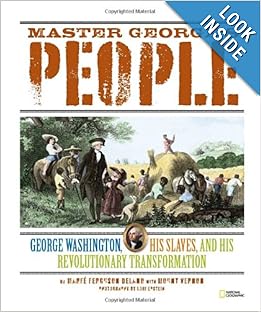
Next comes an entirely different take on George from Marfe Ferguson Delano. Her book, Master George's People, tells the story of George's slaves at Mount Vernon, and she has collaborated with a photographer who shot pictures of reenactors on the scene. 


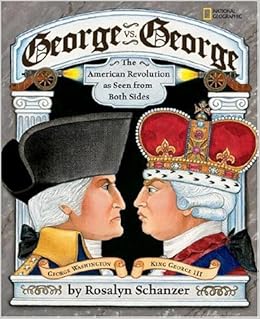
And this one is  (ahem) my version. George vs. George: The American Revolution as Seen from Both Sides shows how there are two sides to every story.  I got to meet George Washington and King George III and paint their pictures myself.
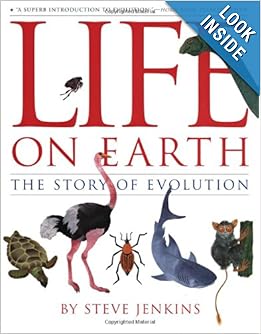
OK, on to the second set.  In one way or another, the next 3 books are all based upon Charles Darwin and his Theory of Evolution. Let's start with Steve Jenkins' handsome book Life on Earth: The Story of Evolution.  With a nod to Darwin, Steve has created a series of stunning collages along with fairly minimal text in order to focus on the history of all the plants and animals on the planet. 
And here's yet another nod to Deb Heiligman for her celebrated true tale of romance between two folks with opposite views of the world. Despite Emma's firm belief in the Bible's version of life on earth, she and Charles enjoy a warm and loving marriage.
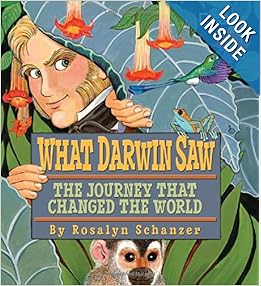
Mine again. What Darwin Saw: The Journey that Changed the World, tells about Darwin's great adventures as a young guy while traveling around the world. We're on board In this colorful graphic novel as he picks up the clues that lead to his Theory of Evolution and then does the experiments that prove it.
And here's series number 3.  Apparently these authors and illustrators were hard at work at the very same time on three very different picture books about the very same person; her name is Wangari Maathai, and she won the Nobel Peace Prize for bringing Kenya's trees back to life after most of them had disappeared. 

The artwork in all three books is outstanding, and each version is truly unique. The writing styles vary enormously too. I strongly recommend that you look at them side by side to prove that there's more than one way to skin a cat.  

Planting the Trees of Kenya was written and illustrated by Claire A. Nivola.


Wangari's Trees of Peace was written and illustrated by Jeanette Winter. 
And Mama Miti was written by Donna Jo Napoli and illustrated by Kadir Nelson.  
I'd bet anything that these folks didn't know they were creating books about the same person until all 3 versions were finally published....writing and illustrating books is a solo occupation if there ever was one. 

OK, that's it--though we could easily go on and on.  Here's hoping that if any kids examine a whole series of books on the same topic written and illustrated in such different ways, they can come up with some unique new versions of their own....and have some fun at the same time. 

Tuesday, February 4, 2014

STRANGER THAN FICTION


OK history buffs (or non-history buffs) - which of the following wild assertions just so happen to be true and which ones are false? Since I have to write about this stuff all the time, I actually know the answers and don’t have to look them up.  See how many you already know….TRUE OR FALSE: 
   
1) Ben Franklin invented the fan chair, which was a rocking chair with a fan on top to blow away flies.

2)  Ben invented a musical instrument that caused dogs to run away and hide and also made people think there were ghosts in their room.

3)  Pocahontas was bald.

4)  She taught her boyfriend, John Smith, how to smoke tobacco.

5)  Before being captured and enslaved, John Smith won a Turkish fortress by making a bunch of explosives and catapulting them into the Turks’ camp while they slept.

6)  George Washington always wore a white wig in public, even as a child.

7)  George Washington chopped down a cherry tree, and when his dad asked him about it, he said “I cannot tell a lie, pa.  I did it with my little ax.”

8)  George Washington had scars on his face from a duel.

9)  During the California Gold Rush, a single piece of paper cost $150 but you could get 12 shirts washed and ironed at the Chinese Laundry for $3.

10) During this gold rush, cooks regularly checked chicken gizzards for small gold nuggets.

11)  Frenzied gold seekers from 37 different countries rushed lickety-split straight toward California to seek their fortunes.

12)  Cowboys traveling on The Old Chisholm Trail used to cross the muddy rivers by running on their cows backs.

13)  The trail was finally closed by barbed wire.

14)  Charles Darwin and Abraham Lincoln were born on the very same day just a few hours apart, and they didn’t always get along with their dads.

15)  When Charles Darwin journeyed around the world by ship, he caught a giant octopus and sent it back to England for scientists to study.

16)   Charles Darwin used to ride on horseback with a wild Gaucho cavalry, ride on the backs of gigantic tortoises, and ride in a box on the back of an elephant in true Indian fashion. 
  
17)  In Salem Massachusetts, some people made medicine by combining boiled snippets of children’s hair, spirits of mummies, and the brains of young men who had died a violent death.

18)  During the Salem Witch Trials, nineteen people were burned for the crime of witchcraft.

19) During this time, people of all ages were accused of turning into a ball of light the size of a bushel basket, choking a woman with nails and eggs, stupefying a boy for 12 years, making a wagon plump down into a hole on flat ground, and killing victims with their evil “eye beams.” (A ghost said so.)

AND THE ANSWERS ARE:

1)  False, but he did have such a chair inside his house.

2)  True.  It was called the glass armonica, and before it went out of style for hurting dogs' ears and sounding spooky during seances, it was so popular that Mozart and Beethoven wrote music for it.

 3)   True.  Pre-pubescent Powhatan Indian girls shaved the tops of their heads, and Pocahontas was between 10 and 12 years old.

4)  False.  Of course she was way too young to be John Smith's girlfriend, and besides, he thought smoking tobacco was disgusting.

5)  True, all true.  He was also great at making fireworks.

6) False.  George hated wigs even though they were in style.  If he absolutely had to, he would powder his hair instead.

7)  False.  Parson Mason Locke Weems made up that fake story to get kids to tell the truth like their hero.  Oh, the irony.

8)  False.  The scars were from smallpox.

9)  All true.

10) True again. One time a chicken gizzard panned out at $12.80

11)  False.  They came from more than 70 countries and set off one of the greatest mass migrations in history.

12)  Yup, that's true.  Those guys had talent.

13)  True.  Barbed wire smarts if you're a traveling cow.

14)  True. Their dads didn't seem to think they'd amount to much.

15)  False, false, false.  He did uncover plenty of humongous fossilized bones from extinct giant animals though.

16)  True.  Darwin perched these various backs in Argentina, the Galapagos, and the Isle of Mauritius.  

17)True.  Guilty as charged.

18)  False.  They were hanged, not burned.  A 19th guy was pressed to death by stones.

19)  True.  People really did tell all of these bald-faced lies in court.  AND THERE ARE NO WITCHES!!!

Didn't I tell you truth is stranger than fiction?  So how did you do? Feel free to try this on your students, friends, and enemies, and if they get all the answers right I will send them a lollipop.  (False.)