My phone rang last month and a smokejumper was on the other end. “I’m jumping this week, lots of blazes, but I got your message and I’ll find a way into that safe for you even if we have to crack it open.”
I had been waiting for this call for weeks. It all started with a cold call to a guy named Steve who knew a lot about the history of smokejumping—including the period of time when the paratroopers I am writing about worked for the Forest Service as smokejumpers. This guy was an absolute wealth of information, and he ended up sending me interview transcripts and knowing just whom I should talk to.
One of the guys Steve sent me to was Wayne. Wayne was equally enthusiastic and genuinely excited to talk with me. With Wayne I hit the photographic jackpot—almost. He told me an incredible story that resulted in a big orange carrot dangling in front of my nose.
One day, as he was busy manning the jump station, a man came up to him, handed him a manila envelope, said there were priceless pictures inside the Forest Service should have, and walked away. When Wayne had a chance to look at them, he knew immediately what they were, and stashed them in the safe in his office for, you guessed it, safekeeping.
Time went by and Wayne retired. The photos, he realized when we were talking, must still be in that safe—which no one had opened for years. “Call Dan (his successor) and tell him Wayne said to find the combination to that old safe and get those photos for you.”
Okay—I had a location, information, and a plan. The first time I called Dan he was out on a jump. The second time, too. I left a message that must have sounded crazy, to the effect of ‘you don’t know me, but the guy who worked in your office before you left some photos in a safe and he wants you to get them for me.” I didn’t know if I would ever hear from him.
It took a while, what with Dan being kind of tied up smokejumping into blazing forest fires, but he did call me back. He also promised that he would find the combination of the safe in his office. A week later came the bad news that no one seemed to know where that combination was, and the safe was so old and tough it was looking like it would be a big job to break into it by force. Still, he told me not to worry. He’d get the job done. Firefighters are like that.
Not long after, Dan had more news for me. They still hadn’t located the combination, but he had discovered the photos had been digitally scanned at some point. A CD was on its way to me! Some time after that, a package arrived in the mail. On that CD were a few old images I had seen before, but instead of the old blurry, many-photocopied, hard-to-reproduce versions I kept finding, these were crisp and clear and bright. Better still, there were a few images I had never seen before. Jackpot!
These are the kinds of detective trails that need to be found and followed for just a handful of photographs that will end up in my forthcoming book, Courage Has No Color.
There are many more photo stories where that came from. Sometimes these chases turn out to be of the wild goose variety; sometimes they are sheer gold.
Thank you Steve, Wayne, and Dan!

Thursday, September 22, 2011


Wednesday, September 21, 2011
A Fall Question
Happy Fall, y’all!
Okay, so it’s a couple of days early but here’s a question for you:
What do maple leaves, apples, pumpkins, and owls have in common?
Okay, so it’s a couple of days early but here’s a question for you:
What do maple leaves, apples, pumpkins, and owls have in common?
Hint: The answer has nothing to do with autumn.
Hint: Think math.
Maybe this coloring page will help:

No? (Please feel free to right click and download the coloring page for personal or classroom use.)
Maybe this will help:
Maybe this will help:

Okay, so what we’re talking about is...

It’s actually a Spring 2012 book, but the plan is to make more coloring pages throughout the year and besides I’m really excited about this book. I’ve been thinking about how to do this topic for literally years so it’s very satisfying to have sent the final files up to the publisher.
Loreen
Twitter: @LoreenLeedy
Tuesday, September 20, 2011
Searching for Sasquatch
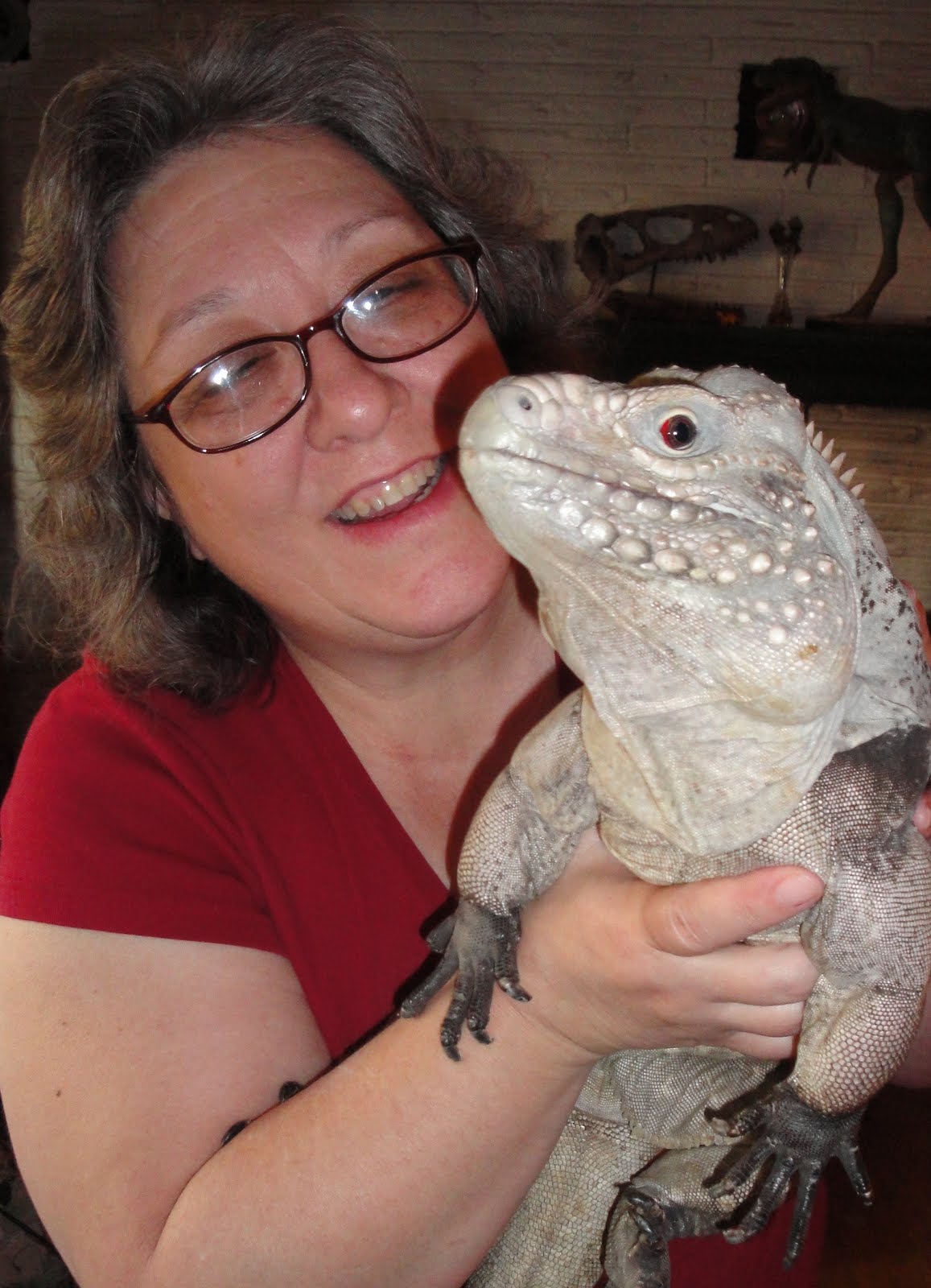


Hello, everyone! Happy almost autumn! I hope you all had a great summer. I did. I read (but not as much as I said I would), I wrote (put the finishing touches on my first YA novel, out next summer) and I went to the Galapagos. I will write about that amazing trip next month. Before Galapagos I went to New Orleans and ALA where I checked out the most important cultural sites:

and was on a panel with a group of stellar authors. One of them, Kelly Milner Halls, agreed to "sit down" for an interview with me about her latest book IN SEARCH OF SASQUATCH, which will be out in a hot minute.
Your website is um, weird, Kelly.
“As a freelance writer, I often got paid for being weird,” she admits. “And it’s still true for many of my books and definitely true for my elementary and middle school visit presentations.”
You told me that with many of your books including IN SEARCH OF SASQUATCH you aim to engage reluctant readers. Which I'm sure you do! Where did the book come from? How did it move from an idea to a book?
I wrote a book called TALES OF THE CRYPTIDS in 2006 – an exploration of the evidence for and against the creatures of cryptozoology; mysterious animals that may or may not be real. Many of the legends seemed unlikely to be real, but a few were surprising in that credible evidence did exist to support the possibility of their being true, undocumented new species of animals. Sasquatch, also known as Bigfoot, was one of those surprises. I had limited space to share that evidence in CRYPTIDS so I set out to write a new book about it, and Erica Zappy at Houghton Mifflin Harcourt made it possible.
What was your process in researching and writing it?
I had done some great preliminary research for CRYPTIDS so my main aim was to talk to the best experts in the field of investigating Sasquatch. I went to the scientists, including Dr. Jeffrey Meldrum, and other credible experts. I read their books, I sat through their lectures, I interviewed them first hand, I mirrored their search techniques and really got a sense of how and why these serious people were searching for Sasquatch.
What was the hardest thing about writing this book?
Knowing what to include and what not to include was the hardest part of writing this book. There are so many elements we didn’t have room to include, in a relatively short book for young readers. I was fascinated by the topic, and I hope that shows in the end product. I hope kids will be as fascinated as I was.
Seems to be a common problem in writing picture books as people have talked about recently here on I.N.K. So what was the most satisfying thing about this project?
When I was a kid, I was one of those squirrel-y kids who asked WAY too many questions. The adults in my life did their best to help me with that curiosity, but answers were hard to come by. The most rewarding part about this book -- and all my books -- is having the license to actually ask the experts, not just for myself, but for all of those kids LIKE me. I do my best to anticipate what THEY might want to know, and reflect that in my final work.
What do you hope for the book?
I love to hear kids tell me they were engaged by the books I’ve written. And I am so lucky that they very, very often do. Kids who don’t normally read get lost in the projects I put together for them, and nothing could be more fulfilling. Our community, the world of children’s writing, is an eyes-open endeavor. We know we may not collect material wealth, beyond having our basic needs met. But we are incredibly rich of heart. What more could anyone want?
Well, that and a country house with a full staff. But maybe that's just me. What’s next for you?
IN SEARCH OF SASQUATCH will be released on October 25, 2011 by Houghton Mifflin Harcourt, and I am so excited to see how it will be received. But my first fiction work, a YA anthology called GIRL MEETS BOY, will be released by Chronicle in January of 2012. My next nonfiction book, ALIEN INVESTIGATION will be released by Millbrook in April of 2012 and HATCHLINGS: LIFE SIZED BABY DINOSAURS will be released by Running Press, also in April of 2012.
You're a slouch, aren't you, Kelly?
Kelly? You still there?
I guess she's back to work. Go, Kelly, Go! And thanks for talking with all of us here at I.N.K.!
To find out more about Kelly, check out her website.
Monday, September 19, 2011
Aarrrr, me Hearties!
"Books, like friends, should be few and well chosen," wrote Samuel Johnson, a long, long, long time ago. In fact, everything he wrote, said, and did was a good long time ago seeing as he got his ticket punched, turned in his dinner pail, left the stage, and exited the building way back before the travel-sore delegates showed up at the U.S. Constitutional Convention. As I write this, this cool, damp September Sunday marks 302 years since Dr. Johnson, biographer, essayist, & accomplished definer of words, came into the world (a tired old world even then). I'd wax on a bit about him - or not - if you all were going to be reading this today, but this post is scheduled to appear tomorrow morning, i.e. Monday, allow me to note that today, September 19, 262nd day of this tired old year, is the day, me proud beauties, upon which countless land-lubbers are advised to talk like a pirate. [Aye, do be casting your bleary eyes on this'un.]
So a responsible poster would commend you to check out handsome books by the likes of Gail Gibbons, Val Garwood, Pat Croce & Tristan Elwell; and here's a beauty for you, maties: J. Patrick Lewis's Blackbeard, the Pirate King. You'd best be checking out Eric A Kimmel's Blackbeard's Last Fight, but best of all, for my money, is the glorious book PIRATES, by gentleman/poet David Harrison and Dan Burr, a most accomplished illustrator.
What do you do with a blockhead nation?
What do you do with a blockhead nation?
What do you do with a blockhead nation, ear-lye in the mornin?
Give 'em a book and make 'em read it!
Give 'em a book and make 'em read it!
Open it up and turn the pages, ear-lye in the mornin'!
Learn 'em 'bout the country and its hist'ry! .... Ah well, belay that. 'Nuff o' that. What really interests me just now is my need to be getting back to a big-ass painting depicting my town's smelly glory days back when boatloads of emigrants were crowding into Independence,MO, & other 'jumping off' towns along the big bend o' the MO River, readying themselves for a godawful trip along the westward trails [for some history panels hereabouts/what was I thinking] AND the fact that today (tomorrow. 19 Sept) also makes 130 years since poor old suffering 20th President James A. Garfield finally got released and kicked the bucket thanks to his assassin[s], among whom I'd count his germy-handed doctors, according to a new book, about which I read in this morning's paper. Ahoy there, Jimmy Garfield, off 'n' away up there in the Blue Beyond! Any pirates thereabouts, any who made it through the gates o' gold? Sure enough in this wicked old world, e'en Dr. Johnson would agree that there's many a robber or thief who needs no pirate ship to plunder treasure, as Woody Guthrie well knew:
“Yes, as through this world I've wandered I've seen lots of funny men; Some will rob youwith a six-gun, And some with a fountain pen”.
Gee, what rhymes with laptop?
Thursday, September 15, 2011
Short and Sweet
Today’s post will be short and sweet—as I write this, I’m gearing up to take a research trip (more on that in a future post), and I have a lot to get done.
But actually, “short and sweet” is the perfect theme for the post, itself. And that’s because I got a very needed reminder, this summer, of the downside of going on.
I’ve been working for months on a new picture book biography (hence, the research trip). A few weeks back, I finally had enough of a draft written to bring to my critique group.
My critique group is small—Nancy Coffelt, Elizabeth Rusch, Ruth Tenzer Feldman, and me—but we are mighty. Not everyone can attend every time, but even if there are only two of us sitting at the table, we seem to hone in on what needs to be said, and I leave very grateful for my little group.
At one such meeting last summer, I brought my new draft. Not even a whole draft, actually. Just the opening of the book. Boy, did it need work. It seemed to go on and on for two pages before the story started. And in a picture book, that is a huge problem.
I needed to establish just who my historical figure was before the action really started, so readers would care about the outcome, but it seemed to be taking forever. And even beyond the problems with the opening, it seemed like I was doing an awful lot of talking for one little book.
And then I got the help I needed: two gentle reminders from my critique group.
Nancy looked at the bogged-down text and asked, “Can’t some of this be shown in the art?”
Liz looked at a dense cluster of paragraphs and said, “You know, all this information could be shown in a silent spread.”
Oh yeah. I’d forgotten: a picture book is a marriage of text and illustrations, and my words only carry half the story.
In an early draft, all those words may need to be there, to help me get the story down on the page so I can see what I have. But I’m grateful to have a smart critique group to remind me that revising can fix almost any problem--and that, for picture books at least, short is sweet.
But actually, “short and sweet” is the perfect theme for the post, itself. And that’s because I got a very needed reminder, this summer, of the downside of going on.
I’ve been working for months on a new picture book biography (hence, the research trip). A few weeks back, I finally had enough of a draft written to bring to my critique group.
My critique group is small—Nancy Coffelt, Elizabeth Rusch, Ruth Tenzer Feldman, and me—but we are mighty. Not everyone can attend every time, but even if there are only two of us sitting at the table, we seem to hone in on what needs to be said, and I leave very grateful for my little group.
At one such meeting last summer, I brought my new draft. Not even a whole draft, actually. Just the opening of the book. Boy, did it need work. It seemed to go on and on for two pages before the story started. And in a picture book, that is a huge problem.
I needed to establish just who my historical figure was before the action really started, so readers would care about the outcome, but it seemed to be taking forever. And even beyond the problems with the opening, it seemed like I was doing an awful lot of talking for one little book.
And then I got the help I needed: two gentle reminders from my critique group.
Nancy looked at the bogged-down text and asked, “Can’t some of this be shown in the art?”
Liz looked at a dense cluster of paragraphs and said, “You know, all this information could be shown in a silent spread.”
Oh yeah. I’d forgotten: a picture book is a marriage of text and illustrations, and my words only carry half the story.
In an early draft, all those words may need to be there, to help me get the story down on the page so I can see what I have. But I’m grateful to have a smart critique group to remind me that revising can fix almost any problem--and that, for picture books at least, short is sweet.
Wednesday, September 14, 2011
Who Has What? A Guest Post by Robie Harris
Creating Nonfiction for Our Youngest Children
I should have known better. But for a few days, I was fooled again, as are so many of us, when we think about writing nonfiction for very young children. “Simple,” one friend told me. “You’re writing a book for little kids. They don’t need a lot of information.” A colleague who writes for older children said, “Only about fourteen pages of text, and a couple of short paragraphs per page. And oh yes, two of your characters talk. Can’t take all that long… can it?”
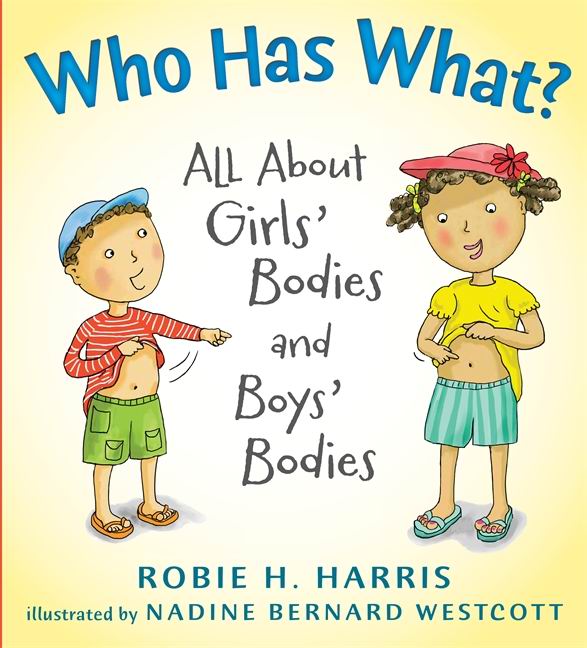
That question sent me right back to reality as I answered in my most calm voice, “Yes, it can,” At least, it takes me a very long time to write any picture book for young children.” And yes, it did. It took me a lot longer than I had expected to write my newest nonfiction picture book for very young children—WHO HAS WHAT? All About Girls’ Bodies and Boys’ Bodies, illustrated by Nadine Bernard Westcott and published by Candlewick Press.
The idea for this book came to me one day when I heard a young child sing, “Head, shoulders, knees and toes, knees and toes. And eyes, and ears, and mouth, and nose…” While listening to the child, it crossed my mind that not all parts of the body are named in that song and I wondered what that omission meant for young children. And that’s what led to my writing a book for them that would name all the parts of the body, including the genitals. I wanted to write this book because it matters that children know and understand at an early age that every part of the body, including the genitals, is a perfectly healthy and perfectly normal part and that there is nothing shameful or dirty about one’s private body parts or even knowing and saying the names of those parts such as “the vagina” or “the penis."
“Okay,” I thought to myself as I began to collect and outline the information that would be in this book. “Easy to do. Just name the parts. Label them. The illustrator will create charming art and labels for each body that will make naming all the parts make fun and easy for young children.”
However, it turned out that this book was neither simple nor easy to create. I did know from the get-go that the text had to be short. But only a few days after I began writing, I realized that the text could not be all that short. It became clear that there were some explanatory details that had to be added to help young children understand the information that I was including in this book. For example: in order to help young children know just where some of these parts are located—in particular their genitals and the fact that your genitals are what make you either a girl or a boy—I knew I would have to include more information and that would result in a longer text. I wondered if the amount of text would be too long for a young child. I also worried that I was underestimating a young child’s yearning to know. A few days later, I thought about the fact young children are fascinated by—to use their language—“pee” and “poop.” I suspected that they would want it confirmed that the opening where pee comes out is located in different places for girls and boys and that poop comes out of the same opening for both boys and girls.
I also realized that it would be helpful to include boys’ and girls’ “inside parts”—parts that they can’t see—parts that also make them either a boy or a girl. Soon, I was writing about gender differences between male and female anatomy in a book for young children. I wondered if this was “too much information.” I worried I that the more information I added, the more complicated the text would become, resulting in a longer text. After several weeks of indecision, I made the decision to go with more rather than less information resulting in more text. That’s because I felt that even our very young children want to know and have the right to have honest information that is also age-appropriate. And I felt that it would be irresponsible to ignore the fact that most young children ask endless questions about their own and other people’s bodies. They are simply curious and this is their way about learning about themselves. More specifically, most wonder about and often have some concerns about what makes them male or female. My hope was I could write a book that would answer most of their questions and respond to most of their concerns.
So what began as a very simple book that was just going to name all the parts became a book that needed to talk about the function of some of those parts. I also realized that I needed to make the point that most parts of the body are the same for girls and boys, but some parts are different. I hoped my text would help them understand that whatever parts you have are normal parts—whether its your elbow, your neck, your penis or your vagina, your ears, your toes—and that each is simply another part of our amazing bodies.
After several rewrites, I finally knew that I had to include all this additional information. This was based on the fact that the more young children know about all the parts of their amazing bodies and how they work, the better they feel about their own bodies and themselves. Understanding that each part of one’s body is a normal and healthy part contributes to a child’s positive sense of self and a healthy respect for and understanding of their own bodies and other people’s bodies.
Then I struggled with trying to figure out how could I include this information and still make it understandable to a young audience. Some days, I felt I had to include all this information. Other days I regressed and felt I should only label the parts. Then much to my relief, I finally realized that the book had to do both. Label the body parts and talk about those parts that make one a girl or a boy. After even more time, I figured out how to do just that.
—I had to keep the sentences short. But sometimes, when I’d take out a phrase to shorten a piece of science writing, the science suddenly became inaccurate. I feel that even our youngest children need to have accurate information. So in some places, I left those phrases in, even though it resulted in a text being a tad longer. By the time I finished the book, I felt that wherever I had written longer text, it read out loud just fine.
—I also had make those tough choices that every writer has to make. I had to decide what information young children absolutely positively needed to have about their bodies. I put only that information in the book, nothing else. The result: I left out some fascinating and fun facts. But in the end, I hardly missed those facts and know that children won’t either. I also had to leave space on the page for Nadine to create the visual narrative that would accompany the text and the two main characters’ speech bubbles. All in all, there was not a lot of room for text.
—The question that nagged me the most was, “Could I keep the text on each double-page spread short enough and at the same time include enough information so that the text would make sense and young children would not lose interest as the text was being read aloud to them?” My test was to vet the text with experts, including parents, early childhood professionals, pediatricians, child analysts and psychologists, to make sure that my text was not too long and would resonate with young children. I did that before Nadine even saw the text.
I spent about a year and a bit more writing the text for WHO HAS WHAT? But in doing so, I learned that though I had to “keep it simple,” I also could not forget that even our young and very young children crave information about themselves and the world around them. As writers we have to give them enough information so they can actually understand what we are trying to “say” to them and also write in a manner that will hopefully strike a responsive chord in them. I also realized that I had to put in any information that young children might seek or need, even if there were people who would object to some of the information that I was going to and did include in WHO HAS WHAT? Being honest in our writing matters. If we are not honest, even with our youngest children and we leave out information they have a right to know and want to know, then the words we write will have no credibility with them. When we make our choices about what information to include in the nonfiction children’s books we write, if putting a piece of information in our books is “in the best interests of the child,” we owe it to children to include that information. These kinds of challenges and tenets are what I find so fascinating about writing nonfiction. That’s why I can’t wait to start in on my next nonfiction book for young children. Maybe this one won’t take as much time to write. Uh-oh! I suspect I’m fooling myself again. —Robie H. Harris
Tuesday, September 13, 2011
Can Something Be Too Perfect?
While on vacation in the Adirondacks this summer I read Laura Hillenbrand's Unbroken. For those who might not know the book, it's about a World War II crew of a B-24 (not affectionately called a "Flying Coffin") that plunges into the Pacific, killing most of the men. The few who lived through the crash, including Olympic runner Louis Zamperini, survive in a tiny, disintergrating rubber raft for over a month, are captured by the Japanese and imprisioned on a small island, and then sent to Japan and made to do hard labor, accented by senseless torture. It's the sort of story where just when you think nothing worse could possibly happen to these guys something even worse does indeed happen.
It's an amazing book and one I would highly recommend to anyone interested in gripping, well-written nonfiction. But here's the thing: it's almost too perfect. Hillenbrand has clearly done a ton of research as even a casual glimpse of her Notes and Acknowledgments makes clear, with Zamperini providing a wealth of information in over seventy-five interviews. Even so, I sometimes found the level of detail startling and wondered if it all came from Zamperini or whether some was author speculation. Take this brief paragraph (that I picked by opening the book and, without looking, pointing at a part of the page) that describes the moments after Zamperini is thrown into a small, wooden cell on the island of Kwajalein:
"At first, Louie could barely see. His eyes darted about uncontrollably. His mind raced, flitting incoherently from thought to thought. After weeks of endless openness, he was disoriented by the compression of the space around him. Every nerve and muscle seemed in a panic."
I have no problem with the basic facts; the notes for p. 174 say that Zamperini provided them. But do any of us think he described his eyes darting about or the panic in his nerves and muscles? I'm willing to say "well, maybe," but in my heart I'm thinking this is made up stuff. And I wouldn't be bothered by one or two places where this happens. Or ten. But it seemed that every scene (whether Zamperini is the focus or not) is fleshed out with similar rich, dramatic detail and emotional insight. It's almost as if they're too complete and rounded out
It's possible that I was recalling the numerous blog-o-sphere discussions recently where non-fiction writers have been urged to speculate more about their subjects (to build drama and emotion and to help go beyond "history as story" in order to discuss opinions and ideas). Or maybe I was remembering an article that (wiesly in my opinion) warned about fictional details sneaking into children's non-fiction. So I may be a little too sensitive to these things and as a result totally unfair to Hillenbrand. Maybe she did write a perfect book! Even so, it did make me wonder where the line should be drawn when it comes to speculation and who, besides the author, should be monitering it. I've had editors (Dinah Stevenson to name one) who know history and can sniff out every false note in a text. But I think that a lot of editors might not be quite so versed in history and might not be able to spot fact from decent, based-on-solid research speculation versus made up stuff. Reviewers? Again, a mixed bag of expertise that might allow a nonfiction book loaded with questionable speculation to pass unchallenged.
It's a complex and potentially troubling situation (especially considering who our main audience is) and one that may never be resolved in a clear and satisfying way. I'd love to hear what others think about this and what we should do.
It's an amazing book and one I would highly recommend to anyone interested in gripping, well-written nonfiction. But here's the thing: it's almost too perfect. Hillenbrand has clearly done a ton of research as even a casual glimpse of her Notes and Acknowledgments makes clear, with Zamperini providing a wealth of information in over seventy-five interviews. Even so, I sometimes found the level of detail startling and wondered if it all came from Zamperini or whether some was author speculation. Take this brief paragraph (that I picked by opening the book and, without looking, pointing at a part of the page) that describes the moments after Zamperini is thrown into a small, wooden cell on the island of Kwajalein:
"At first, Louie could barely see. His eyes darted about uncontrollably. His mind raced, flitting incoherently from thought to thought. After weeks of endless openness, he was disoriented by the compression of the space around him. Every nerve and muscle seemed in a panic."
I have no problem with the basic facts; the notes for p. 174 say that Zamperini provided them. But do any of us think he described his eyes darting about or the panic in his nerves and muscles? I'm willing to say "well, maybe," but in my heart I'm thinking this is made up stuff. And I wouldn't be bothered by one or two places where this happens. Or ten. But it seemed that every scene (whether Zamperini is the focus or not) is fleshed out with similar rich, dramatic detail and emotional insight. It's almost as if they're too complete and rounded out
It's possible that I was recalling the numerous blog-o-sphere discussions recently where non-fiction writers have been urged to speculate more about their subjects (to build drama and emotion and to help go beyond "history as story" in order to discuss opinions and ideas). Or maybe I was remembering an article that (wiesly in my opinion) warned about fictional details sneaking into children's non-fiction. So I may be a little too sensitive to these things and as a result totally unfair to Hillenbrand. Maybe she did write a perfect book! Even so, it did make me wonder where the line should be drawn when it comes to speculation and who, besides the author, should be monitering it. I've had editors (Dinah Stevenson to name one) who know history and can sniff out every false note in a text. But I think that a lot of editors might not be quite so versed in history and might not be able to spot fact from decent, based-on-solid research speculation versus made up stuff. Reviewers? Again, a mixed bag of expertise that might allow a nonfiction book loaded with questionable speculation to pass unchallenged.
It's a complex and potentially troubling situation (especially considering who our main audience is) and one that may never be resolved in a clear and satisfying way. I'd love to hear what others think about this and what we should do.
Monday, September 12, 2011
An Extraordinary Book
 I can’t remember how long after 9/11 I started hearing about the publication of children’s books inspired by the event. I do, however, remember my reaction. Of course, kids’ thoughts and feelings had to be addressed. But I could not help thinking of the books about Princess Di or Jonestown that sprung up like mushrooms after a wet spell. Whether my own feelings were caused by grief, cynicism, decorum or all of these, I do not know. But I didn’t read these books when they came out.
Eventually I did read The Man Who Walked Between the Towers by Mordicai Gerstein. I can’t imagine a better response to that day. Gerstein deservedly won the Caldecott for his ink and oil paintings that captured Philippe Petit’s wonderful escapade, stringing a tightrope across the towers to walk and dance in the sky. They are stunning, with perspectives that let us walk and dance right along with him.

But the book is so much more. At the beginning of the story, the towers are just there, waiting—much like Mount Everest for Sir Edmund Hillary. An amazing, soaring structure, yes, but a vehicle for Petit to do his art. It is only on the last spread that we get a hint of Gerstein's impetus. He writes simply, “Now the towers are gone,” showing a skyline that would look full if you didn’t know better.
The final page has a misty image of the towers united by a tiny Petit on a tightrope. It says, “But in memory, as if imprinted on the sky, the towers are still there. And part of that memory is the joyful morning, August 7, 1974, when Philippe Petit walked between them in the air.”
Pretty perfect. By celebrating Petit’s daring-do, Gerstein also celebrates the vision of people who thought big and built big. By commemorating Petit’s courage, he also commemorates those who clear-sightedly rushed in to deal with what turned out to be an even riskier situation.
By telling this story as he did, Gerstein reminds us that grief over anything or anyone’s destruction should never erase the pleasure caused by their existence.
Friday, September 9, 2011
“Where Do You Get Your Ideas?”
Hi, Everybody. It’s great to be back blogging on I.N.K. for another school year. I thought I’d start off the year by answering the most frequent question people ask me when they learn I write books for a living, “Where do you get your ideas?” The short answer is that sometimes my editors suggest my book topics, but more often they come from me, usually after percolating for quite a long time. They can spring from anywhere: a book, magazine, or newspaper article; a TV show; a conference I attend, even a conversation. Sometimes, the topic of one book I write suggests an idea for another book.
Specifically, the inspiration for my earliest book, A Whole New Ball Game, came from an item about the All-American Girls Professional Baseball League in the book First of All: Significant “Firsts” by American Women by Joan McCullough. Having grown up a baseball fan and studied women’s history in college, I was amazed that a professional women’s league had existed for 12 years and I’d never heard of it. I’d been working on Scholastic’s news magazines, writing one article or more per week, and I was anxious to find a subject I could research in depth. When I met with an editor about possible books I could write, she said she could hear the excitement in my voice as I spoke about the league. It wouldn’t be altogether wrong to say that the topic chose me.
After completing a project that was so meaningful to me, I had a hard time choosing what to write next. So I decided to get some perspective by putting together a timeline of women’s sports history. When I was done, I realized the timeline was actually a terrific outline for a book. Winning Ways: A Photohistory of American Women in Sports (published in 1996) looks at the relationship between women’s participation in sports and changing ideas about women’s roles in society from the mid-nineteenth century to the 1990s. As I was writing it, I wished I could take a deeper look at some of the topics I covered. Ultimately, I did, writing three other books whose content grew directly out of Winning Ways: My first picture book, Basketball Belles (published in 2011), looks at the first women’s intercollegiate basketball game, between Stanford and Cal Berkeley in 1896; Wheels of Change (published in 2011) examines the impact of the bicycle on women’s lives in the 1890s; and my as yet untitled second picture book, due to my editor very soon, will look at the phenomenon of Roller Derby in 1948, focusing on star skater—and notorious villain—Midge “Toughie” Brasuhn.
If someone else suggests a book topic, I’m willing to consider it, but it’s got to resonate with me in some way. Back in the late 90s, Nancy Feresten, Editor-in-Chief of National Geographic Children’s Books, asked if I’d be interested in writing a book for their photobiography series. We discussed a number of subjects, but Annie Oakley was the one who clicked. At the time, I didn’t know anything about Annie beyond what was presented in the highly fictionalized musical, “Annie Get Your Gun,” but the more I researched, the more fascinated I became. I learned that it’s definitely possible to “own” a book topic that comes from someone else as long as I can find a personal connection to it. Besides piquing my interest as a pioneering sportswoman, Annie had spent 10 years living in Nutley, New Jersey, which shares a border with my hometown of Clifton. I was very curious to learn more about this “Jersey girl.”
Likewise, it was my editor at National Geographic, Jennifer Emmett, who suggested that I write a history of the Olympic Games. I came to own that topic so thoroughly that I was convinced I had come up with the idea for my two Olympic books, Swifter, Higher, Stronger and Freeze Frame, until I found Jennifer’s e-mail wondering if I’d be interested in the topic.
Of course, a viable book idea needs to be marketable as well as meaningful to the author. Some of that marketability grows out of the author’s reputation and passion for the subject, but these days, that’s not always enough. As the world of children’s publishing changes, I’m finding that there’s a bit more negotiating between author and editor before settling on book topics. But that’s a matter for another blog post.
I’ll be back next month on I.N.K. In the meantime, check out my personal blog on my Web site, suemacy.com, or follow me on Twitter at @suemacy1.
Wednesday, September 7, 2011
An Outside-the-Box Proposal
Welcome back, I.N.K. readers.... Another school year begins and one where we're gaining strength and a real voice. Our Ink Think Tank Website has been updated with many new features. But that's not what I want to discuss today.
For the past two years, I’ve been working on a very innovative project, and it has taken me a while to find a way to get others to share my vision. I’ve been on a very steep learning curve, but learn I have! I think I’ve finally figured out how to present my idea so others get it. I’m going to make it very specific and concrete. So this is an experiment; I’m going to share my outside-the-box thinking with you.
Here are the questions I’m asking:
* What would happen to the learning environment of your school if your teachers and a team of award- winning children’s nonfiction authors collaborated in a large-scale, school-wide project where everyone was involved in sharing knowledge and skills?
* Is the love of learning—the passion that drives us children’s nonfiction authors--contagious? Can you catch it from us? Because lifelong learning is who we are and what we do
.
* What happens to student literacy when the core reading material is children’s nonfiction literature? Our books are normally considered “enrichment” and relegated to a secondary role in student learning, if not completely ignored in most classrooms, although they more than meet national educational standards. Suppose that they become the intellectual meal rather than a sometime dessert? Can you imagine it?
* How could personal contact with the award-winning authors of the books enhance the professional development of your teachers in both literacy skills (writing) and knowledge of content?
* How can these questions be addressed in a way that is affordable for a school and yet compensates authors (who have no salary or benefits) for their time and expertise?
Ink Think Tank has a group, Authors on Call of nine award-winning nonfiction authors and two consultants, one in literacy and one in children’s nonfiction literature. .We are pioneering a way to work with schools via interactive videoconferencing (ivc). Let me describe how a partnership with an elementary K-5 school with about 500 students would work. Please note that this is just an example that can be modified to fit your school:
* Your school would select one title from each author that fits into your scope and sequence in science, social studies and math. The authors can help with the selection. They can also show how the selected books fit into the scope and sequence of your language arts program.
* The authors are as follows:
Vicki Cobb (hands-on science, biography, physical science, chemistry, biology)
Penny Colman (history, women’s history, history of unusual things)
Trish Marx (geography, multicultural issues)
Jim Murphy(history, disasters)
Dorothy Hinshaw Patent (natural science, ecology, wildlife, western expansion history)
Rosalyn Schanzer] (author/illustrator history. science, and biography)
David M. Schwartz (math, animals, natural science)
Alexandra Siy (natural science, animals, technology)
Andrea Warren http://andreawarren.com/ (history—major world events from the point of view of the children who lived through them)
(Check out the videos on our Authors on Call Page)
* Your school would order 100 books of each title, one for each author, about 3 classroom sets.
* Your school would assign the books to the appropriate teachers who would read the book (s).
* Just prior to teaching a book, the teachers would meet for an hour via interactive videoconferencing (ivc) with its author for a brain-storming session on classroom strategies for teaching that particular book including tips on researching and writing.
* INK would establish a wiki for the project with your school. Each author would have a page on a wiki to answer teacher questions on an on-going basis for the duration of the use of the book. Teachers could also use the wiki to blog about their experiences.
* After the students finish studying the book, they would meet face-to-face with the author via ivc for questions and answers. In order to keep the groups small, this would be three 20 minute periods or four 15 minute periods.
* In addition, the teachers would attend an ivc with Dr Myra Zarnowski, a professor of children’s literature at Queens College, CUNY author of Making Sense of History and one with Angela Maiers, author of The Passion-Driven Classroom.
To sum up, the package would include about three classroom sets for each of nine titles (900 books in all), eleven hours of just-in-time professional development, and 9 hours of interaction with children. The wiki created by the authors and teachers would be a permanent record of the insights developed during the course of the program. The total investment is $50 per child, no more than $25,000 for a school of 500 students, with the books and the knowledge available for years to come.
I believe that this program will generate unprecedented excitement and a culture of learning in your school. Teachers and students will love the writing projects that come out of interacting with real authors. We could be a catalyst to rev up learning and creativity throughout your school. I also believe that reading terrific nonfiction will have a significant effect on test scores. Don’t forget, it is our books that are excerpted on the assessment tests. There is grant money available in technology, literacy and professional development and now is not to soon to start thinking about next year. We are piloting this program starting in October and will know more in the next few months. Think about it. And contact me if you’re interested in knowing more. My email address is: Vicki@inkthinktank.com. I’d love to hear from you.
Tuesday, September 6, 2011
WITCHES! The Absolutely True Tale of Disaster in Salem
Welcome back to I.N.K. everyone! As our our opening act, I have a good story for you and an evil one too.
At exactly 10:03 A.M. on August 2, my 12-month-old granddaughter and I were sitting upstairs on the floor pretending to talk to each other on some broken old telephones I had never thrown away, when the real telephone rang. First I had to shut the door at the top of our long wooden staircase so that she wouldn’t fall down. Then I had to find the real phone, wherever it was. I almost didn’t find it before it stopped ringing, but it’s a good thing I did.
“Hello, is this Rosalyn Schanzer?”
“Um, yes….” (everybody I know calls me Roz, so this must be an ad, right?)
“Well, this is Kate Feirtag from the Society of Illustrators in New York, and I’m calling to let you know that you’ve just won the Gold Medal for the Best Illustrated Book of 2011!”
Wow….I have never won anything of this caliber in my entire life, so I was positive this had to be a joke. Then I saw the NYC area code on my phone and the hair and the back of my neck stood straight up. (That’s the good story - at least it sounds good to me - because it actually turned out to be, um, nonfiction!) Funny thing is that the book that magically won this award is supposed to make the hair on the back of your neck stand straight up too. (That’s the evil story….but I kinda like it anyway). Here 'tis:
 WITCHES! The Absolutely True Tale of Disaster in Salem will be released in exactly one week on September 13. Since the gold medal is for the artwork, I thought it would be fun to introduce this evil tale by showing you some art I did for my book trailer. By clicking right here, you can catch a glimpse of a most bizarre event in Salem and watch a fast paced time-lapse movie of the art being created all in one fell swoop. There’s even some spooky music and scary sound effects. (Be afraid….be very afraid…)
The artwork in this book was done on scratchboard, a hard thin board akin to masonite that's covered with a layer of white clay and then coated with black India ink. To make the demon swoop forth, I used an extra-sharp pointed scratch knife that cut away the black ink coating until its picture appeared. It takes forever to make a video this way but I think it's worth the effort.
Here’s the drill:
1) Clamp wooden frame to desk next to artist’s work space. Frame must be larger than scratchboard.
2) Mount camera on sturdy tripod so that camera lens points directly down at frame.
3) Draw picture with a scratch knife 1/8” at a time. Each time you scratch a new 1/8” line, put scratchboard inside left front corner of frame and take its picture. That way when all the thousands of photos are put together, the resulting movie is very smooth. Whew!!
4) Record scary narrative in soundproof room in exactly one minute and 30 seconds. If you rattle any papers you have to start over.
5) Add terrifying music and sound effects.
That's it! Have a blast!!
Monday, August 1, 2011
We're On Vacation!
All of our I.N.K. bloggers are on vacation for the month of August. Feel free to look through our archives that go back as far as 2008 or use our search feature to focus on a certain topic.
Please leave a comment(on any post)if you have any thoughts on our blog or what you'd like to see in the future.
We'll be back with brand new posts right after Labor Day. See you then!
Please leave a comment(on any post)if you have any thoughts on our blog or what you'd like to see in the future.
We'll be back with brand new posts right after Labor Day. See you then!
Subscribe to:
Posts (Atom)